
Marketers Seek Integrated Stacks, Ditch "Frankenstacks" by 2026
Serge Bulaev
By 2026, marketers may move away from complex, disconnected tool stacks and focus on integrated systems that share data in real time. This shift appears to be caused by more complex buying processes and the rise of AI. Many marketers still struggle with measuring results across channels, and most believe integration is a key factor when choosing new tools. Studies suggest that better integration, not just more tools, could lead to better performance. Privacy concerns and the need for clear data rules remain important, and experts indicate that shared data and unified systems might help companies work more smoothly and measure their impact more accurately.

Marketers are increasingly pivoting from disjointed "Frankenstacks" to lean, integrated stacks that share data in real time. This strategic shift addresses complex buying journeys and the rise of AI, demanding smarter orchestration rather than simply more tools.
To achieve this, technology teams are weaving CRM, marketing automation, data warehouses, and AI into a single operational fabric. The goal is to accelerate time-to-insight and eliminate manual processes. While cross-funnel measurement remains a significant challenge for many marketers, a growing number of SaaS companies now consider integration a top criterion when purchasing new technology.
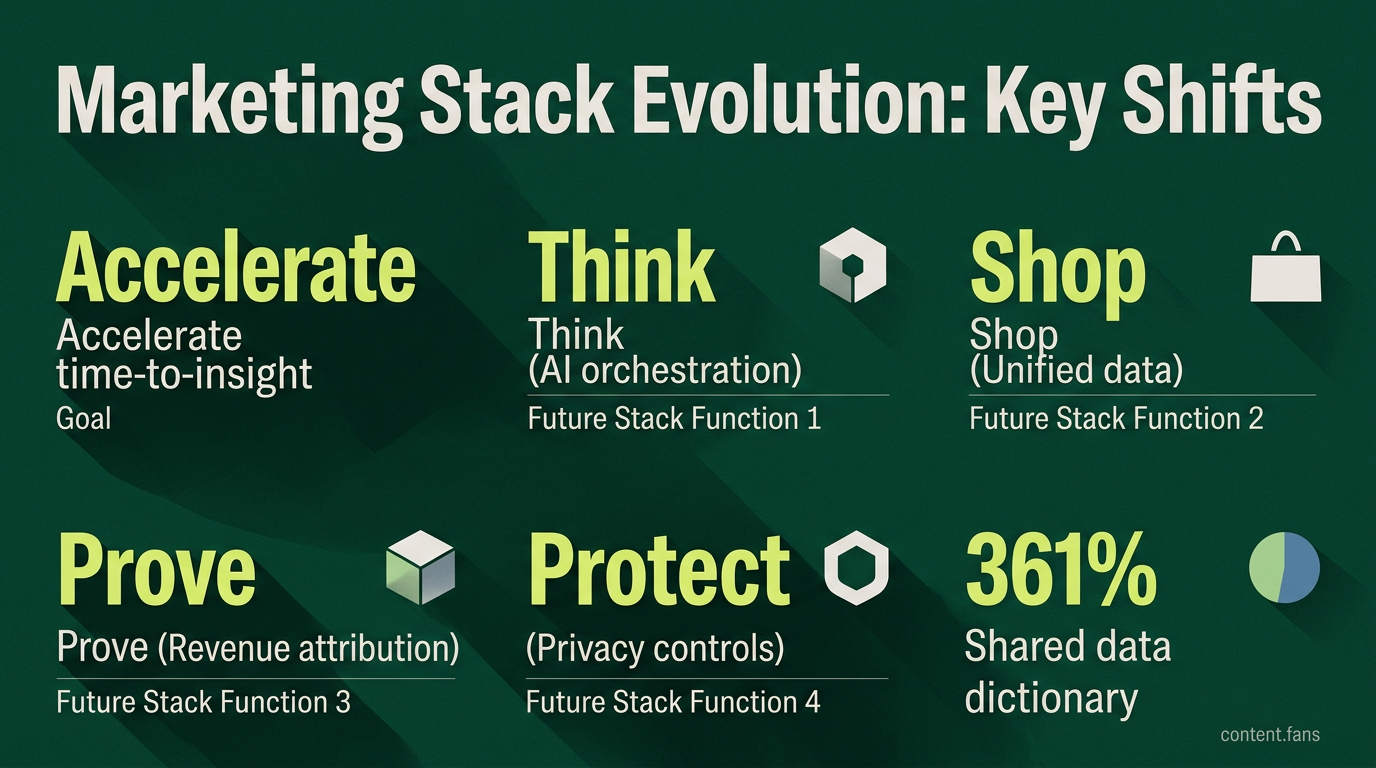
The Next Marketing Stack Will Think, Shop, Prove, and Protect
The future marketing stack is defined by four core functions. It uses AI to 'think' and orchestrate campaigns, creates a frictionless 'shop' experience with unified data, 'proves' its value with clear revenue attribution, and 'protects' customer data through embedded privacy controls and consent management.
Leading MarTech vendors are aligning their features with these four key capabilities to meet modern demand generation needs:
- Think: AI-driven orchestration that predicts intent and selects channels.
- Shop: Unified data flows that sync product, partner, and sales inputs for frictionless buying.
- Prove: Attribution models connected to revenue dashboards for pipeline contribution and LTV-to-CAC tracking.
- Protect: Consent-driven data governance and privacy controls embedded at every entry point.
The gap between adoption and impact is significant. While many marketers are testing autonomous campaigns, fragmented data means only a small portion can show a measurable return. This highlights that the quality of integration, not the number of tools, is the true lever for performance.
From Frankenstack to Connected Ecosystem
Real-world examples illustrate how this new architecture delivers results:
- Several SaaS firms have integrated their marketing automation and CMS platforms, resulting in significant increases in MQLs and notable reductions in sales cycle length through behavior-triggered nurturing.
- Multiple B2B enterprises have adopted a warehouse-first stack with Snowflake, reverse ETL tools, and Marketo, enabling their marketing teams to operate from a single source of truth within 8-12 weeks.
- By combining CRM with intent data and ABM software, enterprise companies have achieved substantial lifts in engagement across their key accounts.
These cases show a clear trend: replacing manual data transfers with seamless, API-level synchronization. Experts assert that a shared data dictionary, consistent from first touch to renewal, is fundamental to success.
Operational Hurdles and Emerging Practices
Despite the clear benefits, teams face significant operational hurdles. Complexity remains a major issue, with industry reports noting that many marketers manage numerous tools, and a significant portion face rising costs without a clear return on investment. To combat this, two key practices are emerging: the use of integration middleware to automate data validation and routing, and the establishment of RevOps councils to align sales, marketing, and finance on shared metrics and dashboards.
Privacy and brand authenticity also remain critical concerns. A significant number of practitioners worry that AI-generated content could dilute brand distinctiveness. In response, companies are developing hybrid strategies that use AI for scale while retaining human oversight for narrative control, aiming for a balance between automation and authenticity.
Furthermore, integrated marketplace ecosystems are proving to be powerful growth engines. Leading companies' partner programs are built directly into their CRM systems and now account for substantial portions of new customers and significant annual revenue. This success demonstrates the power of the 'Shop' capability, where shared data and co-marketing programs are unified within the core stack.
Measuring Without Guesswork
The 'Prove' capability is centered on moving beyond guesswork to concrete attribution. Currently, only a small percentage of firms can confidently connect intent signals directly to revenue. To bridge this gap, emerging standards include unified customer IDs, reverse ETL pipelines, and sophisticated multi-touch attribution models, though adoption rates vary.
Similarly, the 'Protect' layer ensures compliance and builds trust. Instead of storing permissions in channel-specific silos, GDPR-style regulations are driving teams to centralize consent management. This practice is a critical prerequisite for trustworthy AI, as algorithms require compliant data to effectively score and segment audiences.
Ultimately, these trends show an industry moving away from the pursuit of silver-bullet solutions. The focus is now on calibrating technology around shared data, modular architecture, and accountable metrics to drive sustainable growth.
Why are B2B teams abandoning "Frankenstacks"?
Complexity is suffocating performance. Research shows that many marketers report MarTech costs rising without clear ROI, and a significant portion spend more than half their time fixing broken systems [1][2]. In contrast, lean integrated ecosystems unify CRM, MAP, BI and AI layers so data moves in real time instead of being trapped in numerous disconnected tools [1]. The result: faster campaign execution, cleaner attribution and a direct line between spend and revenue.
What does a modern "integrated stack" actually look like?
Think four tightly-linked capabilities:
- Thinking - Consent-driven data warehouse (Snowflake/BigQuery) that feeds AI and BI with a single source of truth [5].
- Shopping - Reverse-ETL (Hightouch/Census) pipes qualified intent signals into MAP instantly, letting teams act while buyers are still active.
- Proving - RevOps dashboards that measure LTV/CAC across funnel stages; companies with connected GTM systems already outperform fragmented ones on pipeline contribution [1].
- Protecting - Native, API-first integrations reduce security gaps and maintain compliance without manual patches.
Illustrative case: SaaS firms linking marketing automation platforms with CMS systems have seen significant increases in MQLs and shorter sales cycles [1].
How big is the adoption gap between intent and impact?
Many marketers use AI today, but only a small portion have measurable ROI [2][4]. The gap is caused by fragmented data that prevents AI models from acting on real-time intent. Connected stacks close the gap by feeding models clean, cross-functional signals so campaigns can auto-pivot to buying-group behaviors rather than generic personas.
What concrete steps should teams take in the next 90 days?
- Audit ruthlessly - list every tool and its integration score; sunset any that cannot share data bi-directionally [1][3].
- Standardize entry points - force every lead, event and content interaction into one data schema at capture.
- Adopt RevOps cadence - weekly joint reviews of pipeline, win-rate and LTV/CAC with marketing, sales and customer success sharing the same dashboard [1].
- Pick API-first vendors - prioritize partners that expose real-time webhooks and prebuilt CRM connectors to minimize middleware.
How will this shift affect partner ecosystems?
Vendors who bundle native integrations and transparent roadmaps will gain preference over point solutions. Leading companies' channel marketplaces now deliver substantial portions of new customers and significant annual revenue by synchronizing partner-sourced leads into their core CRM in real time [4]. Expect tighter SLAs around interoperability to become increasingly important in procurement contracts, making integration depth a competitive moat rather than an afterthought.
[1] iTech Series, B2B Marketing in 2026: Trends & Strategies
[2] DemandGen Report, From Metrics to Revenue: The Real Challenge for B2B Marketing Leaders in 2026
[3] Cognism, Top B2B Marketing Challenges and How to Solve Them in 2026
[4] Fame, Good B2B Marketing Campaigns: 10 Battle-Tested Tactics For 2025
[5] Warmly, The Complete B2B MarTech Stack That We'd Use [2026]