
Consultwebs unveils 2026 digital marketing predictions for law firms
Serge Bulaev
Consultwebs has released digital marketing predictions for law firms in 2026, suggesting new challenges from AI-driven search tools like Google AI Overviews and ChatGPT. The report says firms may need to boost their visibility in AI-generated results by providing timely legal commentary and showing attorney credentials. It also notes that changes to Google's algorithms appear to have made it harder for legal sites to rank well unless they show strong expertise and trustworthiness. The agency recommends updating content for AI search, improving site speed, and using short videos on social media. Consultwebs suggests that combining AI strategies with clear human proof of expertise might help firms stay visible, but does not name any one channel as the best.

Law firms face a seismic shift in online marketing, as outlined in industry reports about digital marketing trends for law firms. The agency's report details upcoming pivots driven by AI search, evolving Google algorithms, and new standards for demonstrating expertise. A comprehensive ebook, which previews its main findings, is available for free download (Consultwebs blog). The forecast positions the coming years as a pivotal period where AI guides discovery, but human expertise and trust will ultimately win and retain clients.
Navigating AI Overviews with Generative Engine Optimization (GEO)
Industry forecasts highlight the growing dominance of AI-driven search, which demands new Generative Engine Optimization (GEO) strategies. They also emphasize stricter E-E-A-T standards, requiring law firms to prominently display verifiable credentials and experience to maintain search visibility and earn client trust in a volatile landscape.
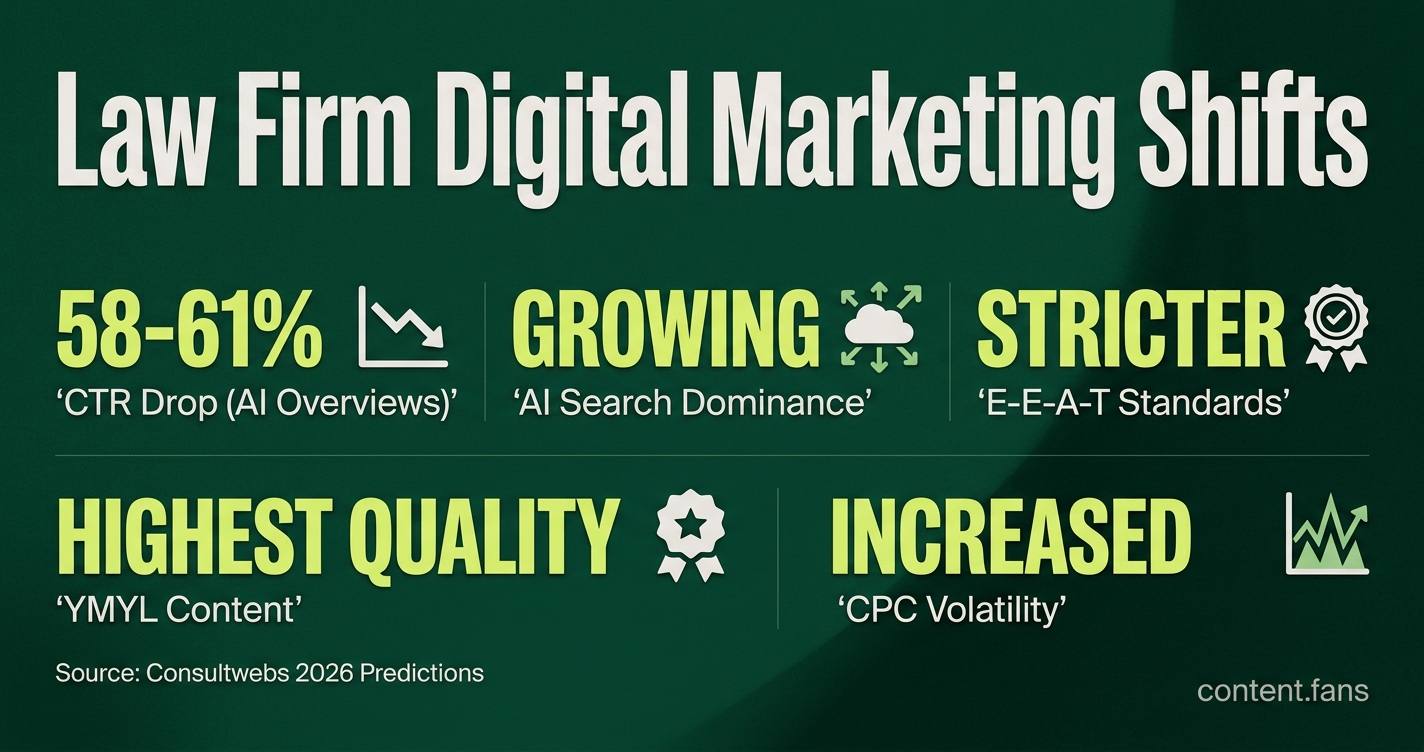
The rise of Google's AI Overviews and other AI search tools like ChatGPT is creating more "zero-click" results, where users get answers without visiting a website. According to sources like Ahrefs and others, click-through rates to traditional links drop significantly (58-61% CTR drops) when AI summaries appear. Consultwebs warns that law firms failing to appear in these AI-generated answers risk becoming invisible to a large portion of potential clients. The recommended strategy is Generative Engine Optimization (GEO), which involves creating content that AI models can easily cite. Key tactics include publishing timely legal commentary on new statutes, defining complex terms in trending cases, and clearly attributing all content to a licensed attorney to be seen as an authoritative source.
Meeting Stricter E-E-A-T and YMYL Standards
Google classifies legal advice as "Your Money or Your Life" (YMYL) content, holding it to the highest quality standards. Recent core updates have reportedly impacted a significant portion of legal websites by raising the bar for E-E-A-T (Experience, Expertise, Authoritativeness, and Trustworthiness). Echoing this, Consultwebs stresses the need for firms to showcase verifiable credentials, including bar admissions, relevant case experience, and updated citations in every author bio. Technical performance is also crucial. A site with strong credentials can still be penalized if it has slow page loads or poor mobile usability, as Google's Core Web Vitals are tied directly to user engagement and rankings.
Adapting Paid Media and Social Video for a New Funnel
The report predicts increased volatility in cost-per-click (CPC) for paid ads as AI-driven bidding systems become more common. To manage budgets effectively, Consultwebs recommends using tighter geographic targeting and adding negative keywords to filter out low-intent informational queries. Simultaneously, short-form video has become a powerful tool on social platforms. Legal explainers on Meta, TikTok, and YouTube Shorts are gaining traction in localized recommendation feeds. Repurposing a single explainer video across these channels is a cost-effective way to maximize reach and reinforce a firm's authority.
The report outlines several key action items for law firms to implement over the next six months:
- Audit author pages for verifiable bar credentials and courtroom experience.
- Map practice-area content to likely AI summary questions, then update language for GEO.
- Trim PPC campaigns to the highest converting zip codes before expanding tests.
- Produce regular short videos answering time-sensitive legal questions.
- Track Core Web Vitals regularly for optimal performance.
Building Trust with a Demonstrable Reputation
Consultwebs' recommendations are backed by its own performance. The agency has been recognized among top U.S. legal marketing firms, which noted its strong reputation signals. This underscores the report's central theme: search engines are increasingly rewarding the same trust signals that clients look for. The report advocates for a blended strategy that combines AI-optimized content with undeniable proof of human expertise, measured consistently across all channels without over-relying on any one metric.
What major shifts are forecast for law-firm SEO?
Google's AI Overviews are replacing traditional blue links for many legal queries, cutting click-through rates significantly when an AI summary appears. The report urges firms to optimize for GEO (Generative Engine Optimization) by feeding AI models concise, citation-ready answers and by publishing attorney-authored insights the moment new statutes or court decisions trend.
E-E-A-T signals - experience, expertise, authoritativeness, trust - move to the front: pages that do not display bar-certified author bios and case results are expected to lose rankings, especially as Google continues to update its algorithms affecting YMYL (Your Money Your Life) content.
How should pay-per-click budgets change next year?
General projections suggest an 8-10% CPC increase through Q4 2026 across industries; legal CPCs rose 9.1% YoY to $18.50. Smart firms will:
- move a portion of spend to YouTube and TikTok ads where legal audiences now research
- adopt AI-driven bid rules that pause campaigns when cost-per-lead exceeds case-value thresholds
- layer first-party data (newsletter lists, intake forms) into Customer Match to reduce wasted impressions
Which content formats will earn the highest client trust?
Short-form vertical video (30-90 seconds) shot on a phone and answering one anxious question - "Will a DUI stay on my record?" - is labeled a fast trust builder. Industry data shows firms that post regular authentic reels see more qualified calls than peers publishing only blog posts. Long-form webinars are still valued, but only when the replay is chopped into snackable clips and seeded across LinkedIn, Facebook Reels and YouTube Shorts within 24 hours.
Is traditional local SEO dead?
No, but the definition is widening. Google Business Profile remains critical, yet visibility also requires showing up across multiple platforms including Apple Business Connect, Bing Places, and voice assistants. The checklist:
- identical NAP (name, address, phone) across multiple data aggregators
- case-specific photos uploaded regularly (courtroom, client meeting, award ceremony) because AI image recognition now factors into relevance
- review velocity goal: regular new reviews; profiles with higher ratings maintain better prominence in AI-generated answers
Where can I get the full prediction playbook?
A comprehensive digital marketing predictions ebook for law firms is available as a free download on the Consultwebs blog. Access it here to see channel-by-channel playbooks, budget templates and implementation calendars for various practice sizes.