
The Marketing Cloud Expands Agent Cloud with New AI Toolkit for SMBs
Serge Bulaev
The Marketing Cloud has launched a new marketing toolkit for small businesses and in-house teams, bundling ten AI-powered agents to help with campaign work. These agents may help teams do tasks like brand checks, messaging, grammar feedback, social trend analysis, and image creation, and they connect with popular work tools. Research suggests this bundle could save teams time and reduce the need to switch between many tools. Some experts believe these AI tools might help small teams work faster and take on more jobs without hiring extra people. Pricing details for the toolkit are not yet available, and it is unclear how it will compete with other platforms.
The Marketing Cloud is expanding its Agent Cloud with a new AI toolkit designed to give small and mid-sized businesses (SMBs) a scalable marketing teammate. Agent Cloud launched October 21, 2025, and the toolkit bundles ten specialized AI agents for daily campaign tasks. This single-subscription platform integrates large language models, partner data, and workspace tools to help smaller teams overcome common execution challenges.
The Marketing Cloud Expands Agent Cloud with Specialized Marketing Toolkit
This new offering provides ten specialized AI agents designed to handle core marketing functions like brand audits, campaign strategy, copy review, social media analysis, and image creation. By integrating with existing workflows, the toolkit helps teams automate tasks and improve efficiency without needing multiple separate subscriptions.
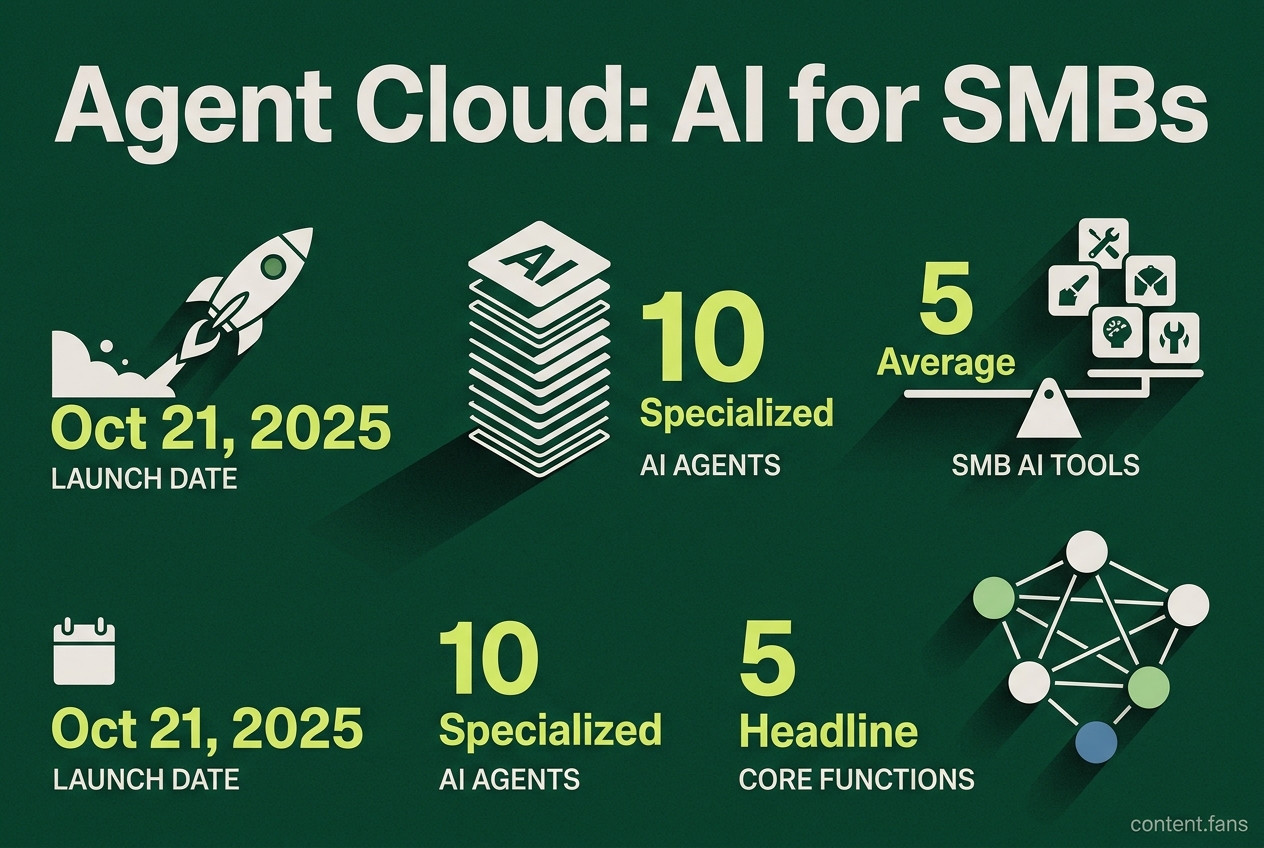
Early materials describe ten agents engineered by veteran marketers. Five headline functions are:
- Brand Audit - checks personality and competitive stance.
- Campaign Architect - drafts positioning and messaging.
- Copy Feedback Pro - flags logic and grammar slips.
- Glystn Social Intelligence - mines cultural sentiment across TikTok and Instagram.
- Image Generator - produces on-brand visuals for social channels.
These agents are powered by OpenAI and Google Gemini models and enhanced with data from partners Glystn, Limbik, and Parallel. To ensure seamless adoption, the platform integrates directly with ClickUp, Slack, and HubSpot, allowing users to maintain their current workflows. A Stock Titan recap highlights this integration as a key strategy to combat tool fragmentation.
Market fit and competitive context
Since its launch in October 2025, Agent Cloud has shown growing adoption and engagement. The market appears ready for such a solution, as analysts note that over half of SMB owners currently use an average of five different AI tools. This suggests a clear demand for consolidated platforms that simplify subscriptions and reduce administrative overhead. Industry reports indicate that teams using AI agents can reclaim significant time from repetitive tasks.
While official pricing for the new toolkit has not been announced, Salesforce's competing Agentforce platform, which charges $0.10 per conversation, offers a rough benchmark.
What integrations add
The toolkit's partner integrations deliver deeper strategic value than standard AI. Glystn provides real-time social intelligence and creator discovery, allowing marketers to identify emerging trends via simple conversational prompts. Meanwhile, Limbik and Parallel add predictive analytics for message resonance and automated research synthesis, moving the platform beyond basic text generation toward providing richer, actionable insights.
Why SMBs are watching
For SMBs, the primary appeal is bridging the gap between strategy and execution without increasing headcount. Industry reports suggest that AI-powered personalization can lead to significantly faster content creation and improved email response rates. Experts suggest that integrated AI agent stacks empower founders to manage both marketing and sales functions more effectively. While The Marketing Cloud has not yet confirmed future agent releases or a final pricing model, observers are watching to see if its unified platform can sustain momentum against competitors offering per-task billing.
What exactly is included in the 10-agent toolkit and which partners power it?
The bundle fields Brand Audit (personality & competitive checks), Campaign Architect (messaging blueprints), Copy Feedback Pro (grammar & tone polish), Image Generator (on-brand visuals), plus six additional task-specific agents. Each agent is fueled by OpenAI ChatGPT and Google Gemini LLMs, while Glystn supplies real-time TikTok & Instagram trend signals, Limbik adds message-resonance prediction, and Parallel contributes database intelligence. One subscription, one workspace, no extra logins.
How does the toolkit close the "execution gap" without hiring?
SMBs typically lose a significant portion of their week to admin copy-paste work. By wiring the agents into ClickUp, Slack, and HubSpot, the toolkit automates brief-to-publish steps - list clean-ups, asset tagging, report builds - that used to need extra hands. Founders now finish newsletters much faster and run always-on paid-search experiments that previously required an outside agency, letting lean crews punch at department weight.
What measurable lift can an SMB expect from AI agents?
Industry reports suggest significantly faster content production, improved email response rates through AI personalization, and lower cost-per-acquisition via smart campaign tuning. For account-based outreach, AI-assisted sequences can trim sales cycles and raise win rates versus manual outreach, producing strong ROI on focused accounts.
How is this different from Salesforce's Agentforce or other DIY AI stacks?
Agent Cloud ships as a pre-built marketing department, not a blank canvas. Where Agentforce bills per conversation and expects you to wire the logic, The Marketing Cloud delivers strategy-ready agents already trained on CMO playbooks. You avoid the common "five-tool sprawl" - the average SMB juggles five separate AI apps - and cut integration risk by running everything inside one governed space.
When can teams start and what should they prepare?
The toolkit is available now; onboarding is streamlined if your HubSpot, ClickUp, or Slack accounts are admin-ready. Before launch, collect three items: latest brand guidelines, a CSV of current customer segments, and one live campaign brief. Feed those into Brand Audit and Campaign Architect first; the agents will auto-build baseline messaging, creatives, and channel plans you can refine instead of starting from scratch.