
7 AI Lead Gen Tools Deliver ROI for Sales Teams in 2026
Serge Bulaev
In 2026, sales teams may start with Apollo.io for AI prospecting because of its large contact database, but other tools might be better for different needs. Clay appears to focus on making sure leads are accurate, while tools like Cognism and SyncGTM are strong in certain regions or for businesses needing strict data rules. Reports suggest that vendors like Enginy, HubSpot AI, and Lemlist may deliver clear improvements in productivity, ROI, or engagement. The best tool for a team likely depends on whether they need more contacts, better data, or faster lead handling, as no single tool fits everyone.

Choosing the right AI lead gen tools is crucial for sales teams in 2026. While many start with Apollo.io for its massive database - boasting 230M+ contacts and strong industry ratings per a Revenue.io comparison - the best platform depends on your specific goals. True success hinges on balancing lead volume, data accuracy, and demonstrable return on investment (ROI). This guide analyzes top vendors to clarify which tool excels in each area.
How Apollo.io holds the volume crown
The best AI lead generation tool depends on a team's primary bottleneck. For sourcing a high volume of new contacts, Apollo.io is a strong starting point. For teams prioritizing data accuracy and email deliverability, Clay offers superior verification. Regional needs, like GDPR compliance, favor tools like Cognism.
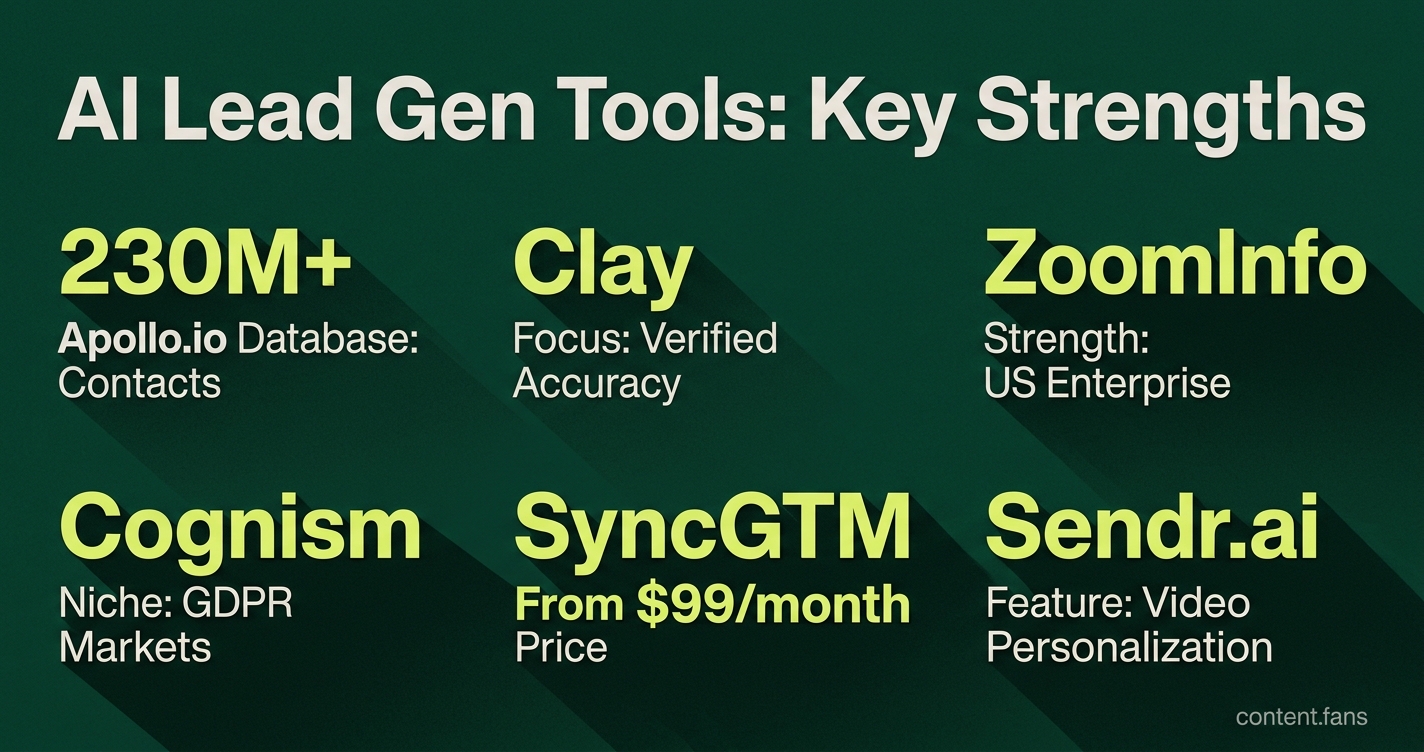
Analysts consistently position Apollo ahead of competitors like ZoomInfo and Clay in terms of sheer database size. While sources praise it for having "the largest raw database size," they also note that its accuracy in Europe can't match phone-verified specialists like Cognism. User reviews highlight its affordable sequencing but caution against interface bloat and upsells, positioning it as an ideal entry point for outbound teams that prioritize volume and can manage occasional data cleanup.
Clay focuses on verified accuracy
Where Apollo offers scale, Clay delivers verified data. The platform uses waterfall enrichment, pulling from over 50 providers to find the best information and then validating emails for deliverability before they enter your CRM. Industry reports highlight significantly higher email match rates compared to single-source platforms. Its conditional logic also helps users reduce bounce rates and protect their sender reputation by prioritizing premium data sources.
Regional and niche challengers
- ZoomInfo: Maintains a strong hold on the US enterprise market with its deep technographic data and robust intent signals.
- Cognism: Excels in GDPR-regulated markets by combining Bombora intent data with rigorous compliance checks, earning high customer satisfaction ratings.
- SyncGTM: Challenges incumbents with competitive pricing (from $99/month) and a multi-provider enrichment model similar to Clay.
- Sendr.ai: Focuses on improving reply rates through AI-powered video personalization, a feature not found in Apollo's standard offering.
AI Lead Generation Tools That Actually Delivered Results
Below are the vendors most frequently cited in recent industry reports for delivering concrete performance gains. All figures are vendor-supplied unless noted and serve as directional benchmarks.
- Enginy: Teams report significant productivity gains from its autonomous meeting booking capabilities, according to an Enginy analysis.
- HubSpot AI: Industry reports link its predictive scoring feature to substantial ROI improvements.
- Apollo.io: Users often describe an "invisible ROI" that comes from cleaner attribution and fewer bad leads, rather than a direct lift in conversion rates.
- LeadAngel: Its lead routing technology reportedly achieves high accuracy rates, significantly reducing delays in sales handoffs.
- Lemlist: Customer success stories frequently mention success stories report 23%+ reply rates, 35% sales growth, and 2-3x ARR growth by using its dynamic personalization features.
What the numbers mean for buyers
For buyers, the path is clear. Volume-driven teams can effectively start with Apollo, adding a verification layer like Clay or SyncGTM as data quality becomes critical. Sellers operating in Europe will find Cognism's GDPR-compliant, phone-verified dataset a safer choice. Meanwhile, revenue organizations focused on measurable returns from their sales funnel are increasingly adopting Enginy for automation or HubSpot AI for predictive scoring. While no definitive market share data exists, the landscape is clearly a mix of large database providers and specialized enrichment tools.
The key takeaway is to align your tool choice with your primary bottleneck, whether that's finding contacts, ensuring data quality, or accelerating lead routing.
What makes Apollo a market leader?
Apollo stays on top because it combines scale with built-in engagement. Its 230M+ contact repository is among the largest raw databases in AI lead-gen platforms, and the same interface lets reps filter, score, and push sequenced emails in minutes. Rivals such as ZoomInfo or Cognism often beat Apollo on data depth or GDPR compliance, but for teams that need a single, budget-friendly workspace to prospect globally, Apollo's reach is hard to match.
Is Clay worth the higher price tag?
Yes - if data accuracy drives your funnel. Clay's waterfall pulls from multiple sources (Apollo, Hunter, LinkedIn, Bombora, etc.) and only bills for verified hits, pushing email match rates significantly higher than typical single-source tools. Open credits are shown up-front, and real-time validators such as Debounce or Lint run before anything reaches your CRM, cutting bounce rates sharply. For outbound teams that lose more money on bad contacts than on software fees, the $349 Pro plan usually pays for itself within the first quarter.
Which tools show hard ROI numbers right now?
- Enginy - customers report significant productivity improvements after automating manual list-building and meeting booking.
- HubSpot AI - Industry reports show substantial ROI from predictive lead scoring and dynamic content.
- LeadAngel - reaches high accuracy rates in AI lead-to-account matching, trimming hand-off delays that stall deals.
Apollo itself talks about "invisible ROI": cleaner routing and fewer junk leads that lower acquisition cost per opp even when headline metrics stay flat.
How do Apollo alternatives differentiate?
- Cognism - Extensive phone-verified contacts, Diamond Data® multi-step validation, and strict GDPR coverage make it the safest choice for EMEA campaigns.
- Seamless.AI - real-time extractor that builds lists as prospects change roles, praised for speed over scale.
- Sendr.ai - adds AI-generated video or text snippets to cold outreach, lifting reply rates above Apollo's benchmarks.
If compliance, immediacy, or creative personalization matter more than database size, these niche picks often outperform the giant.
What pricing surprises should teams expect?
Apollo's entry cost looks low, but seat upsells and enrichment add-ons add up quickly. ZoomInfo and Cognism run higher list prices yet frequently bundle intent feeds or phone-verified mobiles, so compare annual contract value, not monthly sticker. On the other end, SyncGTM offers waterfall enrichment from multiple providers starting at $99/mo, while Clay's transparent credit system charges only for successful data returns - a safeguard against runaway spends when budgets tighten.