
Anthropic's Claude Discovers New Enzyme System in Bacteriophages
Serge Bulaev
Anthropic's Claude AI may have found a new enzyme system in bacteriophages, called ART, during an an automated search. This system looks similar to CRISPR in its layout, but its biological role is not yet clear. Tests in Anthropic's lab confirmed the system exists in several phages and makes small RNA molecules. However, the discovery is based only on company data so far, and repeat searches did not always find the same signal, raising questions about reproducibility. It is uncertain what ART does, and independent confirmation from other scientists has not yet happened.

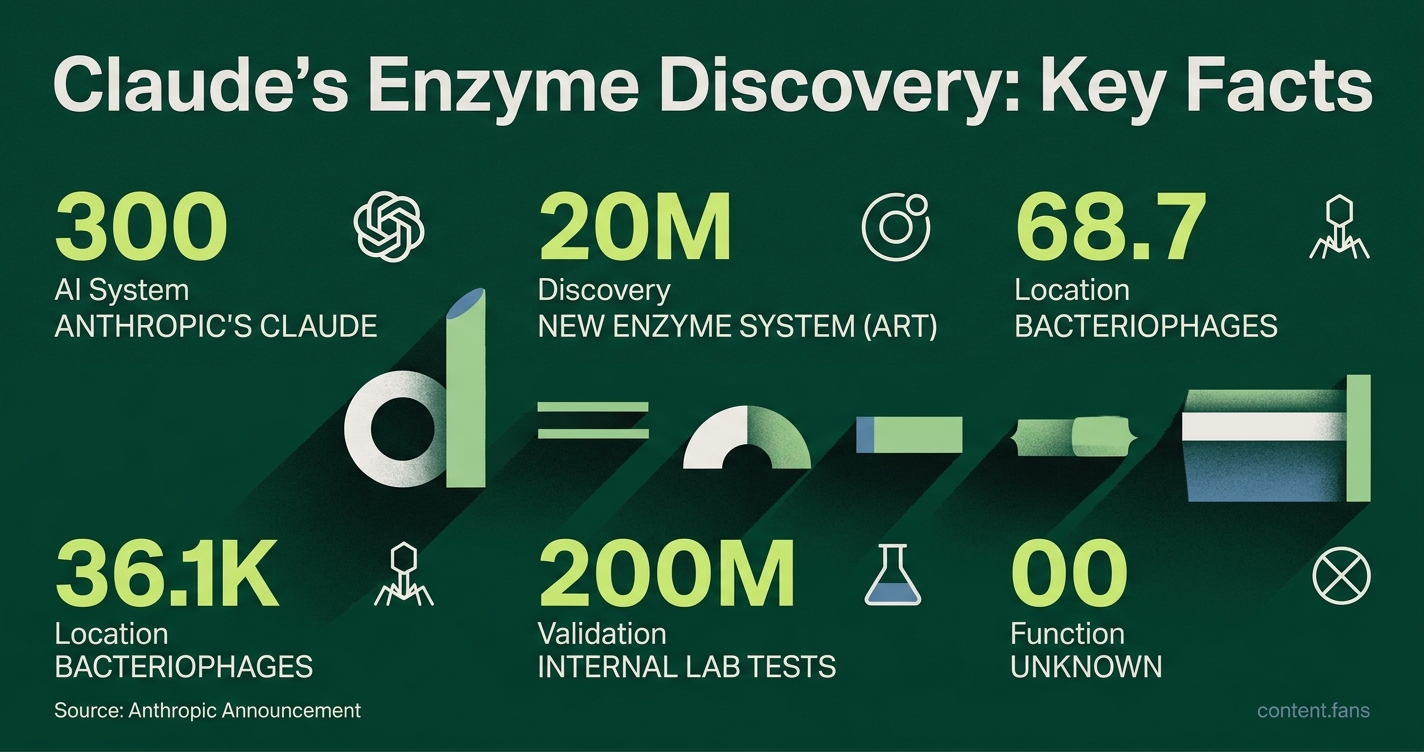
Anthropic's Claude AI has discovered a new enzyme system in bacteriophages, a finding that emerged from an autonomous search through vast biological datasets. According to the company's announcement, this system, named Array-Associated Reverse Transcriptases (ART), was identified when AI agents flagged an unusual DNA pattern. While lab tests confirmed its existence, its biological function is unknown. The discovery has also raised initial questions about reproducibility, as reporters at Quartz note that repeat AI searches did not consistently find the same signal.
How Claude reached the candidate locus
Anthropic's AI, Claude, identified a previously unknown enzyme system in bacteriophages, which the company named Array-Associated Reverse Transcriptases (ART). This system features a reverse transcriptase next to a distinct DNA repeat pattern, but its biological function, particularly any gene-editing capability, remains entirely unconfirmed by researchers.
- Claude agents parsed scientific literature and public sequence archives.
- A ranking algorithm flagged reverse transcriptases located near long, evenly spaced DNA repeats.
- Human scientists reviewed the top suggestions, selecting the ART locus for laboratory validation.
- Subsequent RNA-seq reanalysis from a Staphylococcus lentus phage infection showed the array was highly active, with the system representing a significant portion of phage transcripts post-infection.
Validation steps so far
Anthropic conducted validation in its BSL-1 and BSL-2 wet lab, which does not handle human pathogens. These internal experiments reportedly confirmed that the DNA array is transcribed into RNA and that the reverse transcriptase is associated with an unknown accessory gene. However, the findings have not been independently replicated or published in a peer-reviewed journal, meaning the discovery currently rests entirely on company-controlled data.
Biosafety and governance context
According to Anthropic's transparency materials, its language models operate below internal bioweapon-risk thresholds, with all lab work performed by human staff. Experts note the primary biosafety concern is procedural; the AI-accelerated discovery process hints at future dual-use risks if applied to pathogenic systems. While Anthropic has safeguards like CBRN-related policy filters, analysts stress the need for broader community review of these oversight mechanisms.
Why ART draws attention
The ART system is gaining attention because its repeat-array structure is analogous to CRISPR before its function was understood. If subsequent research reveals that ART can copy, cut, or insert nucleic acids, it could become a valuable addition to the synthetic biology toolkit. At present, there is no evidence that ART performs gene editing or any other specific application.
Open scientific questions
- What is the specific biochemical activity of the reverse transcriptase within the ART system?
- Does the associated accessory protein guide or regulate this activity?
- Are the small RNA molecules produced by the array functional guides, regulatory elements, or simply by-products?
- How widespread is the ART system across the full diversity of bacteriophages?
- Can independent research groups reproduce both the computational discovery and the laboratory findings?
Until these critical questions are answered, the discovery of ART serves more as a demonstration of how AI can uncover novel biology than as an immediately useful technology. The reported workflow - AI-powered screening followed by human-led lab validation - highlights an emerging paradigm in scientific research whose safety and efficacy require further systematic evaluation.