
EY: Only 10% of Businesses Show Clear AI ROI
Serge Bulaev
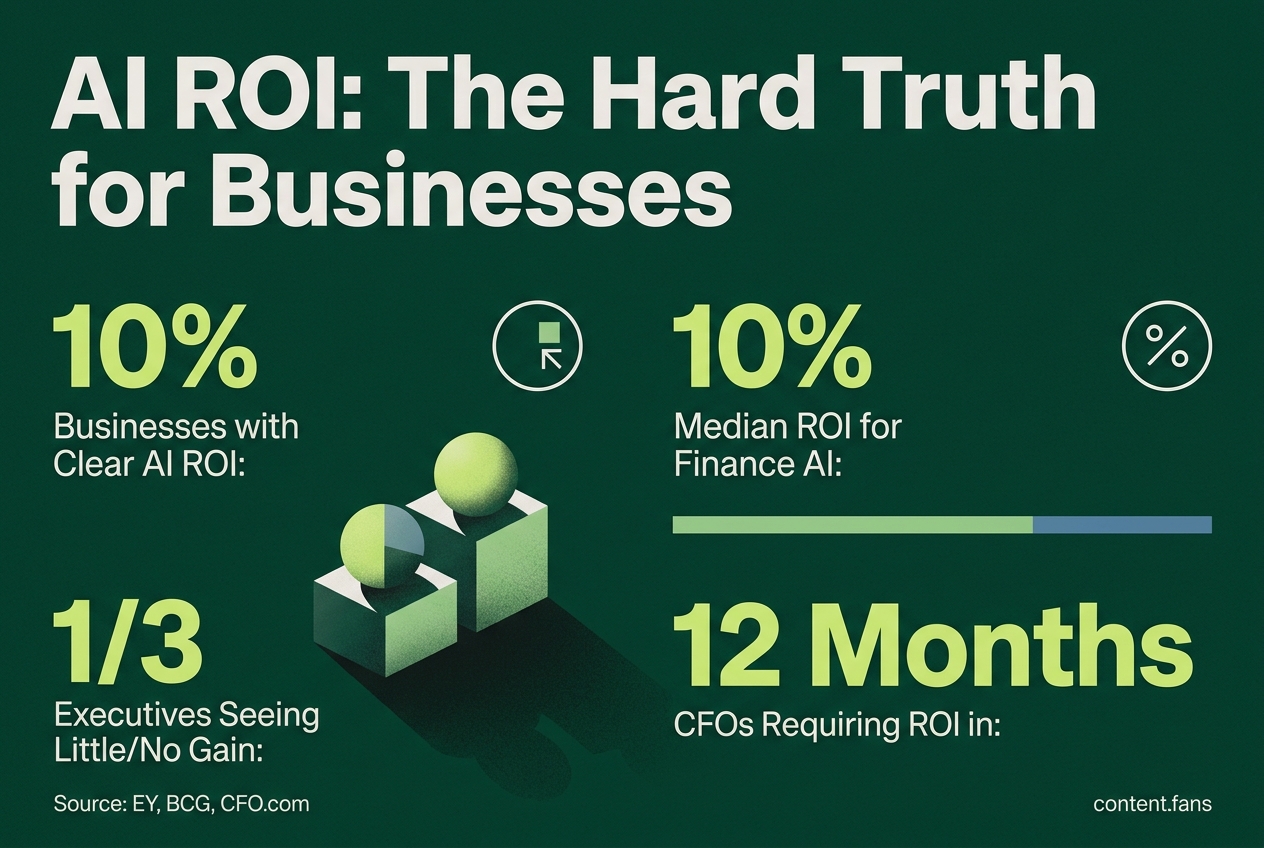
Only about 10% of businesses can clearly show that artificial intelligence leads to financial gains, according to EY. Most companies appear to invest in AI based on enthusiasm, not hard evidence of profit or savings. CFOs are now looking for measurable returns and may require proof within a year, as many are still unsure about AI's impact. While some organizations report benefits like cost savings or higher revenue, these successes seem rare. Until more companies can show clear results, finance leaders might stay cautious about spending more on AI.

According to a stark assessment from EY, a significant minority of businesses show clear AI ROI on their financial statements. Most corporate spending on artificial intelligence appears driven by enthusiasm rather than hard evidence, but finance teams are now demanding measurable proof of value. This growing gap between perceived productivity and verifiable profit is shaping how CFOs evaluate every new AI investment.
Why Demonstrating AI's Financial Impact is a Challenge
According to EY executive Dan Diaso, only a small fraction of the firm's clients can trace AI-driven value directly to an income statement. This highlights a fundamental challenge in the current adoption wave.
The core difficulty in proving AI's value stems from a disconnect between operational metrics and financial results. While many companies see productivity gains, they struggle to translate them into the verifiable revenue increases or cost reductions that appear on an income statement, leading to skepticism from finance leaders.
This gap is validated by broader market data. Boston Consulting Group found the median ROI for finance-focused AI is just 10 percent, with roughly one-third of executives seeing little or no gain. The problem is often compounded by inconsistent measurement, as CFOs and CIOs frequently disagree on what constitutes ROI.
How Finance Leaders Are Responding to Unclear Returns
In response to ambiguous results, CFOs are applying sharper scrutiny and demanding faster proof of value. A recent survey revealed that nearly half of finance leaders require a measurable return on AI investments within 12 months. This pressure is forcing a strategic shift, with many CFOs acknowledging that AI is compelling them to rethink traditional ROI frameworks.
As a result, the definition of a "win" is expanding beyond raw revenue. The most cited metrics for success now include:
- Cost savings and expense avoidance
- Productivity per employee
- Incremental revenue from new digital services
- Improvements in risk, compliance, and forecasting
How Pricing Models Intensify the ROI Debate
Usage-based pricing for AI, popular with large language model APIs, has magnified ROI scrutiny by making costs visible in real time. While this model "matches price with value at every scale," it can also create significant budget unpredictability. Unexpectedly high bills force finance teams to demand stronger justification for spending.
This has led to a market preference for consumption-based pricing for pilots, allowing companies to experiment without large upfront commitments. In response, many vendors now offer a hybrid model - a fixed platform fee plus metered usage - to give finance teams partial cost certainty.
Documented Success Stories Remain Outliers
While rare, some companies have already pointed to tangible gains, offering a glimpse of what's possible when execution and measurement align.
- OSF HealthCare generated approximately $1.2 million in new patient revenue and over $2.4 million in total first-year ROI with its AI virtual assistant.
- IBM watsonx Orchestrate deployments showed an average 236% three-year ROI with payback in under three months.
- ServiceNow used its AI-enabled HR services to save significant annual hours, resulting in substantial cost avoidance.
These bright spots, however, remain exceptions relative to the wider market adoption figures cited by EY and BCG.
The Path Forward: Strategies for Achieving Provable AI ROI
CFO sentiment suggests that enthusiasm alone will no longer secure funding for the next wave of AI projects. The current environment favors disciplined experimentation, with a focus on establishing clear measurement frameworks before deployment. A Deloitte study found that organizations with disciplined measurement are far more likely to see returns, with 84% of such AI investors reporting positive ROI.
Success increasingly depends on choosing use cases where AI's contribution can be isolated and its financial impact can flow directly to the income statement. Until more organizations can match the few documented success stories, the challenge of proving AI ROI will likely continue to dominate boardroom conversations.