
EY Reports Most Businesses Still Can't Show AI ROI
Serge Bulaev
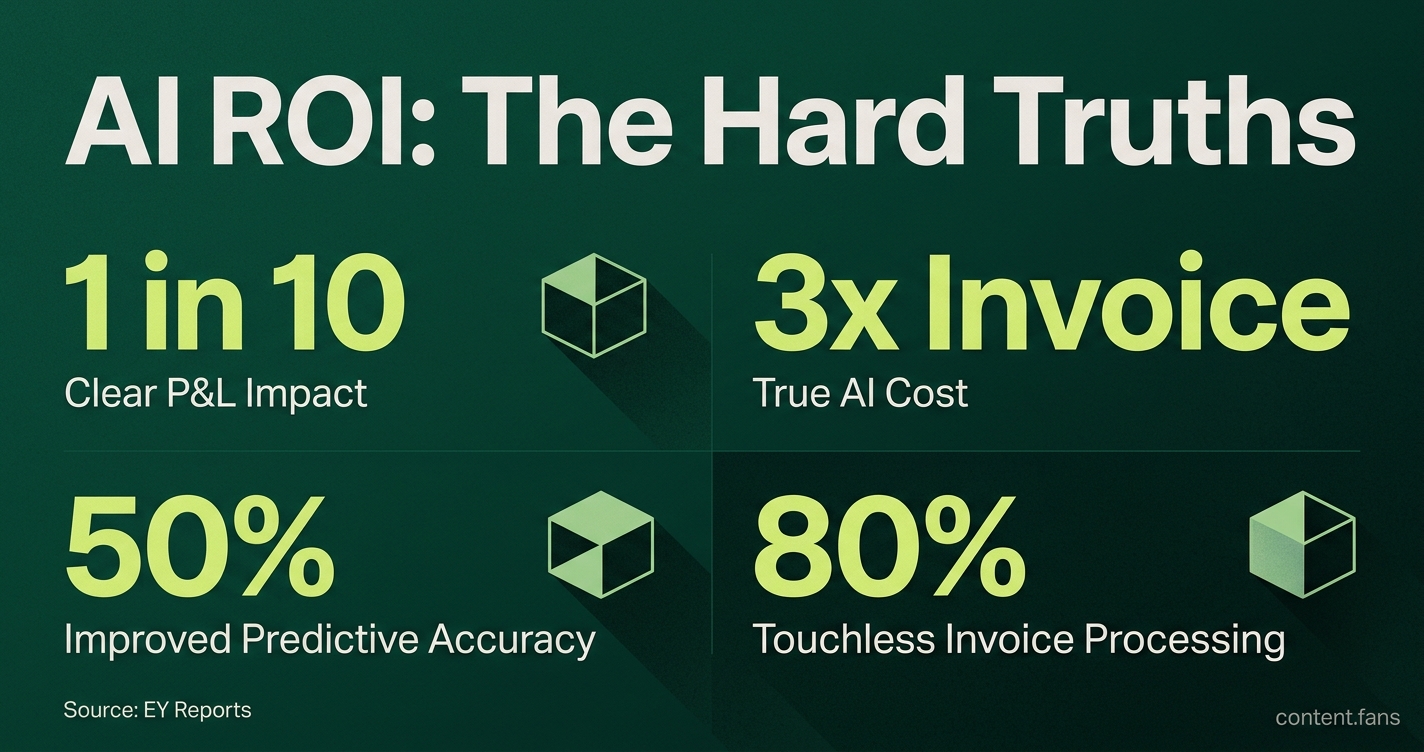
Most businesses still cannot show a clear return on investment (ROI) from using artificial intelligence, according to EY. Only about one in ten large companies can identify exactly where AI is making a financial impact. The true cost of AI may be much higher than expected, with extra expenses for things like systems and management. Many finance leaders are now asking for proof that AI projects will save money or boost revenue before they spend more. While there are some early signs of success in certain areas, it appears that most companies still struggle to show real, measurable value from AI.

An EY report and executive commentary confirm most businesses still can't show AI ROI, with only one in ten enterprises able to pinpoint a clear profit and loss impact from their investments. Speaking at The Information's AI Agenda Live Summit, EY's Global Consulting AI Leader Dan Diasio highlighted a growing disconnect between high spending on AI and the lack of measurable financial proof. This echoes an EY Insights report finding that the true cost of AI can be roughly three times the initial invoice when accounting for infrastructure, governance, and change management.
The Key Obstacles to Proving AI ROI
The struggle to demonstrate returns stems from several core issues. Many companies lack mature KPIs and consistent governance to measure AI's impact accurately. They also often get stuck in pilot phases, fail to redesign core processes, and face escalating and unpredictable usage-based vendor costs.
Diasio attributed the ROI shortfall to these persistent frictions. Escalating usage fees are a major concern, with industry reports revealing that a significant portion of senior leaders worry about token costs. This magnifies scrutiny when savings fail to materialize, prompting CFOs to demand milestone-based ROI validation before approving further deployments.
CFOs Demand Measurable Returns
The pressure from finance chiefs is intensifying. According to recent studies, many finance executives feel pressed to show measurable returns on AI projects. This shift indicates that simply adopting AI is no longer enough; board-level expectations now demand tangible value. Industry reports suggest that while a significant number of firms have AI in production, only a small portion believe it has delivered clear benefits.
The New CFO Scorecard for AI Projects
To enforce accountability, finance leaders are adopting a disciplined scorecard that links AI initiatives to operational baselines. Key requirements now include:
- Dollar-denominated cost and revenue targets for specific workflows.
- Strict 90-day validation windows with clear criteria for project termination.
- Formal governance controls identifying owners, data sources, and risk assessments.
- A strategic shift in spending from tools toward employee skill development.
- Continuous monitoring of token consumption against budgets.
Where AI Is Delivering Early Value
Despite the challenges, some early successes offer a path forward. BCG highlights examples within finance departments where AI has improved predictive accuracy by 50% and enabled 80% touchless invoice processing. These focused wins suggest that targeting data-rich, well-defined processes yields faster and more measurable returns than broad, exploratory pilots.
The True Cost of AI Is Reshaping Vendor Deals
The realization that the total cost of enterprise AI can be triple the initial vendor invoice is changing how companies negotiate. With ROI still uncertain, buyers are increasingly demanding discounts, usage credits, or free pilot programs from model providers. This allows them to explore AI capabilities without committing to high and unpredictable variable costs.
EY's Recommended Path to Closing the ROI Gap
EY's guidance outlines three priorities to close the value gap: first, strengthen governance before scaling; second, define explicit, workflow-level KPIs; and third, invest in workforce readiness to ensure employee adoption. Diasio concluded that achieving AI value requires the right "mindset, skill set, and tool set," in that specific order. His remarks emphasize a crucial theme: technology alone is not enough to impact the bottom line.