
LLM Model Routing Cuts Costs Up To 70% in 2026
Serge Bulaev
Smart Model Routing sends each query to the cheapest language model that still gives good enough results. Case studies suggest this can lower costs by as much as 70% if most requests are simple. Teams usually start with basic routing and strong safeguards, then move to more advanced methods as they gain confidence. Experts say savings depend on how many queries can use a cheaper model and that some complex tasks may not save as much. Guides recommend logging everything, using safety checks, and updating rules when new models become available.

LLM model routing has emerged as a critical strategy for managing operating costs, with some organizations cutting expenses by up to 70% in 2026. Instead of defaulting to a single, powerful large language model, smart routing sends each query to the most cost-effective model that can meet the required quality bar.
What is Model Routing and How Does It Work?
Model routing is an intelligent gateway that sits between an application and multiple LLMs. It analyzes each incoming request and dynamically selects the most suitable model based on predefined rules, semantic meaning, or predicted complexity, balancing performance with cost for optimal efficiency.
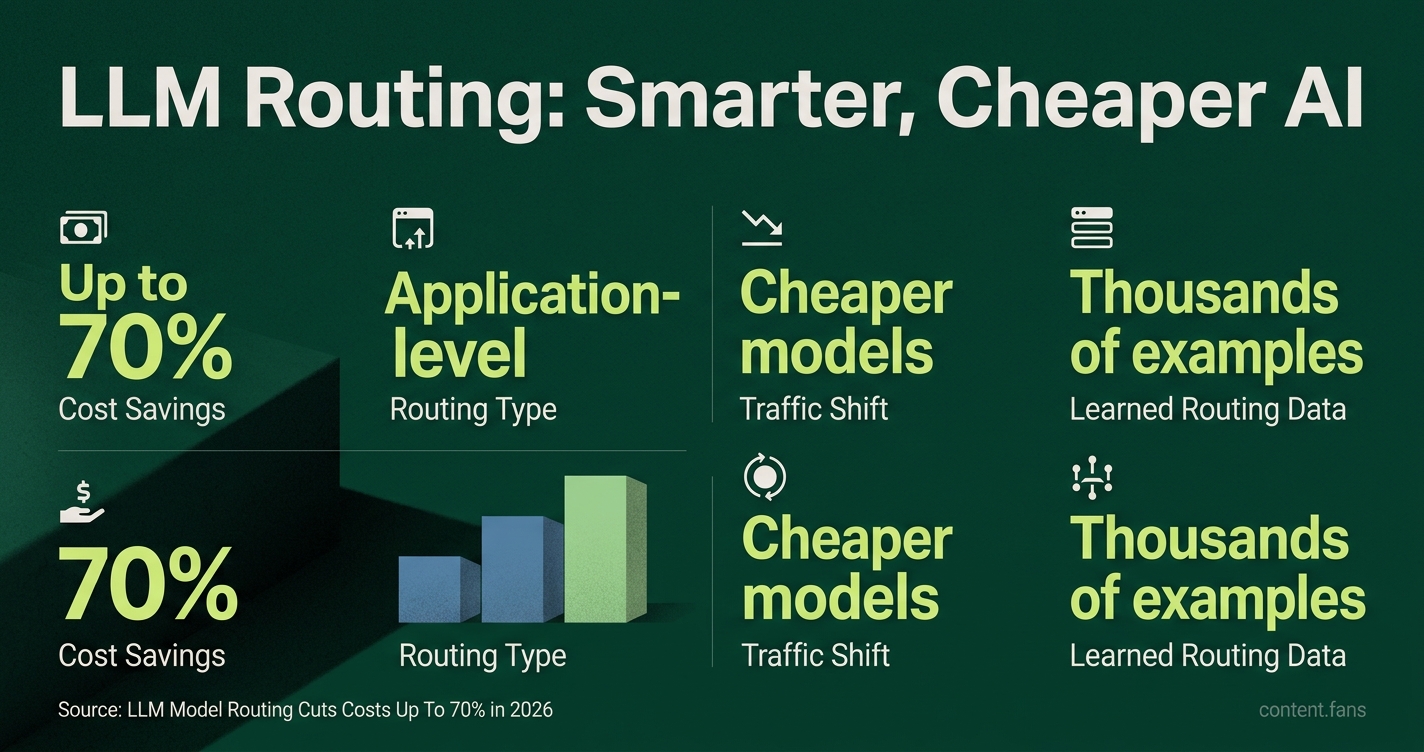
Unlike simple load balancing, model routing is an application-level strategy that makes an intelligent selection for every request. The core idea is to shift the bulk of traffic to cheaper, smaller models, reserving expensive, frontier models for only the most complex tasks. The cost savings are directly tied to workload distribution. When a significant portion of queries are simple enough for a compact model, organizations can see substantial reductions in average cost per request.
Most teams adopt routing gradually, starting with comprehensive observability and conservative rules. A common first step is to log every prompt, completion, and latency metric to establish a baseline before implementing any routing logic.
Key Routing Strategies in 2026
The field has matured into several distinct approaches, each offering different trade-offs. Organizations typically progress through these stages, starting with simple rules and advancing as they gain confidence and collect more data. This progression is often called a 'maturity ladder,' as described in Redis best-practices reference.
| Approach | Best For | Key Advantage | Main Limitation |
|---|---|---|---|
| Rule-based Routing | Known, stable task types | Simple, deterministic, low latency | Brittle; limited adaptability to new patterns |
| Semantic Routing | Meaning-driven selection | Better intent handling than keywords | Depends on embedding quality and cluster alignment |
| Cascade Routing | Tolerating verification steps | Strong cost-quality tradeoff by escalating only hard cases | Adds latency when multiple models are invoked |
| Learned/Predictive Routing | Sufficient labeled production data | Highest accuracy on complex traffic patterns | Requires training data, monitoring, and retraining |
Each step adds overhead but can unlock deeper savings. Experts believe learned routing requires thousands of labeled production examples to justify the effort, while semantic routing is best when query intent is more important than simple keywords.
How Much Can You Realistically Save?
Actual savings depend on three main factors: the price difference between models, the accuracy of the router, and the distribution of task complexity in your workload. Published 2026 benchmarks and case studies provide concrete examples:
- Enterprise reports show median savings of 42%, with top-quartile performers reaching 61%.
- Cascades that successfully push a significant portion of traffic to smaller models can achieve substantial blended cost reductions.
- Industry reports demonstrate it's possible to maintain high performance while sending only a fraction of requests to expensive models, implying significant cost reductions.
What Does a Production-Ready Routing Architecture Look Like?
A robust routing system is more than just a selection algorithm; it's a full stack of policies and safeguards. A production-grade architecture typically includes:
- Gateway: A single API entry point for logging all tokens, latency, costs, and quality metrics.
- Guardrails: A non-negotiable policy layer that enforces rules for PII, safety, and compliance before any cost optimization occurs.
- Router: The core logic engine (rule-based, semantic, or predictive) that selects the initial model.
- Cascade Verifier: An optional but common step where a cheap model's response is checked for quality, with an escalation to a better model only if the result is borderline.
- Fallback Chain: Circuit breakers and redundant model options to handle provider outages or API failures gracefully.
- Evaluation Loop: Continuous monitoring using real production traffic to validate router performance and prevent model drift.
Common Pitfalls and How to Avoid Them
Implementing a router can be complex, and several common issues can undermine its effectiveness:
- Misaligned Quality Metrics: Optimizing for fluency instead of correctness can lead the router to favor cheap models that produce plausible but wrong answers.
- Brittle Routing Logic: Semantic routers can fail if embedding similarity doesn't correlate with model capability for a specific task. Rule-based routers can become outdated.
- Over-reliance on Synthetic Tests: Benchmarking with synthetic data often overstates real-world savings. Continuous evaluation against live production traffic is critical.
- Missing Fallbacks: Without robust circuit breakers, a single model provider outage can bring down the entire system.
- Static Policies: The LLM landscape changes rapidly. Routing rules must be revisited whenever new models are released or pricing shifts.
A recent 2026 paper on routing and cascades adds a key nuance, finding that for some workloads, a static policy (always using a specific model tier) can be optimal. This highlights that while cascades are a powerful pattern, their effectiveness depends on your specific latency budget and task characteristics.
Build vs. Buy: Managed Routing Platforms
For teams that prefer not to build and maintain a full telemetry and gateway stack, several managed routing platforms have matured by 2026. Services like Portkey, OpenRouter, LiteLLM, Martian, and Unify offer multi-provider routing, automatic fallbacks, and observability out of the box. While these platforms can accelerate deployment, independent surveys caution that they still require rigorous integration testing. A misconfigured router that sends sensitive compliance traffic to the wrong model can easily erase all financial gains.
The consensus among engineering guides is clear: start by instrumenting everything. Then, begin carefully shifting simple traffic to cheaper models, implement strong guardrails, and continuously evaluate and adapt your routing policies as the model landscape evolves. With a methodical approach, LLM model routing offers one of the most powerful levers for controlling AI operational costs.