
LLM App Reliability: New 2026 Playbook Details Error Handling
Serge Bulaev
The 2026 playbook for LLM-powered apps highlights that errors can happen even when API calls appear successful, so engineers treat every answer as untrusted until it passes checks. Failures may be technical, related to context limits, or semantic when outputs look fine but break business rules. Teams reportedly use layered controls like schema validation, retries, circuit breakers, fallbacks, and monitoring to catch and contain problems. Adding these controls, especially validating input and output, may boost success rates and help spot issues early. However, no method fully removes uncertainty, so these steps just make systems more reliable and easier to audit when errors appear.

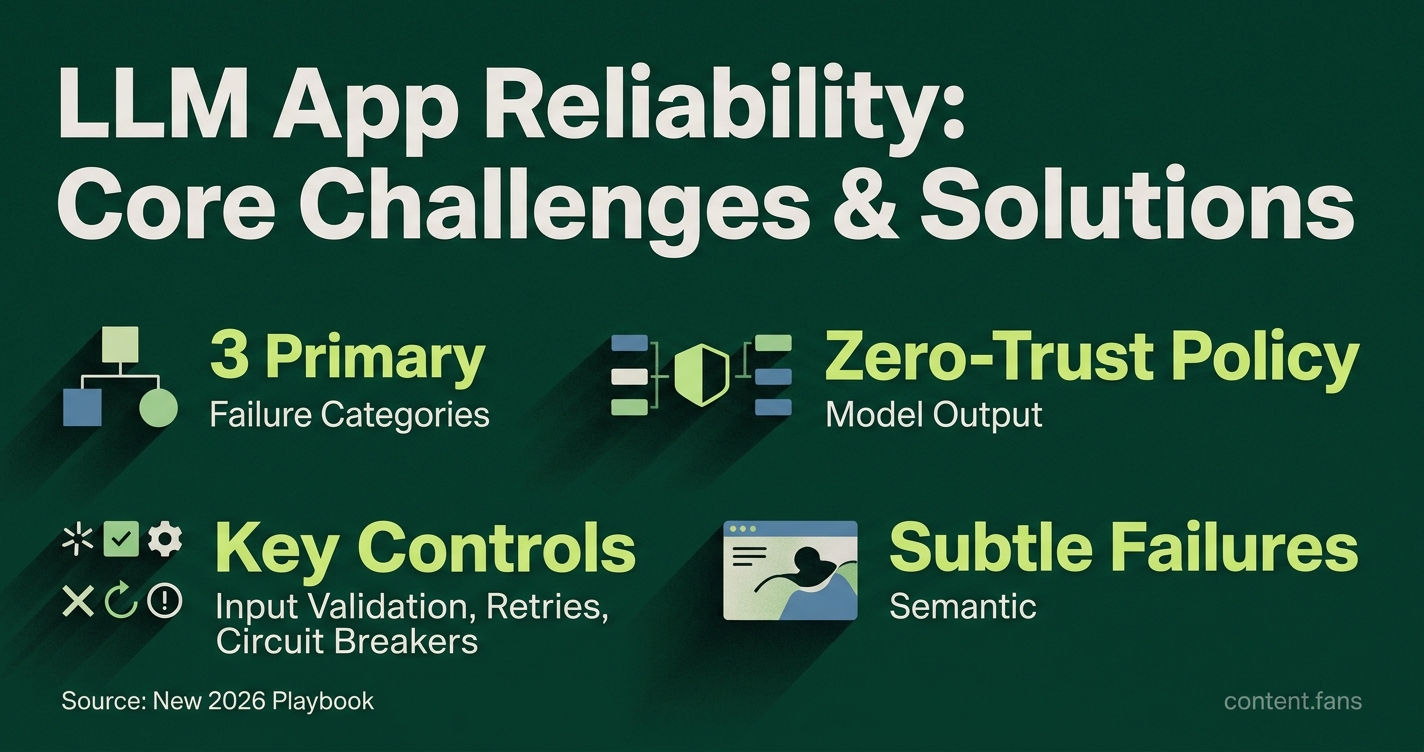
Ensuring LLM app reliability is among the key challenges for engineering teams building generative AI features. Because a successful API call (HTTP 200) does not guarantee a correct response, models can still hallucinate, exceed context limits, or return malformed data. Consequently, engineers must adopt a zero-trust policy, treating every model output as potentially flawed until it passes rigorous validation checks.
A recent industry analysis confirms that robust systems integrate classic resilience patterns, like retries and circuit breakers, with modern quality controls such as schema validation and semantic monitoring (ByteByteGo taxonomy). This framework outlines best practices, organizing them around two core themes: classifying failures accurately and containing their impact effectively.
Classifying Failures in Live Pipelines
LLM application failures are managed by classifying them as technical, context-related, or semantic. Technical issues include network errors, while context failures involve prompt limits. Semantic failures occur when the output is structurally valid but logically incorrect, requiring layered controls like schema validation, retries, and fallbacks to contain them.
Production logs consistently reveal three primary failure categories:
- Technical Failures: Standard network errors, authentication problems, or provider outages that return 4xx or 5xx status codes.
- Context-Window Failures: Occur when the prompt or retrieval context exceeds provider limits, often resulting in a
context_length_exceedederror. - Semantic Failures: The most subtle failures, where an API response is technically correct but violates business rules, JSON schemas, or quality standards.
A significant challenge is that API providers often overload HTTP status codes. For instance, an HTTP 429 error could mean temporary rate limiting, quota exhaustion, or a depleted budget, depending on the vendor (status-code comparison). It is therefore essential to parse the error message body to determine if a request is retryable.
Controls That Limit Blast Radius
Effective observability relies on layered controls to prevent a single failure from cascading through the entire system (datadope monitoring guide). The most effective strategies include:
- Input Validation: Enforce length checks, content moderation, and schema validation before making an API call.
- Intelligent Retries: Use exponential backoff with jitter for transient errors (429, 500, 503). Never retry client-side errors (400, 401) without correcting the request.
- Circuit Breakers: Automatically halt requests to a failing service after a configured error threshold is met, preventing system-wide overload.
- Fallback Tiers: Design a degradation path from a primary model to a lighter-weight backup model, a cached response, or finally, a queue for human review.
- Semantic Monitoring: Track and alert on quality scores, latency, and cost metrics to detect silent degradations in model output.
For example, teams building travel assistants have reported significant improvements in successful itinerary generation by adding schema validation at both the tool-call and final response stages. This demonstrates that structural checks are a low-cost way to eliminate a significant class of silent failures.
An Operational Playbook for Production Releases
This operational loop, supported by a 'golden dataset' for regression testing, provides a disciplined framework for reliability:
- Pre-Validate: Check every request against an input schema and moderation policy.
- Trace Everything: Tag each prompt, model version, and configuration parameter within a trace for full observability.
- Post-Validate: Verify the final output against a JSON schema, safety filters, and critical business rules.
- Classify and Route: Categorize each failure as transient, permanent, or semantic to trigger the correct recovery path.
- Escalate Gracefully: Use a sequence of retries, fallbacks, or human review escalation, logging the chosen path for analysis.
This process guards against the common anti-pattern of retrying the same broken prompt and ensures that regressions from prompt or model changes are caught before they impact users.
Common Pitfalls to Avoid
Discussions on LLM reliability consistently highlight several common missteps that undermine system stability:
- Trusting Model Formatting: Relying on prompt instructions for structured output instead of enforcing a strict schema validation.
- Measuring Uptime Only: Focusing on availability while ignoring critical metrics like semantic correctness, quality, and cost.
- Allowing Failures to Cascade: Permitting a single failed tool call to bring down an entire workflow instead of using a circuit breaker.
- Insufficient Logging: Failing to log enough context, making it impossible to reproduce and debug production incidents.
While no strategy can completely eliminate the uncertainty inherent in probabilistic models, this layered approach to error handling dramatically improves system reliability. By implementing these controls, teams can build resilient, high-quality LLM applications and maintain a clear audit trail to diagnose and resolve failures when they inevitably occur.
Why do LLM applications need different error handling than traditional software?
Traditional software treats a successful API response as a correct result. LLM outputs are probabilistic, meaning a technically successful call can still return semantically incorrect answers - hallucinations, malformed JSON, or off-topic responses. This requires classifying failures into three categories: transient (network blips), permanent (authentication failures), and semantic (wrong content). Each needs different remediation. The playbook emphasizes that availability metrics alone are insufficient - you must monitor answer quality, moderation scores, and latency together to catch silent failures.
What are the most effective retry strategies for LLM failures?
Exponential backoff with jitter remains the standard for transient failures like HTTP 429, 500, 503, and 529 responses. However, the playbook warns against blind repetition: retrying the same prompt without changing conditions is a common anti-pattern. Instead, pair retries with clarified instructions, fallback models, or alternative reasoning paths. For rate limits specifically, provider behavior varies - OpenAI's 429 may indicate rate throttling, quota exhaustion, or budget limits, so inspect error subtypes before retrying. Anthropic offers cleaner rate_limit_error versus overloaded_error distinction, making automation easier.
How should applications handle semantic failures like hallucinations?
Schema validation and structured output verification are your first lines of defense. Treat every model output as untrusted until verified against JSON schemas, business rules, or safety filters. The playbook recommends typed error classification - returning categories like InputValidationError, APIFailure, or QualityFailure with recovery suggestions so agents can adapt. For critical paths, implement progressive fallback chains: primary model → smaller backup model → cached/predefined response → human handoff. This preserves service availability while containing risk.
What makes tool-based LLM workflows particularly failure-prone?
Tool-calling agents face cascading failure risks where one bad tool call propagates through subsequent decisions. Industry research identifies error propagation as a central bottleneck for robust agents. Key mitigations include idempotency for all tool calls (preventing duplicate side effects on retries), state tracking across multi-step workflows, and circuit breakers that stop execution when components fail repeatedly. Newer agent architectures add self-monitoring and reflection loops - metacognitive layers that detect uncertainty and trigger correction before errors compound.
What testing and observability practices ensure long-term reliability?
Version your prompts, configurations, and guardrails under source control so regressions can be traced and rolled back. Maintain a Golden Dataset of known-good and known-bad cases - validate every fix against this regression set rather than single examples. Instrument end-to-end tracing capturing prompts, variables, tool calls, intermediate states, and final outcomes. For production systems, add adversarial testing against prompt injection, malformed JSON, overlong context, and unsafe tool instructions. Finally, implement semantic monitoring - tracking answer quality and safety scores, not just uptime - because a system can be "available" yet produce unusable or harmful outputs.