
Zylos AI outlines new GenAI error handling patterns for 2026
Serge Bulaev
Zylos AI suggests that handling errors in GenAI systems must go beyond technical faults to include problems like hallucinations and wrong outputs, which may not be obvious right away. Their guidance says that every step in an LLM request can have different issues, and each one may need its own way to recover. Teams now label errors as either transient, permanent, or semantic before deciding how to fix them. Common controls include retrying after short-term errors, switching to backup models after bad outputs, and validating every response. These methods appear to help make GenAI systems more stable and easier to manage, though improvements may still be ongoing.

Zylos AI publishes a 2026 guide on AI agent error handling and recovery patterns, including checkpoints, validation, replay, and automated failure attribution. This guide explores the key practices for building resilient LLM applications by addressing the unique challenges of non-deterministic, probabilistic systems.
Why is GenAI error handling different from traditional software?
GenAI error handling differs because models are probabilistic, not deterministic. This introduces semantic failures, such as hallucinations or malformed outputs, which can occur even during a technically successful API call. This requires strategies beyond handling simple network or configuration errors, focusing instead on output validation and quality.
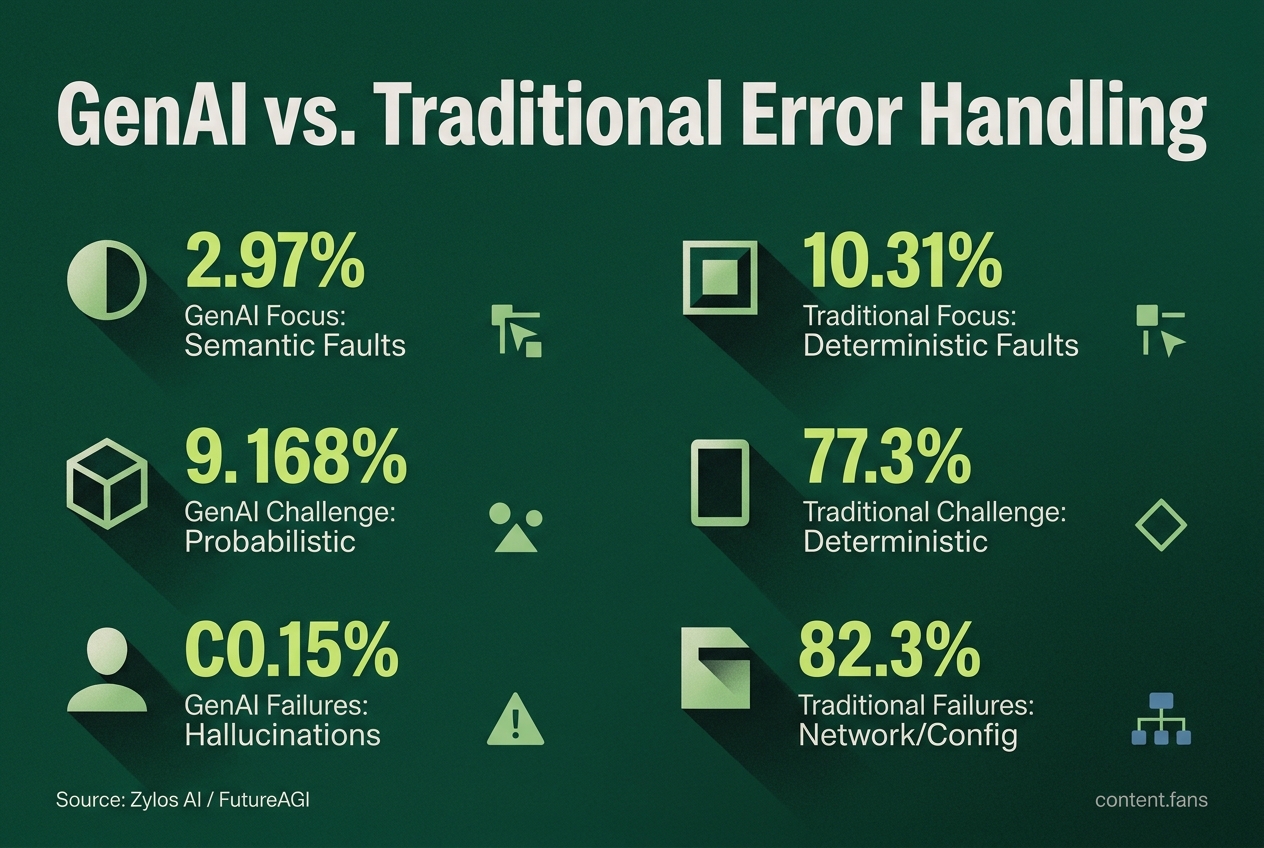
Traditional software error handling focuses on deterministic failures like transport or authentication errors. In contrast, GenAI systems are probabilistic, creating a new class of semantic faults. According to industry reports, a technically successful API call can still return a hallucinated answer or malformed data. This requires developers to handle three distinct issue categories: technical faults (e.g., HTTP 5xx), semantic faults (e.g., hallucinations), and context-window faults like truncation (FutureAGI).
What are the core production patterns for stabilizing GenAI systems?
Leading engineering teams classify every failure to apply the correct recovery strategy. Zylos AI recommends using explicit error taxonomies and treating failures in agent behavior, including semantic issues, as important failure modes (Zylos AI). This classification informs a toolbox of controls designed to make GenAI traffic more resilient.
| Failure Type | Signal / Examples | Recommended Control |
|---|---|---|
| Transient | HTTP 429, timeouts, latency spikes | Exponential backoff with jitter (capped at 3-5 retries) |
| Permanent | 4xx config errors, invalid prompts | Do not retry; log error and alert DevOps |
| Semantic | Hallucinations, schema violations | Trigger repair prompts, use a fallback model, or escalate to a human |
This structured approach replaces ad-hoc logic with traceable, testable recovery pipelines that often include circuit breakers, multi-provider fallbacks, and strict schema validation.
How are these recovery controls mapped to an LLM request's lifecycle?
A layered defense model applies specific controls at each stage of an LLM request:
- Request Boundary: Validate authentication and prompt length. Reject requests immediately if they exceed the model's context window.
- Model Call: Use a bounded exponential backoff policy to retry only transient errors like timeouts or rate limits (429s).
- Output Gate: Perform structural validation (e.g., on JSON) first. On failure, trigger a repair prompt or switch to a fallback model.
- Tool Invocation: Wrap external tool calls with timeouts and idempotency checks to ensure deterministic behavior.
- Orchestration: Implement circuit breakers on all external dependencies to prevent cascading failures.
What emerging trends are shaping the future of GenAI reliability?
Three key trends are advancing GenAI error handling beyond simple retries:
- Quality-Aware Circuit Breakers: These now trigger on repeated semantic failures, such as schema violations or unsafe content generation, blending system reliability with AI safety.
- Self-Healing Runtimes: Research into multi-step agents demonstrates controllers that can roll back to a clean checkpoint and replay a failed step, undoing partial side effects instead of masking them (arXiv 2508.07935).
- Regression Testing from Failures: Teams are now exporting failed production traces into automated test suites. These tests run during CI/CD, halting releases if a known issue reappears and shifting error handling from a reactive to a preventative discipline.