
Anthropic Unveils Claude Fable 5.1, Cuts Cache Read Costs 75%
Serge Bulaev
Anthropic has released Claude Fable 5.1 and Mythos 5.1, which may help cut cache read costs by 75% and improve science and coding test scores. Fable 5.1 is designed for open access, while Mythos 5.1 is for vetted security and research teams. The update also includes new safeguards that adjust to user needs and puts data control into the customer's cloud. Anthropic suggests these changes could help companies save money, reduce false security refusals, and better handle sensitive data. Access to Mythos 5.1 appears to be limited through trusted programs.

Anthropic has released Claude Fable 5.1 and its specialized counterpart, Mythos 5.1, introducing significant cost reductions, enhanced safeguards, and major performance upgrades. This update directly addresses key customer feedback on pricing, data control, and platform usability, with Fable 5.1 available for general use and Mythos 5.1 reserved for vetted research teams.
This update pairs lower operational costs with a flexible safety architecture, giving enterprises greater control over budget and regulatory compliance.
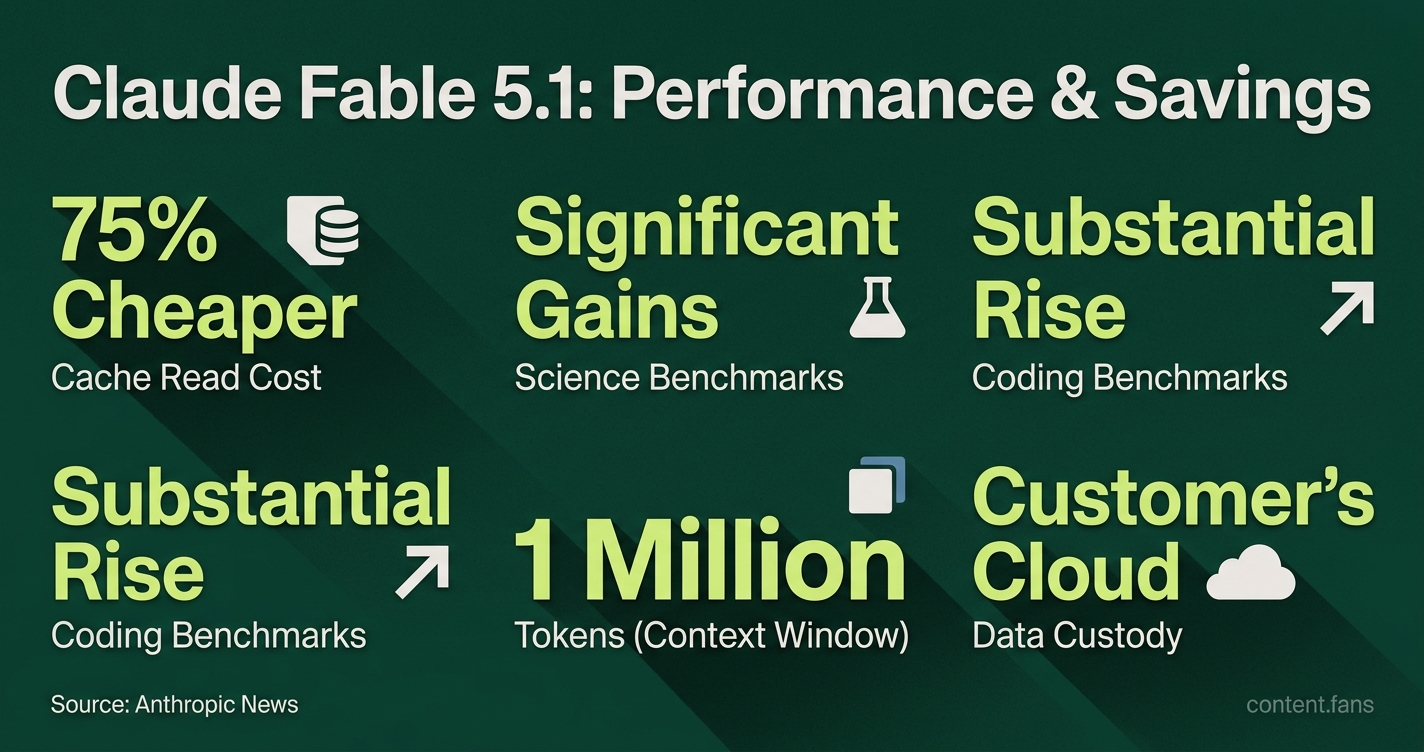
Pricing Shift and 75% Cheaper Cache Reads
Anthropic's update to Claude Fable 5.1 introduces a 75% price cut on cache reads, enhanced performance on science and coding benchmarks, and flexible new safeguards. It also gives enterprises the option to store misuse-monitoring data in their own cloud, addressing critical needs for cost control and data sovereignty.
Benchmarks: Gains in Science and Coding
Claude Fable 5.1 demonstrates major improvements in science and engineering capabilities. According to industry reports, the model achieved significant gains on Terminal-Bench-Science compared to Fable 5's previous performance. Performance on coding benchmarks also rose substantially, with Terminal-Bench 4.0 scores showing notable increases. Additional results suggest strong performance across multiple coding evaluation frameworks, indicating more reliable multi-step tool use.
One reviewer from Every reported that Fable reproduced a Compound Engineering loop diagram cleanly, whereas competing models added decorative noise. This may indicate improved alignment between vision input and structured drawing tasks.
Tiered Safeguards: Fable 5.1 vs. Mythos 5.1
The dual-model release centers on a new tiered safeguard system. While Mythos 5.1 shares the same core architecture and 1 million-token context window as Fable 5.1, it features more permissive controls tailored for vetted cybersecurity and life sciences research, as described in the Claude Platform documentation. Access is restricted to trusted programs like the Cyber Verification Program and Project Glasswing. For the public Fable 5.1 model, Anthropic has significantly reduced false cyber-related refusals.
Data Control Moves to the Customer's Cloud
Addressing enterprise needs for data sovereignty, the upcoming Enterprise Frontier Safeguards feature allows customers to store misuse-monitoring data directly in their own cloud environments like Amazon S3 or Azure Blob. This moves data custody from Anthropic to the customer. As detailed in the company's post on Developing Enterprise Frontier Safeguards, this empowers regulated firms to manage their own encryption and audit trails. Until EFS is fully deployed, an interim zero-data-retention policy is in effect for Fable 5 and 5.1.
Claude Fable 5.1 At a Glance
- Cache Read Price: 0.25 USD per million tokens (Anthropic)
- Performance: Significant improvements across science and coding benchmarks
- Context Window: 1 million tokens (Fable 5.1 & Mythos 5.1)
- Mythos Availability: Invite-only via trusted access programs
The combined package of cheaper cache calls, benchmark gains, and adjustable safeguards positions Claude Fable 5.1 as a candidate for long-running engineering agents and sensitive security research, while giving enterprises new levers over cost and compliance.
What are Claude Fable 5.1 and Claude Mythos 5.1, and how do they differ?
Anthropic has released two versions of the same underlying model tailored to different user needs. Claude Fable 5.1 is the general-public version with standard safeguards, while Claude Mythos 5.1 is an invite-only model for vetted cybersecurity and life sciences customers who require more permissive safeguards for specialized defensive work.
Both models share identical core capabilities: a 1 million token context window, 128K maximum output, and adaptive thinking always enabled. The key distinction lies in safeguard configurations - Mythos 5.1 is available exclusively through trusted access programs like the Cyber Verification Program and Project Glasswing, allowing approved organizations to perform sensitive tasks that would trigger restrictions in the public Fable version.
How much has Anthropic reduced cache read costs, and what does this mean for users?
Cache read pricing has dropped 75% to $0.25 per million tokens - down from the previous $1.00 rate. This is Anthropic's most aggressive pricing move yet for cached context.
Real impact on bills:
- Typical users: ~25% reduction in overall costs
- Heavy agent workflows: Up to ~45% savings
This pricing change particularly benefits applications with long context windows where the same reference material is queried repeatedly - think codebases, documentation, or conversation histories that agents revisit across multiple turns.
What performance improvements does Fable 5.1 deliver?
Science and reasoning capabilities saw dramatic gains. According to industry reports, Fable 5.1 showed substantial improvements on Terminal-Bench-Science compared to its predecessor. Additional benchmarks indicate strong performance across multiple evaluation frameworks including Terminal-Bench 4.0, SWE-bench Verified, and CursorBench.
False refusal rates dropped significantly for cyber safeguard triggers, addressing a major pain point where legitimate security research tasks were previously blocked.
Independent testing by Every found Fable 5.1 particularly strong at coding and product-focused outputs, noting it produced clean, usable diagrams of engineering workflows where competitors added distracting decorative elements.
What is Enterprise Frontier Safeguards, and why does it matter for data retention?
Enterprise Frontier Safeguards (EFS) represents a fundamental shift in how Anthropic handles misuse monitoring data. Rather than retaining activity logs on Anthropic's infrastructure for 30 days, EFS allows eligible enterprises to store this data in their own Amazon S3, Azure Blob Storage, or Google Cloud Storage accounts under their own encryption keys and access policies.
Key implications:
- Data custody moves from vendor-controlled to customer-controlled
- Enterprises maintain their own audit logging and access controls
- Combines zero data retention benefits with maintained safety oversight
The rollout is phased, with qualifying customers receiving interim zero data retention on Fable 5 and 5.1 until EFS becomes available. This responds directly to enterprise feedback on data sovereignty requirements.
What are some notable real-world applications of Fable 5.1?
Beyond benchmark scores, early adopters report concrete problem-solving capabilities. Millennium hedge fund credited Fable 5.1 with identifying the cause of a one-in-a-million system crash - the type of rare, complex failure mode that resists traditional debugging approaches.
The model's strength in long-running agentic work makes it suitable for:
- Multi-step coding and debugging sessions
- Technical documentation generation
- Data analysis pipelines
- Design and presentation creation
Anthropic explicitly positioned this release as responsive to customer priorities: pricing, data retention flexibility, and reduced false refusals - suggesting the improvements target friction points that previously slowed enterprise adoption.