
UBS Requires AI Skills for Junior Bankers Starting in 2027
Serge Bulaev
UBS will require AI skills for new junior investment bankers starting with the 2027 hiring round. Candidates may be asked in interviews about using generative AI for research and client work. Universities appear to be updating their courses to include more AI, data analytics, and responsible use of technology. Other banks may also be moving in this direction, with some already seeking advanced AI users. UBS insiders suggest the AI requirement is likely to continue, and students are advised to collect real examples of using AI in their finance work.

UBS will require AI skills for junior investment bankers starting with its 2027 graduate and intern hiring class. This move establishes AI literacy as a core competency alongside traditional finance qualifications, signaling a major shift in recruitment standards for entry-level roles in the banking industry.
What the New AI Requirement Means for Candidates
Starting with the 2027 intake, junior banking candidates at UBS must demonstrate practical generative AI skills during interviews. Applicants will be asked to explain how they have used AI for tasks like research, modeling, and preparing client materials, making this a new baseline requirement for securing a role.
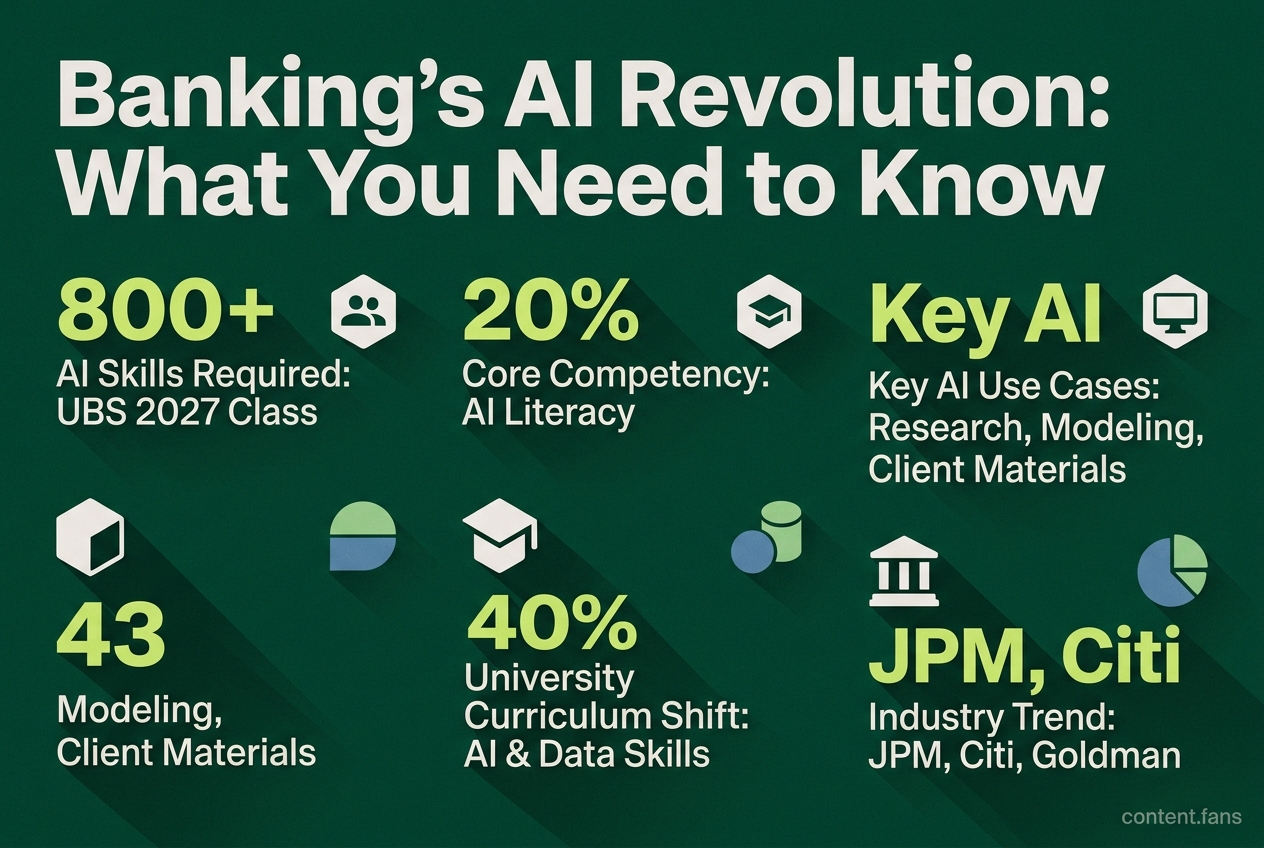
According to industry reports, candidates will be asked to detail how they've used AI to "improve outcomes and efficiency." To support this, UBS's career pages highlight an internal "AI Fluency Pathway," designed to provide new hires with training on real-world use cases and responsible AI application.
How University Finance Programs Are Responding
In response, many university finance departments are reviewing their curricula. The focus is on integrating three key layers:
- Core Finance: Traditional skills in valuation, accounting, and corporate finance remain fundamental.
- AI and Data Skills: New required coursework includes generative AI literacy, Python fundamentals, and automation tools.
- Governance and Judgment: Dedicated modules will cover responsible AI use, including data privacy, model bias, and client confidentiality.
Faculty report that class projects are already shifting toward blended workflows, requiring students to critique AI-generated outputs rather than relying solely on spreadsheets.
A Broader Industry Trend: Other Banks Follow Suit
While UBS is a front-runner in making AI skills a formal hiring prerequisite, other major banks are also embedding AI into their operations. Santander has reportedly sought "advanced AI users" for its 2026 graduate class. According to industry reports, major banks including JPMorgan and Citi have been upskilling new analysts in prompt writing, and Goldman Sachs uses AI to summarize research. This indicates that new hires across the industry are expected to enter AI-driven work environments.
How Aspiring Bankers Can Prepare for 2027
Many career advisors are updating their guidance for finance students. Mock interviews now feature prompts such as, "Describe how you used an LLM to accelerate financial analysis." Candidates are advised to build a portfolio of tangible examples, such as using AI for topic modeling on earnings calls or automating comparable company analysis. Crucially, demonstrating tangible results and mentioning controls like data anonymization will be key differentiators. While AI proficiency is the new benchmark, advisors stress that it complements - not replaces - the need for rigorous analytical skills and clear communication.
What exactly is UBS requiring from junior investment banking candidates?
UBS is making AI proficiency an explicit hiring requirement for candidates applying to its Global Banking and Markets business from the 2027 intake. According to the Financial Times report, applicants must demonstrate how they have used AI tools to "improve outcomes and efficiency" in their work. Interviewers will specifically ask AI-related questions to assess this capability. This requirement sits alongside traditional criteria - candidates still need strong academic backgrounds in finance or economics and analytical skills.
How is UBS supporting new hires in developing AI skills?
UBS has built structured training pathways for incoming talent. Through its AI Fluency Pathway, new hires receive training focused on real-world use cases, responsible application, and sound judgment. The bank also provides hands-on learning, internal AI certifications, and global knowledge-sharing communities for early-career employees. This suggests UBS views AI literacy not as a static requirement but as something to deepen after hiring.
Is UBS alone in requiring AI skills, or are other banks following suit?
While UBS is among the first major banks to make AI skills explicit for entry-level hiring, other institutions are moving in similar directions. Santander has reportedly sought "advanced AI users" for some graduate programs. JPMorgan Chase has reportedly mandated generative AI training for new employees, and Citi has been upskilling significant portions of its workforce in prompt writing. However, these appear as training mandates rather than pre-hiring requirements. The broader signal is clear: AI literacy is shifting from optional advantage to baseline expectation across investment banking.
What does this mean for finance education and career preparation?
Finance curricula will likely need to treat AI literacy as a core employability skill rather than an elective add-on. Based on UBS's stated criteria, students should prepare to:
- Understand what generative AI can and cannot do, including how to evaluate outputs and when human judgment should override model suggestions
- Gain practical experience using AI for research, drafting, market scanning, and workflow efficiency
- Study responsible AI and governance: data privacy, model risk, bias, compliance, and client confidentiality
- Develop complementary technical skills like Python, data analysis, and prompt design alongside traditional finance fundamentals
Critically, traditional finance knowledge remains essential - UBS continues to require degree-level expertise in valuation, accounting, and corporate finance.
When does this requirement take effect, and who does it cover?
The requirement applies to the 2027 intake for UBS's graduate and intern programs in Global Banking and Markets. This gives candidates and educational institutions lead time to adapt. The policy specifically targets junior investment banking roles rather than all positions bank-wide, though UBS's broader early careers framework suggests AI fluency expectations may expand across the organization over time.