
LineShine Supercomputer Hits 2.198 Exaflops, Tops TOP500 List in 2026
Serge Bulaev
The LineShine supercomputer from China may have surprised many by taking the top spot on the TOP500 list in 2026, reaching 2.198 exaflops in performance. This system appears to be the first CPU-only machine to pass 2 exaflops of sustained double-precision speed. Its design uses only CPUs, which might show a new way to build supercomputers without special accelerators. Experts suggest its architecture and all-domestic parts could change how future systems are made, but there is still some uncertainty about how it will perform with real-world jobs.

China's LineShine supercomputer has secured the number one position on the June 2026 TOP500 list, establishing a new era in high-performance computing. Developed for the National Supercomputing Centre in Shenzhen, it is the first platform to exceed 2 exaflops using a CPU-only architecture.
Clocking in at 2.198 exaflops on the High Performance Linpack (HPL) benchmark, LineShine beat El Capitan by approximately 21.5% (2.198 vs 1.809 Exaflops), as detailed in the official HPL results. This remarkable speed is powered by 13,789,440 cores based on a custom LingKun platform with LX2 304C processors.
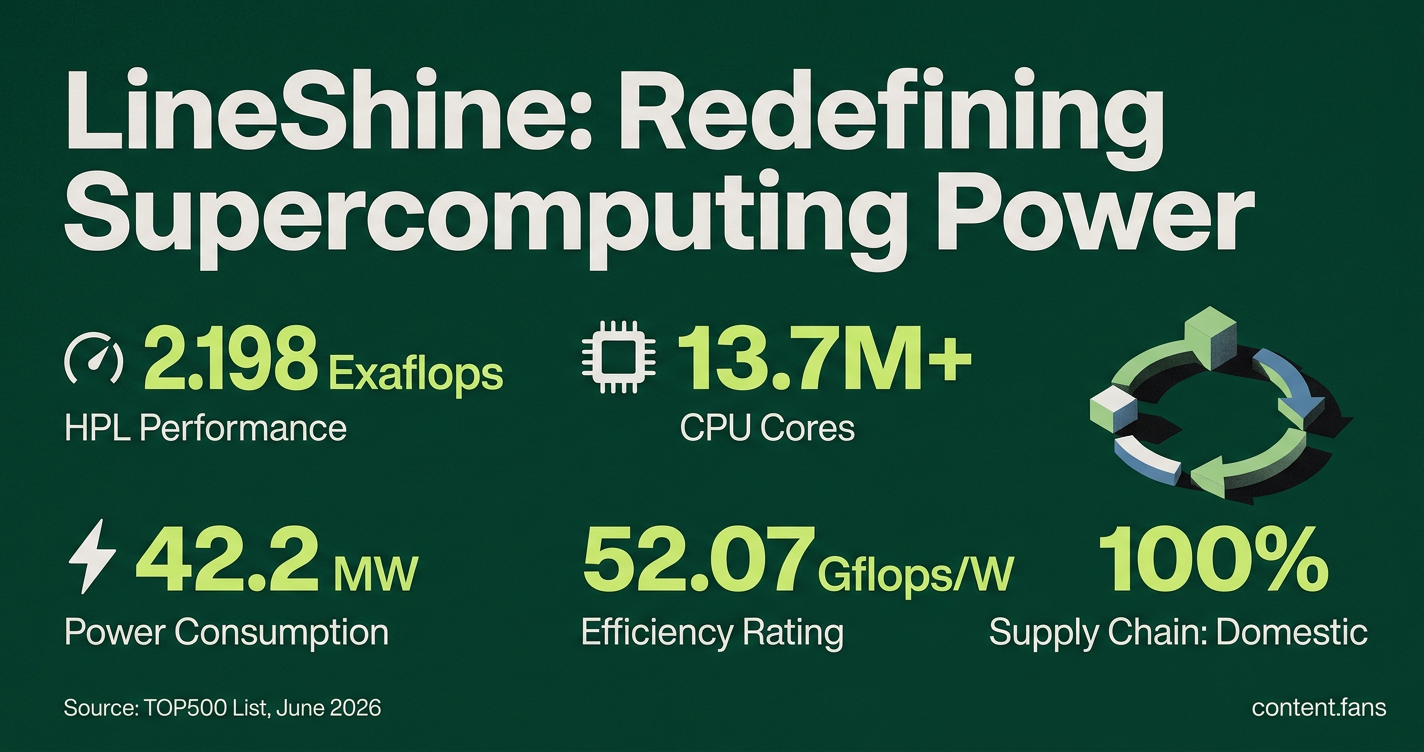
LineShine's groundbreaking architecture suggests a major shift in exascale computing strategy. Its design proves that tightly integrated CPUs with embedded matrix units can rival accelerator-based systems in performance, all while operating within a power budget of approximately 42.2 megawatts.
Why LineShine Surprises by Taking the Number One Spot on TOP500 Matters
LineShine's achievement is significant because it validates a CPU-only path to exascale computing, a design previously thought less viable than GPU-accelerated systems. By leveraging a domestic supply chain and an innovative processor design, it redefines the architectural possibilities for next-generation supercomputers without relying on accelerators.
- Groundbreaking All-CPU Design: The system relies entirely on custom LX2 processors, with each node housing two 304-core CPUs. These integrate advanced Scalable Vector and Matrix Extensions, achieving approximately 80 percent of the machine's 2.736 exaflop theoretical peak performance without specialized accelerators.
- Sovereign Supply Chain: Every critical component, including the LX2 processors, LingQi interconnect fabric, and Kylin operating system, is domestically produced in China. This technological independence is a key strategic element, as detailed in Byteiota's system profile.
- Modest Mixed-Precision Performance: The machine achieves 7.92 exaflops on the HPL-MxP benchmark. This relatively small 3.6x increase over its double-precision score highlights its reliance on general-purpose cores rather than dedicated low-precision hardware for AI-style workloads.
- Impressive Power Efficiency: LineShine achieves an efficiency rating of 52.07 gigaflops per watt. While not number one on the Green500 list, this figure is exceptionally strong for a large-scale system that does not use power-sipping accelerators.
- Advanced Scale and Fabric: The custom dual-plane LingQi interconnect provides 1.6 terabits per second of bandwidth per node. This high-speed fabric allows the system's 90 liquid-cooled cabinets to function as a single, coherent machine.
Architectural Snapshot
| Metric | Reported Figure |
|---|---|
| Sustained FP64 (HPL) | 2.198 exaflops |
| Core count | 13,789,440 |
| Cabinets | 90 |
| Power draw | ~42.2 MW |
| Efficiency | 52.07 GF/W |
Early Industry Read-Through
- Its leadership on both the HPL and HPCG benchmarks indicates powerful performance on both dense linear algebra and complex, memory-intensive scientific applications.
- The success of its CPU-only model provides a viable alternative for organizations looking to build powerful systems without relying on export-controlled GPU accelerators.
- Global hardware vendors will now closely evaluate if embedded matrix units in general-purpose CPUs represent a scalable and competitive path forward for future exascale systems.
The debut of LineShine confirms that the landscape for exascale system design is far from settled. As the supercomputer transitions from benchmarking to production science, the industry anticipates further details on its software ecosystem, operational resilience, and real-world application performance.