
AI Rewrites Executive Hiring Playbook, Prioritizing Adaptability, AI Fluency
Serge Bulaev
AI may be changing how companies hire top executives, with search firms now using data and algorithms to find new candidates more quickly. The focus of hiring appears to be shifting from deep technical skills to qualities like adaptability, AI understanding, and good decision making with data. Tools can scan large amounts of information to identify leaders and help match them to roles, but human judgment is still important for culture fit and final decisions. There may be risks, such as possible bias in the data, and some steps still rely on building trust through conversation. Overall, these new tools suggest that future leaders will need to be comfortable with AI, make quick decisions, and handle change well.

The executive hiring playbook is being rewritten by AI, as search firms deploy data-driven tools to accelerate and expand candidate discovery. Algorithms can now scan public filings, patents, and social media in minutes, identifying high-potential leaders who previously remained invisible to traditional search methods.
This technological shift is redefining how boards judge leadership readiness, placing greater weight on adaptability, governance judgment, and AI fluency over pure technical depth.
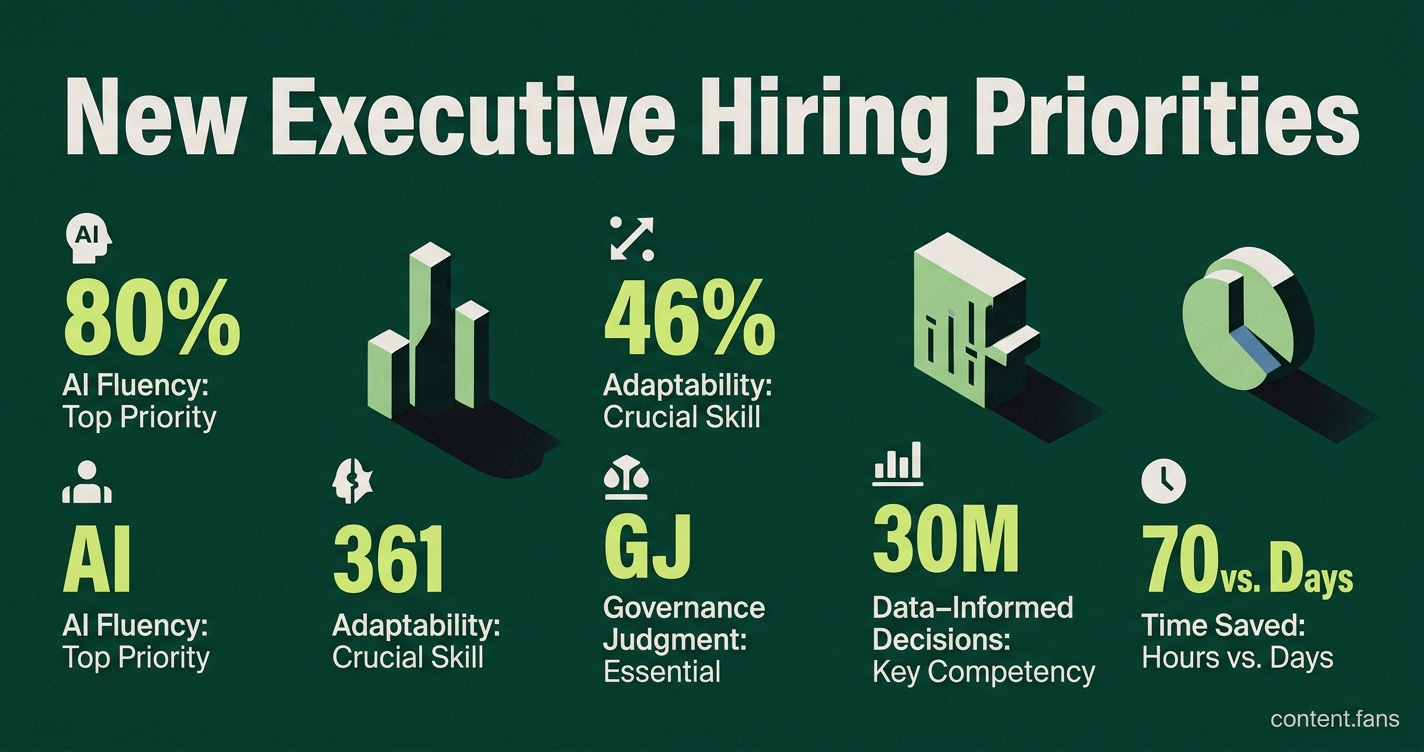
Changing search criteria
AI is shifting executive search criteria from technical depth toward strategic competencies. Boards now prioritize a leader's adaptability, governance judgment, and AI fluency. Data-driven tools help identify candidates with strong decision-making skills and the ability to manage risk, moving beyond simple keyword and experience matching.
Market-mapping platforms powered by large language models can significantly reduce research and initial screening time, according to industry reports. This speed allows recruiters to assess more candidates against broader signals like scale experience and geographic mobility. While human judgment remains key for culture fit, digital dashboards provide structured scoring for risk management and data-informed decision-making.
A major adjustment is the shift in core competencies. Industry experts note that boards now expect leaders to interpret AI-generated insights and establish governance for privacy and bias, a skill valued more highly than coding ability. Consequently, recruiters are focusing on candidates who demonstrate sound judgment under pressure and can bridge the gap between technical and commercial teams.
Practical uses inside the search workflow
- Sourcing: AI-powered pattern recognition scans vast talent pools to flag passive candidates whose career paths match the success profiles of previous placements.
- Screening: Sentiment analysis tools review public interviews and board minutes, offering preliminary insights into a candidate's communication style and leadership approach.
- Market Mapping: AI algorithms consolidate news and regulatory filings, enabling search partners to brief clients on prospects in hours instead of days.
Real-world applications confirm this impact. Industry reports indicate that companies are achieving significant improvements in internal candidate conversions using AI-enabled matching. Similarly, Veris Insights reports an asset management firm uses Microsoft Copilot to auto-draft role profiles from performance data, suggesting a move toward more dynamic C-suite job descriptions.
Competency profile emerging for 2026
According to industry reports, several key attributes consistently appear in new executive search briefs:
- AI literacy and governance insight
- Data-informed decision-making
- Adaptability and change leadership
- Emotional intelligence
- Strategic communication
While traditional requirements like P&L responsibility remain important, their weighting has shifted. One consultant noted that final interviews now focus more on "how the candidate frames AI risk and opportunity" than on operational details.
Limits and open questions
Despite these advances, sources agree that algorithms augment, rather than replace, human judgment. Key areas like assessing culture fit, board chemistry, and negotiating compensation remain fundamentally high-touch processes. Experts also warn of risks, including potential bias amplification from unaudited datasets and the fact that a faster shortlist doesn't guarantee a faster placement, as final decisions depend on trust built through direct conversation.
Ultimately, AI-driven discovery and evaluation are reshaping the modern leadership archetype to favor digital fluency, governance rigor, and a capacity for rapid learning. Boards that understand these changes can create more precise hiring mandates, and candidates who develop these competencies will have a distinct advantage in data-heavy assessment processes.
As artificial intelligence reshapes how organizations identify and evaluate leadership talent, executive search is undergoing its most significant transformation in decades. The following FAQ explores how hiring criteria are evolving, what new competencies matter most, and how companies are practically applying these insights.
How is AI specifically changing what boards look for in executive candidates?
AI is shifting evaluation from pedigree and technical expertise toward adaptability, commercial instinct, and change leadership. Rather than seeking deep specialists, boards increasingly prioritize leaders who can interpret AI-generated insights, govern AI use responsibly, and manage organizational transformation.
Research shows executive search firms now emphasize calibrated criteria including capability fit, motivation, and leadership potential over traditional title-matching. The most valued competencies for 2025-2026 include AI literacy and governance, data-informed decision-making, strategic agility, and emotional intelligence - with human judgment remaining essential for assessing cultural fit and long-term organizational alignment.
What does "AI fluency" actually mean for a non-technical executive?
AI fluency does not require coding expertise. Industry experts note that leaders need a working understanding of AI concepts - machine learning, generative AI, data analytics, and cybersecurity - sufficient to make informed decisions and communicate credibly with technical teams.
The critical skill is strategic judgment: distinguishing AI hype from genuine business value, identifying high-impact use cases, and building investment-grade business cases with clear KPIs. Leaders must understand when AI represents strategic opportunity rather than just technology implementation.
Are there proven examples of companies successfully using AI in executive talent acquisition?
While public case studies specifically for C-suite hiring remain limited, several documented examples demonstrate AI's impact on leadership pipeline development:
| Company | Application | Outcome |
|---|---|---|
| Kuehne+Nagel | AI-enabled platform for internal candidate conversion | Significant increase in internal conversions and decreased time-to-fill |
| Accenture | AI workforce planning mapping employees to AI-based roles | Scaled AI workforce through structured succession planning |
| Hilton | AI-driven matching for cultural fit indicators | Above-average retention rates |
These cases illustrate how AI strengthens internal mobility and succession planning - often the fastest source of executive successors - rather than replacing human judgment in final selection decisions.
Why can't AI simply replace executive recruiters entirely?
AI excels at scale and speed - scanning large talent pools, significantly reducing search and screening time in many workflows, and surfacing passive candidates manual search would miss. However, final placement decisions remain fundamentally human.
Executive search requires assessing narrative, motivation, leadership maturity, and political context - dimensions AI cannot reliably judge. Trust-building, stakeholder alignment, offer negotiation, and determining whether a candidate fits a specific organization at a specific moment demand executive-level human assessment that technology cannot replicate.
The field is evolving toward a hybrid model: AI handles market mapping and initial screening while humans concentrate on interpretation, relationship, and final judgment.
What practical steps should organizations take to align their executive hiring with these new priorities?
Organizations should focus on three structural adjustments:
1. Redefine success profiles around transferable capabilities rather than industry tenure alone. Emphasize pattern recognition, scale experience, and change leadership evidenced across diverse contexts.
2. Invest in assessment rigor for AI-era competencies. Evaluate candidates on workflow redesign capabilities, governance judgment, and cross-functional communication - not merely technical familiarity.
3. Build internal AI fluency within talent and board functions. Industry experts emphasize that AI governance is now a core board-level responsibility - search committees themselves need sufficient understanding to evaluate candidates effectively.
The transformation is clear: executive hiring is becoming less about finding proven templates and more about identifying leaders who can navigate uncertainty, translate between technical and human domains, and build organizational capability faster than competitors.