
Israel Warns Iran Uses AI to Polish Disinformation, Recruitment
Serge Bulaev
Israel's National Cyber Directorate warns that Iranian hackers may be using AI to make disinformation and recruitment messages more convincing and harder to detect. These AI-powered efforts appear to include mass text messages and fake social media profiles, sometimes using very natural-sounding Hebrew, which suggests generative AI is involved. Officials say these campaigns often try to cause panic or recruit Israelis to share information. Experts believe that AI allows these groups to quickly change their messages for different audiences, making operations cheaper and faster. Israel is responding by advising the public to verify alerts and is running drills to prepare for both technical and psychological attacks.

Iran uses AI to polish disinformation and recruitment messages aimed at Israelis, a threat that has escalated into a daily concern, according to Israel's National Cyber Directorate (INCD). In a recent interview, Director-General Yossi Karadi described how Tehran-aligned hacking units are coordinating more closely and using AI to refine their psychological operations, marking a significant "escalation in sophistication" Nextgov/FCW. The directorate connects these AI-driven tactics to a wave of wartime deception and phishing attempts flooding Israeli devices.
AI-Powered Disinformation and Recruitment Tactics
Iranian state-backed actors are using generative AI to create highly realistic disinformation in native-level Hebrew. These AI-enhanced campaigns involve mass text messages and fake social media profiles designed to sow panic, spread false information, and recruit Israeli citizens for intelligence gathering by appearing more credible.
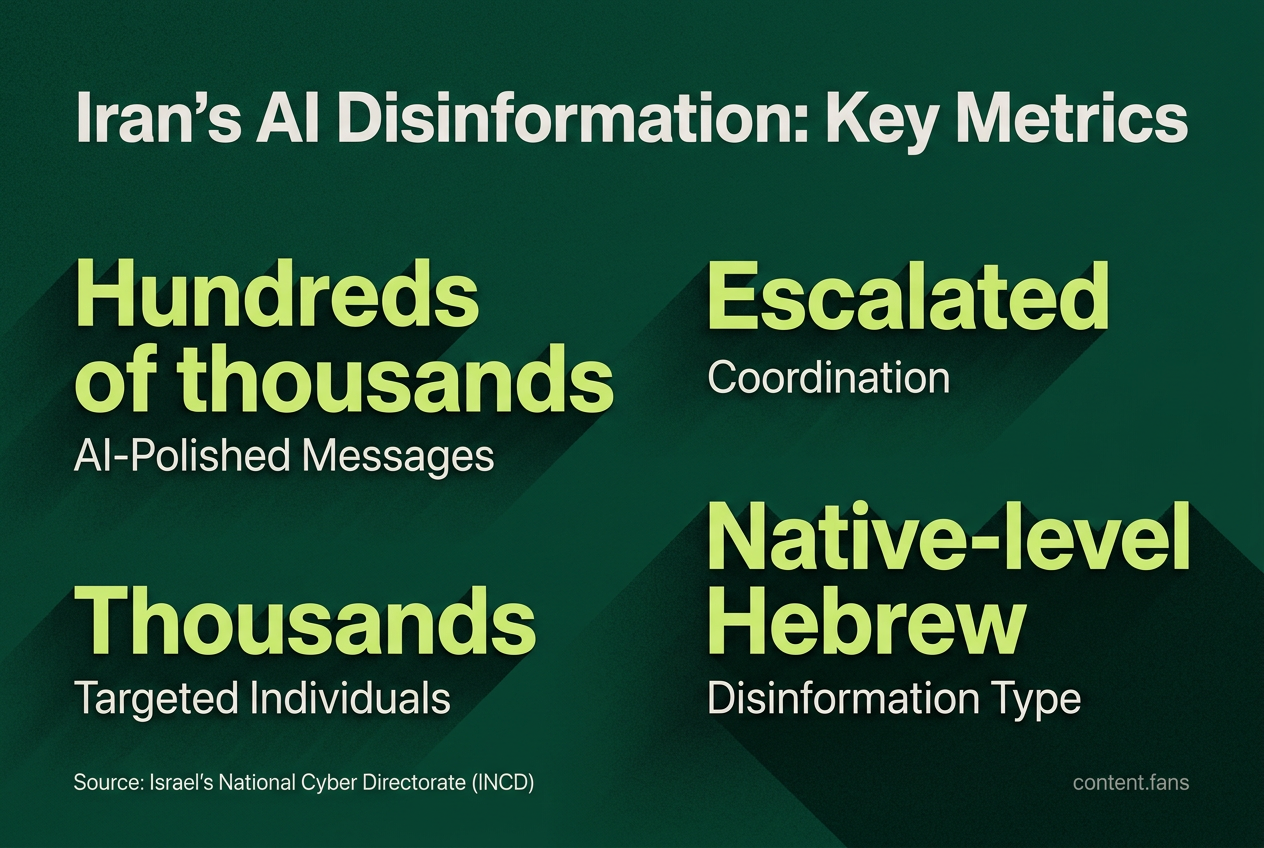
Iranian psychological operations now deploy AI to generate native-level Hebrew, a stark improvement from earlier messages riddled with errors. Director-General Karadi noted that Iran has sent "hundreds of thousands" of AI-polished text messages, including false warnings like "bomb shelters are closed" intended to create panic. These sophisticated campaigns also attempt to recruit Israelis for intelligence gathering, using a natural, persuasive tone to offer payment or appeal to a sense of "resistance," which analysts believe significantly boosts response rates.
The Scale of Iran's AI-Enhanced Influence Operations
The scope of these operations is vast. According to industry reports, the INCD has recorded a significant number of psychological warfare incidents, with phishing attempts accounting for a substantial portion of the total. The directorate has been tracking many distinct social engineering campaigns, many of which targeted thousands of individuals simultaneously.
Key tactics observed by the INCD include:
- Massive SMS campaigns impersonating official bodies like the Home Front Command.
- Automated voice calls that mimic Israeli emergency alert systems.
- Networks of fake social media accounts used to amplify panic-inducing narratives.
- Phishing links disguised as news updates to harvest credentials.
The Strategic Advantage of Using AI in Cyber Warfare
Artificial intelligence provides a significant strategic advantage, allowing attackers to operate faster, cheaper, and more effectively. The INCD highlights that AI enables operators to instantly localize language, adapt the tone for specific demographics, and rapidly iterate on their messaging. This agility, combined with what experts believe is increased coordination and shared tools among Iranian hacker groups, presents a more formidable and dynamic threat.
Israel's Countermeasures Against AI Disinformation
In response, Israel is implementing a multi-layered defense strategy. This includes public awareness campaigns with counter-messaging videos and advisories urging citizens to verify alerts via the official Home Front Command app. Suspicious messages can be reported to the INCD's hotline. Behind the scenes, cybersecurity teams in critical sectors are conducting drills that merge technical incident response with strategies to counter narrative attacks. Karadi emphasizes the goal is to ensure "the technical fix and the public statement happen in the same hour," minimizing the impact of confusion.
A Growing Global Trend in AI-Driven Influence
This development in the Middle East reflects a broader global trend. The INCD's warning echoes previous alerts from the U.S. Department of Justice about foreign adversaries, including Iran, using AI-generated content to obscure their activities. Security experts agree that AI makes it increasingly difficult to identify and filter hostile influence operations based on traditional markers like language errors. While a formal INCD report is pending, the current data points to a new front in cyber warfare where technology and psychology converge, making the monitoring of coordinated campaigns - rather than individual fake posts - essential for future defense.
How is Iran reportedly using AI in its influence operations against Israel?
Israel's National Cyber Directorate (INCD) says Tehran-linked hacker teams are now pooling tools and data and running their 2024/2025 SMS, voice-call and social-media campaigns through generative-AI polishers. The result: Hebrew-language messages that once read like "very bad Google Translate" now sound local, urgent and personal, lifting click-through and recruitment rates.
What form do these AI-enhanced campaigns take on Israeli phones?
- Hundreds of thousands of SMS sent during combat-alert periods, some impersonating Israel's Home Front Command
- Voice and text warnings that "bomb-shelters are locked" or that reservists should ignore call-ups
- Follow-up chats that gently ask for photos of troop movements or offer cash for "quick surveys," a classic spy-recruitment wedge
How big is the wave of attempted persuasion?
INCD has received a significant number of citizen reports of Iranian psychological-warfare messages in recent periods, with phishing attempts accounting for a substantial portion. Each campaign can hit thousands of numbers inside minutes, and the agency's director-general told Nextgov/FCW that coordination among Iran's hacking groups is "stronger than ever."
Why does AI make the threat harder to spot?
Large-language models let attackers:
- Write slang-filled Hebrew in seconds
- Vary wording so every text looks unique, blasting past spam filters
- Generate fake profile pictures, voice clips and even short videos that mimic trusted Israeli sources, increasing the chance targets will click, share or reply
What can individuals do to lower the risk of falling for an AI-polished lure?
- Pause before acting on any "urgent" security SMS; verify through official radio, TV or the Home Front Command app
- Never forward photos or location data to unknown contacts, even if they promise payment
- Check the sender's number - INCD notes Iranian texts often arrive from long international or spoofed short codes
- Report suspicious messages to the government's 119 hotline; the data feed helps block the next wave
- Turn on automatic OS updates and use the phone's built-in spam-filter to trim the noise