
Inflation Devalues Paychecks: How to Protect Your Purchasing Power
Serge Bulaev
The article suggests that inflation may make paychecks lose value each year, even if the amount goes up. Central banks and commercial banks can create more money, which may cause prices to rise if more money chases the same goods. People who only look at bigger paychecks might feel richer, but could actually buy less. To protect their money, individuals might want to use assets that can adjust with inflation, but experts warn that no single investment is perfect in every situation. Denning suggests people should watch how much new money is created to help decide how to save or invest.

To protect your purchasing power from inflation, it's vital to look beyond nominal pay raises. Modern money creation devalues earnings annually, a concept Stephanie Denning illustrates by comparing our financial system to Monopoly players using IOUs after the bank runs out of cash. This analogy reveals that money is essentially a ledger entry that key institutions can expand. Tracking this expansion is critical to preserving real wealth.
How fresh ledger entries appear
Inflation devalues paychecks by increasing the general price of goods and services. When central and commercial banks create more money, a larger supply of currency chases the same amount of goods. This bids up prices, meaning each dollar - and therefore your entire paycheck - can purchase less than before.
New money enters the economy through a two-tiered system. First, central banks expand their balance sheets via asset purchases or loans. The Federal Reserve explains this action directly credits bank reserves, increasing the base money supply. Second, commercial banks create new money by issuing loans, which generates new deposits. This process is not permanent; the Bank of France notes the money supply contracts as loans are repaid.
This dual system means pay raises are meaningless unless they outpace the growth of the money supply. When policymakers increase liquidity, more dollars compete for the same goods, pushing prices higher and reducing the purchasing power of each dollar. This leaves workers who focus only on nominal raises feeling richer while their actual ability to afford goods and services declines.
The practical scoreboard
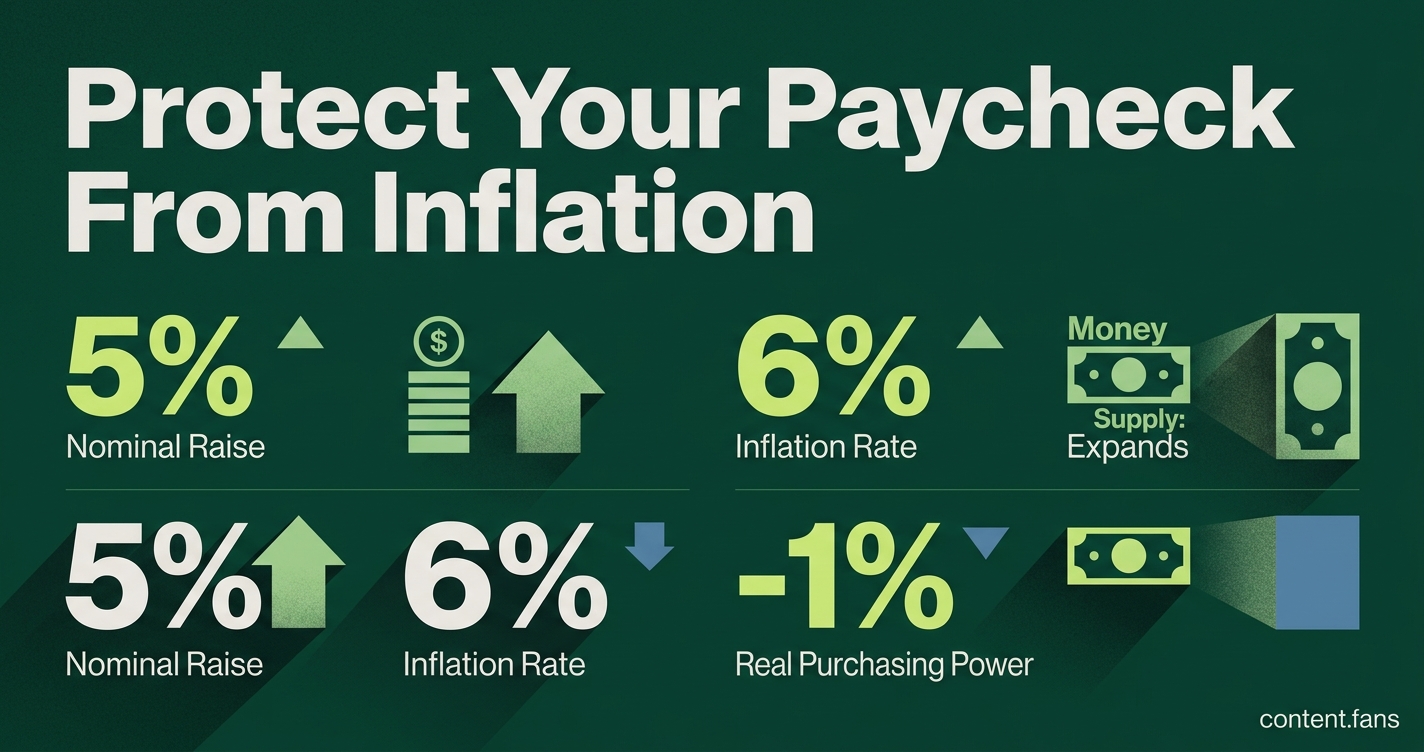
Inflation is the scorecard for this monetary dilution. Consumer prices have experienced significant fluctuations in recent years, with periods of elevated inflation creating challenges for workers. During such periods, an employee receiving a 5% raise in a year with 6% inflation would suffer a 1% loss in real purchasing power.
Investors can gauge expectations for future inflation through market instruments. Treasury Inflation-Protected Securities (TIPS) are designed to "help keep your purchasing power whole," as Morningstar notes, by adjusting their principal value based on official CPI data. A strategy involving short-term TIPS can provide a hedge against unexpected inflation spikes.
Defensive playbook for individuals
A portfolio aimed at outrunning monetary expansion should combine assets that reprice with inflation, minimize interest-rate risk, and achieve real growth. Key strategies include:
- Inflation-linked bonds: TIPS and their global equivalents offer a direct link to CPI changes.
- Short-duration debt: Short-term bonds and floating-rate notes are less vulnerable to price drops when interest rates rise.
- Equities with pricing power: Stocks of companies that can pass on costs to customers in essential sectors can protect value.
- Real assets: Investments like rental properties or infrastructure generate income streams that can adjust for inflation.
However, experts warn that no single investment is perfect in every situation. For instance, commodities can hedge against supply shocks but are volatile, while long-duration bonds perform poorly when inflation rises. The primary lesson is to first understand the monetary environment before choosing your investment exposures.
A mindset shift rather than a forecast
The most crucial takeaway is to view money as a manufactured product with a shelf life that can spoil. Just as Monopoly players accept IOUs as cash, people often celebrate nominal pay raises without accounting for the silent erosion from inflation. By understanding who creates money and at what pace, you can shift from being a passive victim of devaluation to an active player who strategically holds, exchanges, or invests to protect value before it disappears.