
IBM and Northflank Detail Safe AI Code Deployment Checklist
Serge Bulaev
IBM and Northflank share advice for safely deploying AI-generated code in companies. They suggest starting with small pilot projects, using strict testing and security checks before expanding to more teams. Human oversight and clear tracking of code changes appear to be important for meeting legal rules and catching problems early. Teams may want to wait until defect and security rates are low before wider rollout. While this approach does not guarantee perfect results, experts suggest it may help make using AI-generated software safer and more reliable.

As enterprises adopt AI coding assistants, they encounter new risks. To address this, a new safe AI code deployment checklist is emerging, based on guidance from industry leaders like IBM and Northflank. This framework moves beyond classic QA, introducing new controls for provenance, regulatory compliance, and non-determinism. The following practices represent the minimum standard for responsibly integrating AI-generated code into production environments.
Controlled pilots before broad rollout
To safely deploy AI-generated code, experts recommend a cautious, data-driven approach. Start with a small pilot project on a single team, implementing rigorous testing, security scanning, and human oversight. Collect metrics on defect rates and security findings before considering a gradual, wider rollout to other teams.
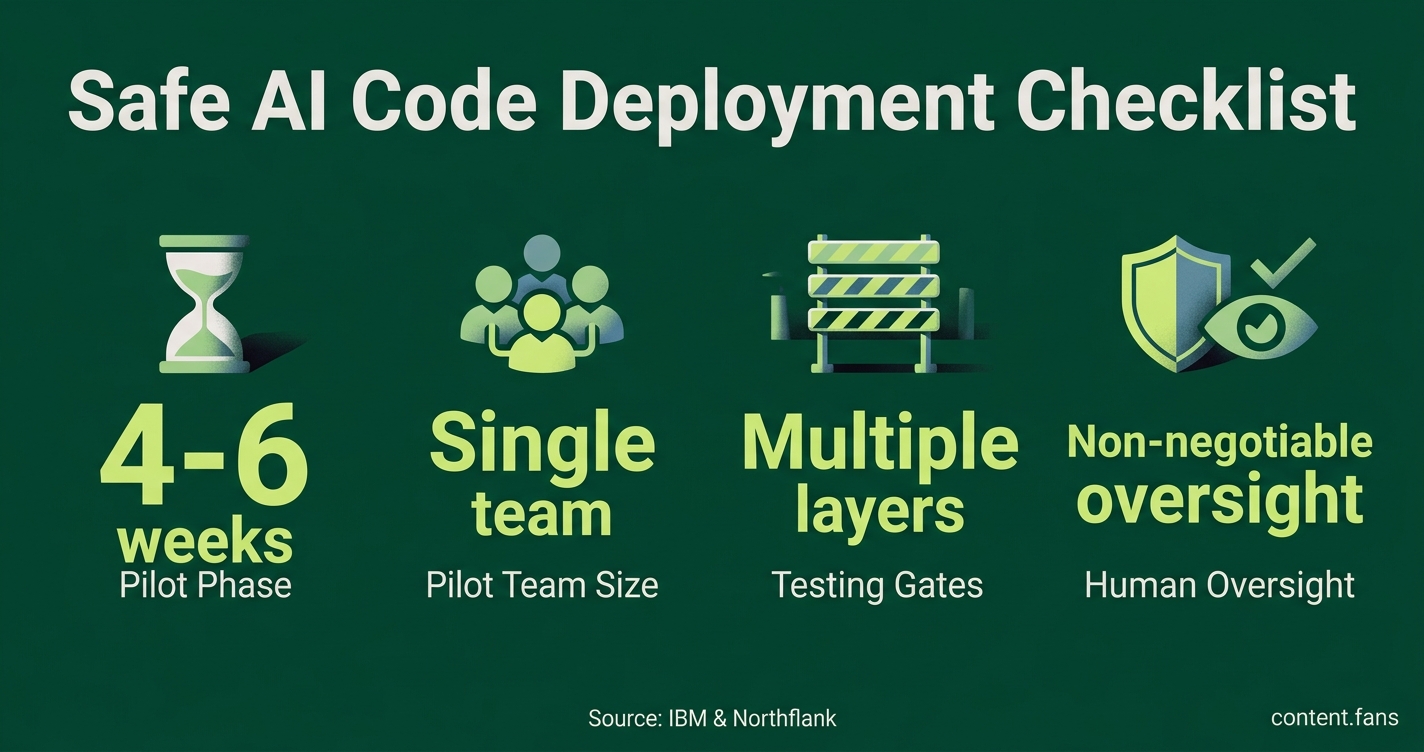
Northflank's guidance recommends starting any AI code adoption with a contained, four-to-six-week pilot on a single team. This initial phase focuses on measuring key metrics like PR throughput, defect rates, and security vulnerabilities before any expansion (Northflank blog). Using preview environments that replicate production allows teams to assess agent performance, refine coding standards, and safely observe system behavior without impacting customers. Skipping this crucial step often correlates with higher rates of merge-bypass, suggesting poor policy integration. A phased rollout also simplifies the configuration of access controls like SSO and role-based permissions.
Layered testing and security gates
According to IBM, best practices involve a "global rules plus project rules" strategy, embedding security scans, comprehensive tests, and coverage requirements into every pull request (IBM Think). Any pull request that fails a required status check - such as linting, SAST, secret detection, or owner review - is automatically blocked from merging. A robust testing pipeline should include:
- Unit tests for logic and edge cases
- Integration tests for service calls and auth flows
- End-to-end tests in a preview environment
- Security scans for secrets and vulnerable dependencies
- Operational tests for load, latency, and rollback
To enhance traceability, Northflank further recommends labeling every AI-generated pull request with tool and session identifiers. This ensures that audit logs can trace each line of code to its originating prompt, simplifying SIEM ingestion and incident response.
Core elements of the enterprise checklist for safe deployment of agent-authored code
Human oversight is a non-negotiable legal and technical requirement. For instance, the EU AI Act mandates that high-risk systems must have interfaces allowing human experts to override AI outputs (Galileo overview). In practice, this translates to risk-tiered approval workflows where low-risk changes might auto-merge, but high-risk changes require explicit human sign-off. Effective oversight requires combining powerful tooling with clear processes. Review portals should provide full context - including prompts, model versions, and code diffs - to enable rapid, informed decisions. Complete traceability is also critical for supporting upcoming EU AI Act documentation requirements, requiring logs of dataset quality, risk assessments, and monitoring.
Metrics that signal readiness
A pilot program should only be expanded after key performance indicators (KPIs) remain within established targets for at least two consecutive release cycles. This data-driven approach ensures quality is maintained as AI assistance is scaled. Key metrics include:
| Metric | Target example |
|---|---|
| Defect rate per agent PR | ≤ baseline human rate |
| Security findings per PR | severity low or medium only |
| Coverage impact | no decrease below 80 percent |
| Merge bypass frequency | near zero |
| Trace completeness | 100 percent of PRs tagged with session ID |
According to the Northflank study, this gating strategy has proven effective for early adopters in maintaining quality while scaling AI tooling.
While no playbook can guarantee flawless results, the consistent guidance from technical and regulatory experts is clear. A strategy built on disciplined pilots, layered testing, mandatory human oversight, and comprehensive logging provides a pragmatic and reliable path toward deploying trustworthy, agent-generated software.
What makes IBM and Northflank's Safe AI Code Deployment Checklist different from conventional QA playbooks?
The checklist introduces risk-tiered gates that treat every AI-authored change as untrusted until proven safe rather than assuming code correctness. Instead of a single human review, the workflow layers sandbox execution, automated security scanning, traceability logging, and rollback rehearsal for each pull request. Industry reports indicate that teams adopting comprehensive multi-layer gates see significant reductions in production defects and security incidents within months of adoption.
How should teams test AI-generated code before it reaches customers?
Start with controlled pilots. Deploy the agent to one team only, measure defect rate, security findings, and merge bypass frequency for four to six weeks, then expand gradually. Every change must pass:
- Unit and integration tests inside an isolated preview environment
- Policy tests for approved libraries, naming conventions, and documentation
- Security scans - secrets, SAST, dependency vulnerabilities, license compliance
- Operational tests - load, latency, and observability
- Required human approval by the service owner before merge
All results are pushed to SIEM so security teams can correlate future incidents back to the original prompt and session ID.
What traceability artifacts are required for audit readiness?
Each agent session must generate an immutable log bundle containing:
- Prompt and session ID
- Model version and parameter hash
- Generated diff plus file provenance
- Test results and policy compliance score
- Reviewer identity and time stamp
- Rollback plan with estimated blast radius
These logs are streamed to the corporate SIEM and retained for at least one year to meet EU AI Act documentation obligations for high-risk systems.
Which human-in-the-loop checkpoints should be hard-coded into CI/CD?
Industry best practices suggest implementing a risk-based approval matrix with different review requirements based on change complexity and potential impact. Organizations typically establish tiered approval workflows where low-risk changes like documentation updates may auto-merge after passing automated checks, while high-risk changes affecting authentication, billing, or data migrations require multiple reviewers including security and legal teams. Critical changes to public APIs or regulated workflows often require formal change management board approval.
How can regulated industries adopt the checklist without violating compliance timelines?
Begin with internal-only micro-services that process synthetic data. Once the pilot shows acceptable defect rates and minimal unresolved high-severity security findings, graduate to staging environments with real data under the same compliance controls, but still behind a feature flag. Only then open the agent to customer-facing code and run parallel manual reviews for the first 60 days, collecting metrics for regulators. The EU AI Act is phased, with obligations entering into force at different times rather than all becoming enforceable by August 2026, giving teams time to validate processes according to their specific regulatory timeline.