
Meta raises 2026 AI infrastructure spending to $145 billion
Serge Bulaev
Meta plans to spend $125 - $145 billion in 2026 on AI data centers, which almost doubles its 2025 spending and is higher than its previous estimate. This increase may be due to rising costs for components and building, as well as a push to prepare for future needs. The heavy spending also appears to be causing longer wait times for computer chips and equipment. Meta's investment is still less than Amazon's and Alphabet's for 2026, but it is the company's biggest push yet. Some experts suggest Meta might earn money by renting out extra computing power, but this is not certain.

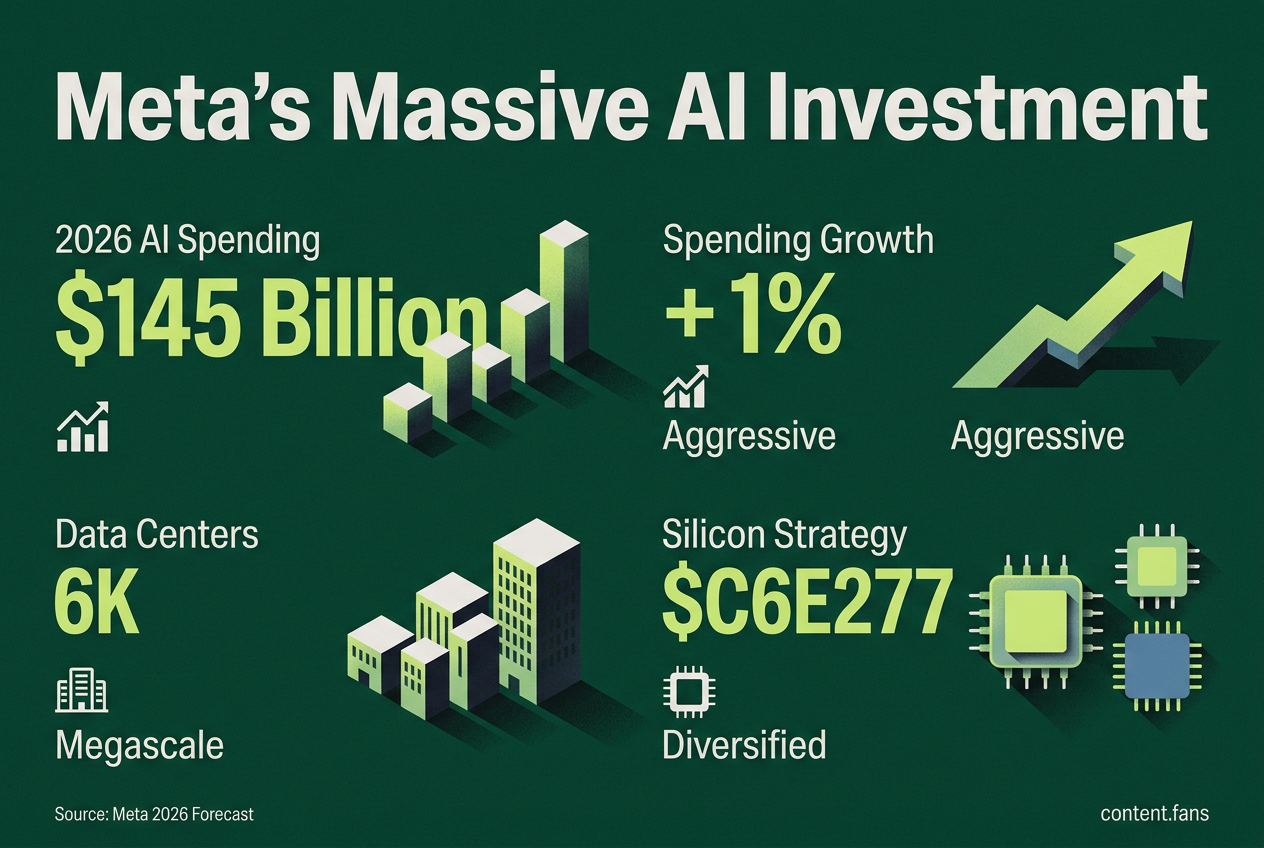
Meta's massive 2026 AI infrastructure spending plan involves a decision to raise its capital expenditure forecast to $125 - $145 billion, representing one of the most aggressive build-outs in corporate history. This revised guidance pushes the upper bound higher than previous estimates and represents a significant increase from 2025 levels.
This spending surge reflects more than simple expansion - it signals a fundamental strategic bet on AI as Meta's core business engine. The investment encompasses massive data center projects, a diversified silicon strategy, and a long-term plan for vertical integration that sets it apart from competitors.
How does Meta's 2026 AI spending compare to other tech giants?
Meta's projected $125 - $145 billion AI spending for 2026 places it among the highest spenders among major tech companies. While the exact rankings vary, Meta's substantial year-over-year increase represents one of the most aggressive growth rates among its peers.
| Company | 2026 CapEx Guidance |
|---|---|
| Amazon | Significant investment |
| Alphabet/Google | Major spending planned |
| Meta | $125 - $145 billion |
| Microsoft | Substantial investment |
Collectively, these major technology companies are projected to spend hundreds of billions in 2026 - a significant increase from 2025 levels. Meta's substantial year-over-year spending increase represents one of the most aggressive growth rates among peers.
What specific infrastructure projects is Meta building?
Meta's capital is flowing into several megascale data center initiatives:
- Ohio facility: Large-scale capacity under development
- Louisiana project: Potentially scaling to multi-gigawatt capacity - one of the larger single-site data center developments
- Meta Compute: A new initiative targeting data centers with substantial power capacity planned for this decade
The company is also diversifying its silicon strategy through partnerships for AI chips and plans to advance its own AI chip development to increase computing capacity.
Why did Meta increase its spending forecast from the previous range?
The upward revision reflects several converging pressures:
- Higher component prices: GPU and specialized AI chip costs have risen significantly.
- Additional data center operating costs: This includes third-party cloud spending and facility expansion expenses.
- Future-year capacity investments: Meta is building infrastructure now to support anticipated AI demand in coming years.
Meta has indicated that expenses will grow significantly as new data centers come online and require staffing and power.
What supply chain impacts is Meta's spending creating?
Meta's investment is contributing to a structural reset in global technology supply chains with measurable effects:
| Component | Current Impact |
|---|---|
| AI chip lead times | Extended significantly |
| Semiconductor lead times | Lengthened considerably |
| High-Bandwidth Memory (HBM) | Consuming growing share of DRAM wafer capacity; shortages expected to continue |
| Advanced packaging | Has become a significant industry bottleneck |
The surge has contributed to rapid price inflation in memory and AI chips, now tracked as a concern by financial analysts.
What are the long-term implications of this spending commitment?
Meta has signaled this is not a one-year spike. The company has announced plans for substantial ongoing U.S. infrastructure investment - representing one of the largest capital commitments by a U.S. technology firm.
This spending trajectory suggests several strategic shifts:
- Vertical integration advantage: Owning rather than renting infrastructure aims to reduce long-term unit costs.
- Hybrid cloud evolution: Meta plans to potentially sell excess computing capacity to external clients, creating new revenue streams.
- Talent concentration: Higher operating expenses include substantial investment in AI research and engineering personnel.
However, investor reaction has been mixed - Meta's stock declined following the capex increase announcement, while some competitor shares rose on reported AI cloud growth, suggesting markets question the near-term return on Meta's infrastructure-heavy approach compared to competitors' more service-oriented models.