
FrugalGPT study cuts enterprise AI costs by 50-98%
Serge Bulaev
A 2026 FrugalGPT study suggests that routing AI queries from large models to smaller ones can cut enterprise computing costs by 50-98% while keeping similar accuracy. Experts recommend a step-by-step approach: first, analyze and tag costs by workflow, then try cheaper models for simpler tasks, use caching, and adjust infrastructure to save more. Some methods, like model tiering and right-sizing hardware, reportedly lead to major savings. Contract negotiation strategies may also bring 20-40% savings and offer more flexibility. Overall, combining these steps appears to let companies lower their AI costs by over 70% without losing quality.

With enterprise AI costs soaring, the FrugalGPT study demonstrates how to achieve substantial cost reductions in test environments without sacrificing quality, offering a playbook for CIOs beyond simple tweaks. The original FrugalGPT study (2023) demonstrated up to 98% cost savings in test environments using LLM cascades by routing AI queries from powerful frontier models to smaller, specialized engines, which can match GPT-4 accuracy for many tasks, as detailed in the Truefoundry guide. This article outlines a durable savings path, starting with a disciplined diagnostic of AI spending and strategic trials on lower-cost models.
Diagnose before you migrate
To reduce AI expenses, begin by implementing tagged telemetry to map costs to specific workflows, teams, and models. This diagnostic phase clarifies spending drivers and identifies high-volume, low-complexity tasks that can be shifted to cheaper models, cached, or batched, unlocking significant and immediate savings opportunities.
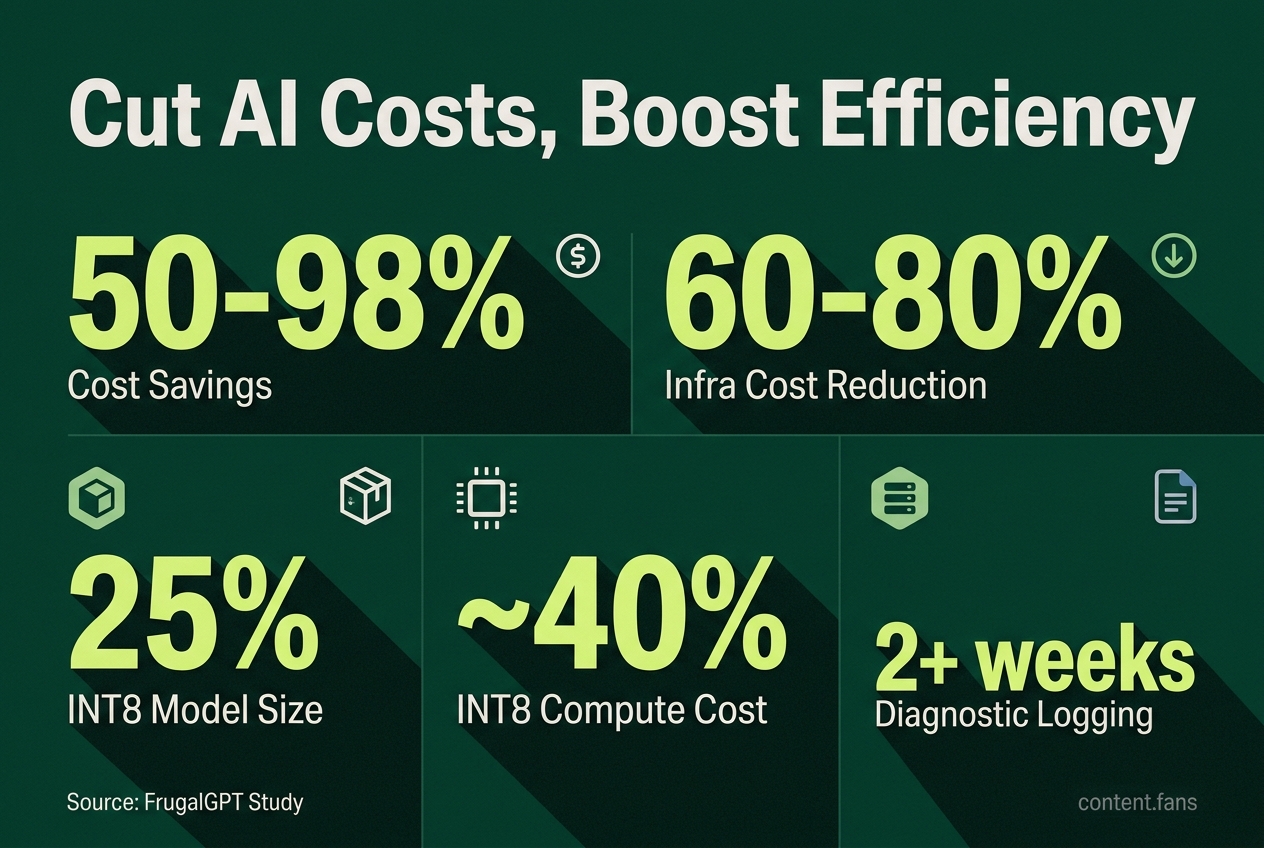
Tagged telemetry provides the foundational data for any cost optimization strategy. Experts advise breaking down AI invoices by workflow, team, and model to pinpoint exact cost drivers using tags like feature, environment, and owner. After establishing clear tagging, log at least two weeks of production prompts to classify them by complexity and identify inefficient patterns like agent retry loops. This method allows teams to find routines that can be served from cache or batched overnight. Key performance indicators to monitor include Cost per Resolved Ticket and Spend by Model-Route.
How to cut enterprise AI bills: a practical migration and cost-reduction playbook
- Model Tiering and Routing: Divert high-volume, low-complexity calls to fine-tuned, smaller models. Reserve expensive frontier model capacity for complex reasoning tasks. The FrugalGPT pattern demonstrated up to 98% savings in test environments.
- Prompt and Semantic Caching: Cache deterministic or semantically similar outputs to reduce redundant API calls. Studies show this technique can significantly reduce API volume when combined with intelligent routing.
- GPU and Infrastructure Right-Sizing: Optimize hardware usage by moving batch jobs to cheaper spot instances and quantizing FP16 models to INT8. Organizations implementing systematic inference optimization (quantization, pruning, hardware acceleration) typically report 60-80% reductions in infrastructure costs. INT8 quantization reduces model size to approximately 25% of the FP32 original (75% reduction) and can reduce computational costs by ~40%.
- Evaluate Lower-Cost Models: Benchmark emerging, cost-effective models. For example, a recent MindStudio benchmark found emerging models can offer substantial cost advantages while showing only minor performance drops on key coding and retrieval tests.
- Implement Guardrails: Enforce cost controls with real-time spending limits, circuit breakers to halt runaway agent loops, and automated alerts tied to budget thresholds.
Negotiate smarter contracts
Strategic contract negotiation can yield substantial savings. Procurement teams can unlock significant discounts by bundling AI spend into existing hyperscaler commitments, as noted in a TechTarget briefing. Key negotiation points include:
- Data Rights: Secure explicit carve-outs preventing vendors from training on your data and confirm your full ownership of all generated output.
- Pricing and Flexibility: Negotiate short, one-year commitments with price reopeners tied to list-rate drops, tiered discounts for usage growth, and model substitution rights to ensure new releases inherit legacy pricing.
- Performance SLAs: Mandate service-level agreements that cover latency, uptime, and require deprecation notice periods of at least six months to ensure operational stability.
By systematically combining disciplined measurement, tiered model architectures, aggressive caching, infrastructure tuning, and strategic contract leverage, enterprises can reduce operational AI spend by over 70% while fully preserving the quality and performance end users expect.
How does FrugalGPT achieve significant cost savings?
Stanford's FrugalGPT study showed that model routing - sending simple tasks to small, fine-tuned models and reserving frontier models for complex reasoning - can cut enterprise AI spend substantially while maintaining or improving accuracy. Caching can save 50-90% on input tokens, and batch APIs can guarantee ~50% savings by avoiding repeat API calls and amortizing overhead.
Which low-cost model should we test first?
Start with emerging cost-effective models: according to industry reports, many newer models cost significantly less per token than established options like Claude Opus while showing competitive performance on long-context retrieval and coding benchmarks. For high-volume agentic pipelines, this can translate to substantial daily cost savings.
What is the fastest way to benchmark our current AI spend?
Tag every API call by workflow, team, model, and environment for two weeks, then classify workloads into routine/high-volume vs complex/low-volume. Enterprise request analysis typically shows 50-70% of traffic can be handled by the cheapest model tier without quality loss.
How do we negotiate vendor terms without lock-in?
Bundle new AI spend into existing cloud commitments instead of parallel contracts, negotiate one-year deals with price reopeners, and secure model-substitution rights so newer models inherit old pricing. Model routing routinely unlocks 40-70% savings in production, with research benchmarks reaching up to 98% and keeps the option to switch providers.
What compliance steps are required before migrating models?
Include training carve-outs (no vendor training on your data), output IP ownership, and EU-resident processing clauses if the EU AI Act applies. Add 6-12 month deprecation notice and data-portability terms so fine-tuned models and embeddings can be exported if you exit.