
US bans AI chip sales to Chinese firms' offshore subsidiaries
Serge Bulaev
In June 2026, the U.S. clarified that its export controls on advanced AI chips also apply to overseas subsidiaries of Chinese companies, not just those based in China. This move appears to close a loophole that let Chinese firms buy restricted chips through places like Singapore, where many subsidiaries are registered. However, experts suggest that Chinese firms might still access U.S. technology by renting remote computing power in other countries, a gap that may not be fully closed yet. The situation may keep changing as new rules or enforcement methods are discussed.
The U.S. government has confirmed its ban on AI chip sales applies to offshore subsidiaries of Chinese companies, a significant policy clarification aimed at closing a critical export loophole. The move addresses concerns that Chinese tech giants were circumventing restrictions by procuring advanced hardware through international business units.
Understanding the "Ultimate Parent" Rule Clarification
The U.S. Bureau of Industry and Security (BIS) stated its export controls apply to any company whose ultimate parent is in China. This "ultimate-parent-company test," part of existing regulations, means offshore subsidiaries now face the same licensing hurdles as their parent corporations when buying advanced AI chips.
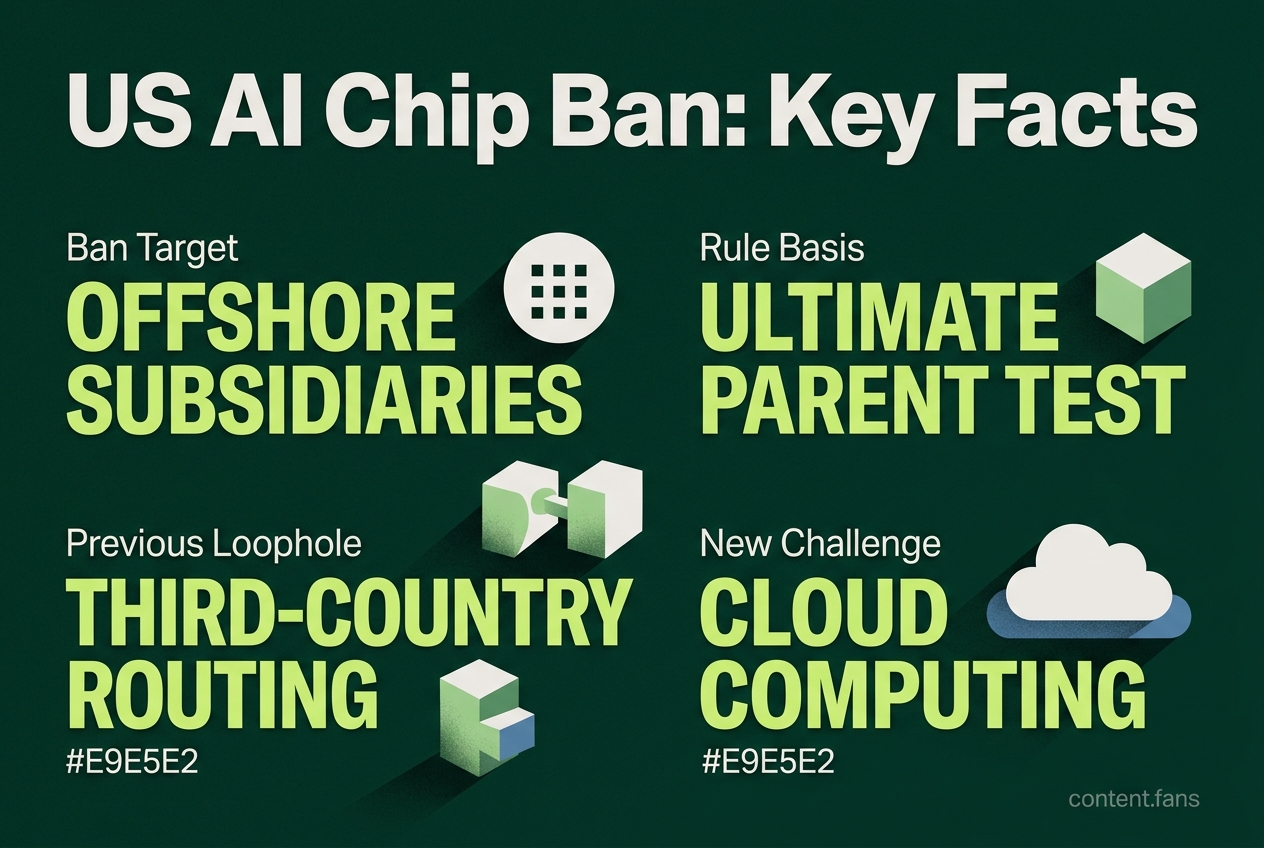
This directive is not a new rule but an enforcement of the "ultimate-parent-company test" from existing Export Administration Regulations. According to guidance from BIS, any entity controlled by a parent in China or Macau requires a license to buy restricted technology like advanced AI chips. This closes a route previously used to acquire chips via third countries. Analysts suggest this signals a shift toward scrutinizing complex ownership structures over simple corporate addresses.
How Third-Country Routing Worked
Singapore and other jurisdictions have emerged as key hubs for routing restricted AI chips to China. The city-state was an ideal conduit due to:
- Favorable trade relations with the U.S. combined with limited checks on re-exports.
- A highly efficient logistics network capable of reshipping valuable semiconductors rapidly.
- Corporate laws that facilitate the registration of foreign-owned subsidiaries.
The Next Challenge: The Cloud Computing Loophole
While the ban now covers physical hardware shipments, experts warn that a significant "cloud loophole" persists. Chinese AI firms can still legally rent AI computing power from data centers in third countries, gaining access to restricted chips without physically importing them. U.S. Commerce Department officials are considering extending licensing rules to cover these virtual exports, but no definitive regulation has been announced. Compliance experts advise U.S. cloud providers and software vendors to apply the same diligence to service contracts as they do to hardware, as future enforcement may target access to frontier AI models.
Key Compliance and Enforcement Hurdles
The guidance leaves several critical challenges for both regulators and the tech industry:
- International Cooperation: Effective enforcement will depend on whether customs agencies in third countries will share real-time shipment data with BIS to prevent diversion.
- Monitoring Remote Access: Regulators face the technical and privacy challenge of monitoring remote compute leases without violating customer confidentiality.
- Corporate Compliance: Multinational cloud providers must now update their service contracts and client vetting processes to align with the "ultimate-parent" rule.
These unresolved issues mean that the landscape for AI technology exports remains complex and subject to further change.
Frequently Asked Questions About US AI Chip Export Rules
What exactly is the rule on AI chips to Chinese-owned subsidiaries outside China?
The Bureau of Industry and Security has clarified that any subsidiary, wherever located, must obtain a US export licence if its ultimate parent is headquartered in China, Macau or other restricted countries. The rule targets advanced AI semiconductors, closing a loophole that let Chinese firms order through overseas offices.
How significant was the loophole before it was closed?
Industry analysts indicate that significant quantities of restricted GPUs reached China via third-country subsidiaries. Singapore was a preferred hub because local incorporation allowed for legally separate purchasing entities even though the parent companies were on restricted lists.
Does the ban also cover remote access to AI chips in overseas data-centres?
Hardware shipments are now blocked, but a separate "cloud loophole" still exists. Chinese firms can technically lease AI compute capacity from foreign data-centres that already possess the chips; Washington is weighing licensing requirements for such service exports but has not yet issued binding controls.
What compliance steps should exporters take immediately?
- Run ultimate-parent-company checks on every buyer outside the US.
- Add contractual clauses prohibiting resale or remote access for Chinese-headquartered entities.
- File for a BIS export licence whenever the supply chain touches China-linked ownership; licences are reviewed under a presumption of denial for advanced AI chips.
Are AI model weights and software covered by the same rule?
The US has begun controlling AI model weights and AI software or models under export-control scrutiny, meaning companies must now treat frontier models as controlled technology under the Export Administration Regulations.