
Hershey invests $250M to accelerate supply chain automation by 2026
Serge Bulaev
Hershey plans to invest $250 million by 2026 to make its supply chain more automated and digitally connected. The company expects this may save about $300 million a year, with a large part coming from better supply chain productivity. Hershey's approach suggests other companies should first standardize processes, then connect real-time data, and only later expand automation. The roadmap points to using key technology systems and careful pilot projects. Some surveys warn that digital projects might fail if workers lack the right skills, so training and upskilling appear important for success.

With its planned investment to accelerate supply chain automation, Hershey offers a powerful blueprint for other leaders. The company's Advancing Agility and Automation Initiative, led by incoming Chief Supply Chain Officer Mitchell Arends, provides a clear playbook for driving digital integration and enterprise-wide efficiencies (Supply Chain Dive). This analysis distills Hershey's public signals into an actionable roadmap for manufacturers aiming to scale digital operations.
What Hershey's Strategy Signals
Hershey's initiative focuses on standardizing processes on a single ERP system before expanding automation. The company is prioritizing real-time data integration and connecting its planning and execution systems to drive significant expected annual savings, with substantial portions coming from supply chain productivity improvements.
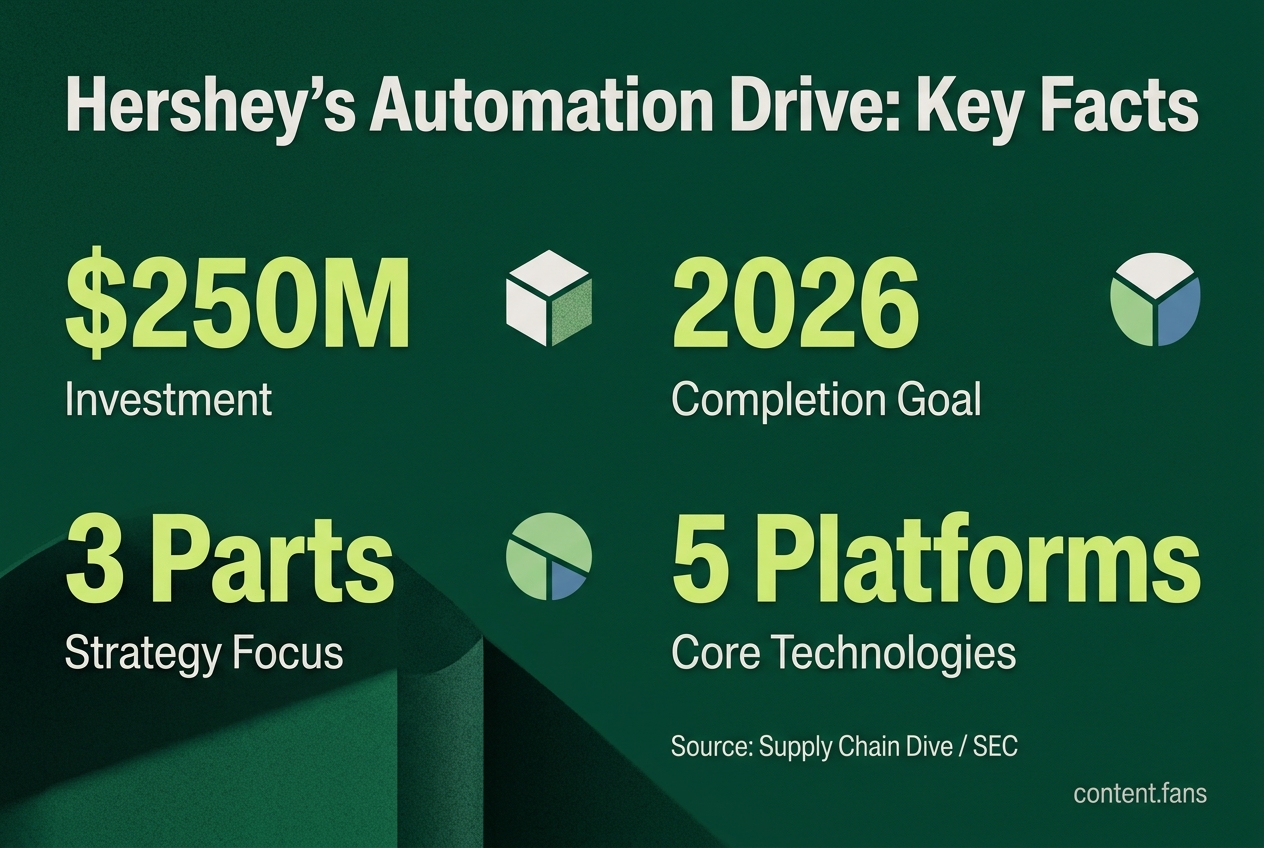
The program, slated for completion by 2026, is projected to generate considerable annual savings, with supply chain productivity gains accounting for a significant portion of that total. Hershey has already made substantial progress standardizing its global transactions on a single ERP platform, establishing a foundation for advanced automation. An SEC press release confirms that leadership will focus on integrated planning and network optimization, suggesting a three-part strategy: finalize ERP integration, embed real-time visibility, and link planning with execution.
Core Technologies for a Digital Roadmap
A review of best practices in the food and beverage industry highlights five foundational platforms:
- Manufacturing Execution System (MES)
- Advanced Planning and Scheduling (APS) or Integrated Business Planning (IBP) engine
- Warehouse Management System (WMS) and Transportation Management System (TMS)
- Industrial IoT (IIoT) sensors with edge processing
- Robotic Process Automation (RPA) for back-office exceptions
Industry experts favor a horizontal, API-driven architecture that integrates these systems. This approach enhances cost and quality tracking, while edge computing ensures operational continuity during cloud disruptions. Key systems like MES are vital for traceability, and real-time WMS inventory data enables dynamic rescheduling by the APS.
Sequencing Pilots for Scalable Success
To de-risk implementation and manage change fatigue, leading manufacturers follow a phased pilot sequence:
- Map the value stream and define a canonical data model for items, lots, and resources.
- Deploy MES in one high-volume plant, integrate with the existing ERP, and validate genealogy reporting.
- Add IoT devices for temperature, vibration, and yield; buffer data locally to protect uptime.
- Connect WMS so finished-goods records flow automatically to the warehouse.
- Layer RPA bots only where APIs are unavailable, such as for supplier portal updates.
Limiting initiatives to five or fewer parallel pilots is a proven strategy for managing change fatigue while delivering valuable cross-functional results.
Building the Talent to Power Automation
Technology investment must be paired with talent development to succeed. Workforce surveys repeatedly show that digital transformation stalls when employee skills lag behind technology. With many firms reporting challenges in AI scaling, proactive talent strategies are critical. Best practices include creating role-specific upskilling programs, using KPIs that reward technology adoption, and empowering cross-functional teams to ensure data integrity.
This three-pronged approach - standardize, integrate, then automate - reflects the strategic discipline Hershey has outlined. It ensures that people, data, and governance mature in lockstep, creating a sustainable foundation for a fully digital supply chain.
What is Hershey's automation initiative about?
Hershey's Advancing Agility and Automation Initiative (AAA) runs through 2026 and targets end-to-end digitization of procurement, manufacturing, and planning. The firm expects substantial annual savings once the program is complete, with significant portions of those savings coming directly from supply-chain productivity gains.
Which technologies are on the roadmap?
Public statements point to five priority layers:
- ERP standardization already covers a significant portion of global transactions
- MES for shop-floor execution and quality/traceability compliance
- APS/IBP for finite-capacity planning using real-time production data
- WMS/TMS with open APIs to keep inventory and movement events synchronized
- IoT + edge computing for machine-level data capture without cloud dependency
RPA is being layered last, automating exception-handling where APIs do not exist.
How will the new CSCO drive digital integration?
Incoming Chief Supply Chain Officer Mitchell Arends has an explicit mandate to accelerate digital integration, automation, and insights-driven planning across Hershey's network. Outgoing CSCO Jason Reiman will step down as CSCO on June 22, 2026, remain as SVP, Supply Chain Modernization during the transition, and intends to retire in Q2 2027; Hershey says he will partner on supply chain modernization through the first quarter of 2027.
What best-practice architecture should food manufacturers copy?
A horizontal, event-driven integration model outperforms vertical silos:
1. Connect IoT/edge to MES for condition data
2. Let MES publish production events to APS and WMS
3. Allow APS to return optimized schedules back to MES
4. Keep WMS inventory events available to all systems via APIs
5. Drop RPA on top only for exception or document-heavy workflows
Edge buffering is recommended so temporary cloud outages do not stop production lines.
Why is talent development mentioned in the same breath as technology?
Hershey paired its technology briefing with a talent-capability warning because many organizations cite digital skills shortages as a primary barrier to scaling automation. The firm is building cross-functional squads, continuous upskilling paths, and role redesign so humans can operate, exception-manage, and improve the new automated workflows.