
Google's Gemini hints at "Omni" multimodal AI for Webflow sites
Serge Bulaev
A leak from Google's Gemini interface mentioning "Powered by Omni" hints at a possible future, unified multimodal AI model, but Google still officially uses the name Gemini and has not confirmed any new product or release date. Industry observers suggest "Omni" may just be an internal label or tier, and third-party information about future launches remains unverified. The current Gemini model is already multimodal, able to handle text, images, code, audio, and video, and this may impact how B2B SaaS Webflow sites prepare content. Marketers are advised to focus on adding machine-readable images, video, and descriptive text to their sites, as multimodal answers may soon become the default in search results. There is no need to rebrand or use the "Omni" term until Google officially updates its documentation.

A leak from Google's Gemini interface mentioning "Powered by Omni" has sparked speculation about the future of multimodal AI for Webflow sites, even as Google maintains its official branding. While "Omni" remains an unverified codename, the underlying technology is already here. The current Gemini model was built from the ground up to be multimodal, natively processing text, code, images, and video (Google Blog). For B2B SaaS marketers, this signals an urgent need to adapt content strategies for an AI-driven search landscape.
Why Multimodal AI is Critical for Webflow SEO
Gemini's ability to interpret images, parse tables from screenshots, and even summarize long videos is transforming search (Google Developers Blog). When these capabilities power search results, a SaaS company's visibility will depend on providing machine-readable assets. While Webflow's CMS supports diverse media, many marketing teams must shift from treating images and videos as design elements to seeing them as critical, indexable data.
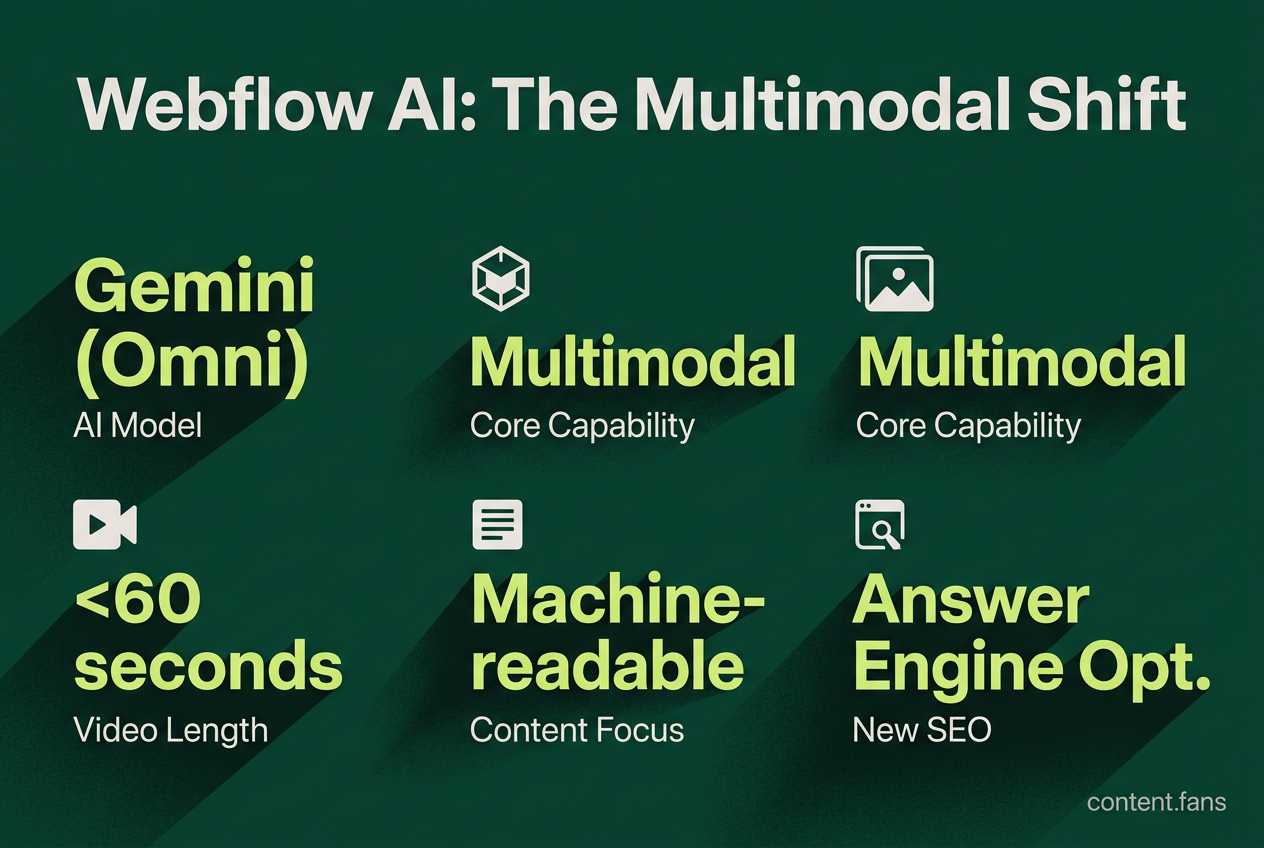
Multimodal AI can help create and understand richer content, but search ranking for Webflow SEO is not documented as directly based on integrated multimodal analysis in the provided original sources. To achieve high visibility, sites must offer machine-readable media with descriptive alt-text, video transcripts, and structured data, as these assets are essential for feeding AI-generated search answers.
Early Action Items for B2B SaaS Teams
- Enrich high-intent pages with at least one supporting image and one sub-60-second video demo.
- Embed transcripts with all videos to allow language models to index and quote the content.
- Structure content with semantic headings (H2-H4) to clearly label features, benefits, and pricing.
- Use descriptive file names and alt-text for all media, avoiding internal jargon.
- Prioritize and monitor page load speed, as Gemini's ranking signals are expected to penalize heavy media files.
The Shift from SEO to Answer Engine Optimization (AEO)
Traditional SEO is evolving. According to industry reports, it is being "supplemented by optimization for AI answer engines." For Webflow developers and marketers, this places new emphasis on schema markup, concise FAQ sections, and structured data tables. A pricing grid that an AI model can read and present verbatim will likely outperform a dense paragraph of text in attracting qualified clicks.
Optimizing Content Operations for a Multimodal Era
Gemini's cross-modal reasoning will enable more complex user queries, such as, "Show me an ROI chart and a customer testimonial for the same feature." Marketers can prepare by organizing assets within a single Webflow CMS collection. This allows for the dynamic assembly of persona-based landing pages, where scripts or AI agents can generate and deploy page variants for human review via API.
A Cautionary Note on Speculative Branding
Despite some publications using the term "Gemini Omni," Google's official documentation has centered on the Gemini family of models. Until Google formally updates its branding, teams should avoid using "Omni" in metadata, content, or marketing materials. Aligning with official public naming conventions is crucial for maintaining clear entity recognition by search engines.
In short, the speculation around "Omni" is less important than the reality of Gemini's current capabilities. The pressure is on for B2B SaaS companies using Webflow to enrich their digital presence with a full spectrum of machine-readable media. Those who act now to optimize their text, images, and videos will secure better visibility and relevance as multimodal results become the standard in search.
What does the leaked "Omni" reference actually mean for Google's Gemini ecosystem?
Recent interface strings hinting at "Powered by Omni" are widely considered to refer to an internal codename or a potential future model tier, not an officially announced product. Google's public documentation has centered on the Gemini family, and Gemini models are already fully multimodal.
How will true multimodal AI change the asset mix on a Webflow site?
Gemini (or a future "Omni" model) can generate text, diagrams, and short videos from a single prompt, collapsing traditional content workflows. For Webflow marketers, AI can take "primary responsibility" for multi-asset variation, enabling the rapid creation of persona-specific landing pages, localized explainer videos, and auto-generated infographics from product data, keeping the site visually fresh and frequently updated.
What new SEO or discovery tactics should Webflow teams prepare for?
As user discovery moves to AI-generated answers and social platforms, Webflow SEO must adapt. Key tactics include building modular content blocks for reuse across channels, adding schema-friendly FAQs for citability by large language models, and rendering key data as SVG diagrams whose underlying code can be read and indexed by AI.
Will generative AI dilute brand voice if we scale content across modalities?
The risk is manageable with a human-in-the-loop workflow. Best practices use AI for "variation and technical execution" while reserving "creative oversight and emotional intelligence" for in-house teams. In Webflow, brand guidelines like colors and fonts can be locked in a design system, ensuring AI-generated content remains on-brand.
How soon should Webflow teams pilot these capabilities?
You can begin immediately with Google's existing Gemini API. A practical pilot involves using the API to auto-generate a product tour script from a Webflow CMS page, embedding the resulting video, and measuring its impact on demo requests before expanding the strategy.