
Google integrates Gemini 3.5 Flash into Search, unveils XR glasses
Serge Bulaev
Google announced big changes to Search by adding Gemini 3.5 Flash, which may help it work better across devices like phones and new XR glasses. Search could move from a simple box to an always-on helper that uses text, images, and even other apps as input. Google says the XR glasses, expected in late 2026, might let users get answers about things they see without opening a browser. Early reports suggest smart glasses could grow, especially for businesses, but most people may wait for lower prices and more stylish designs. Experts suggest that to show up in search results, brands may need to use clear data, trustworthy labels, and content that is easy for AI to use.

Google's latest I/O announcements signal the most significant evolution of Search in 25 years, as the company integrates Gemini 3.5 Flash into Search and unveils new Android XR glasses. The platform is shifting from a simple query box to an always-on, agentic assistant that leverages multimodal inputs and ambient computing across all devices.
Search becomes agentic
Google is transforming its search engine into an "era of Search agents" by integrating advanced AI model capabilities. The company has upgraded its AI Mode with Gemini 3.5 Flash, establishing it as the default engine for its billion-plus monthly users. This allows users to create persistent "information agents" for tasks like tracking prices or research. The new intelligent Search box now supports multimodal inputs, including text, images, files, and even other Chrome tabs, representing the platform's biggest revamp since 1998.
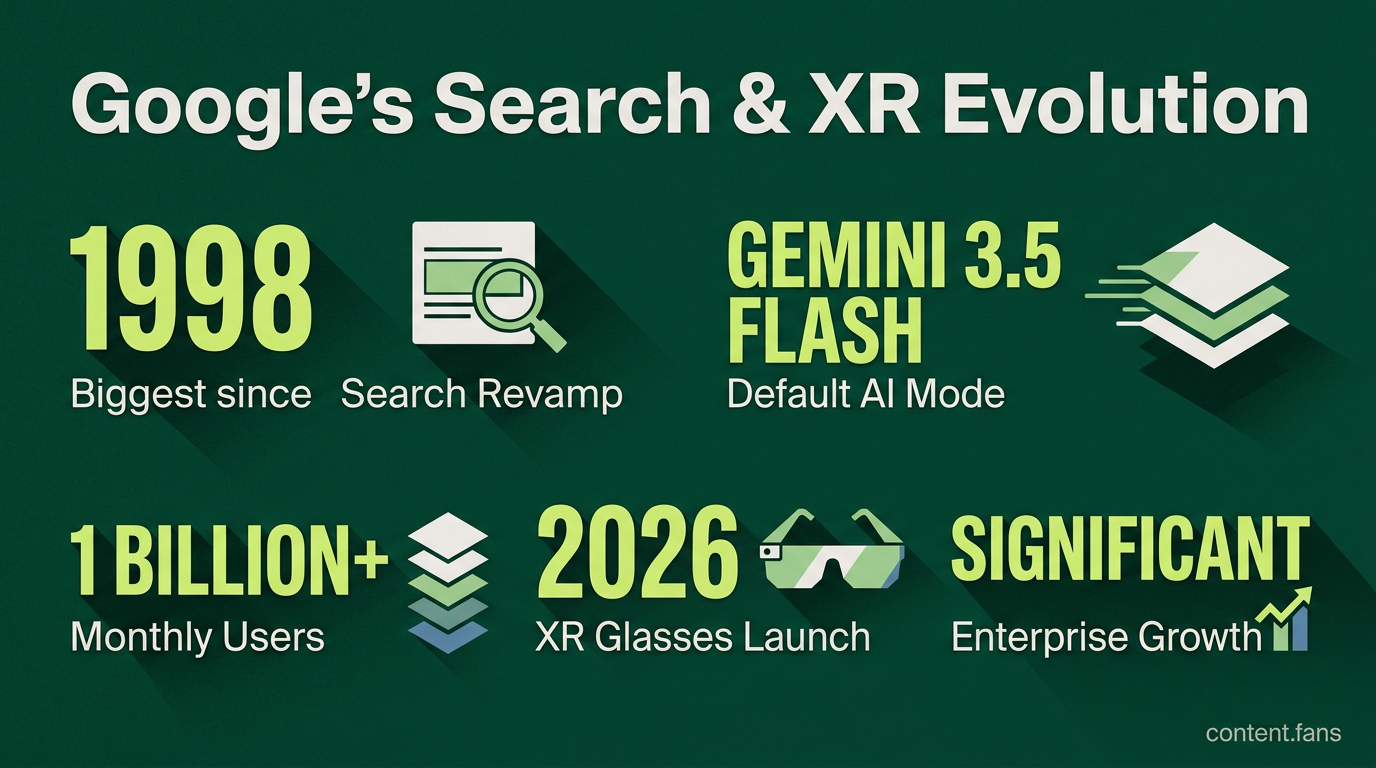
Google has fundamentally upgraded its search engine by making Gemini 3.5 Flash the new default model within AI Mode. This change introduces "information agents" that can perform ongoing tasks and enables a multimodal search experience that accepts text, image, file, and video inputs for more contextual results.
Glasses and XR feed ambient search
This strategic pivot extends to hardware with the planned 2026 launch of Android XR glasses, developed in partnership with Warby Parker and Gentle Monster. These devices embody Google's vision for ambient computing, allowing users to get contextual search answers about their environment without using a browser. Reinforcing this, the Chrome team is positioning the browser as a "proactive assistant" that embeds Gemini in Chrome.
Smart glasses turn Search into a glance-first experience. Early use cases Google highlighted include:
- Visual translation overlays
- Object identification prompts
- Scene-aware step-by-step guides
- Hands-free booking recommendations
Early market signals
While current adoption is modest, industry forecasts point to significant momentum for smart glasses. According to various industry reports, growth rates are expected to be substantial across different market segments. Regionally, North America has shown strong market presence, while the Asia Pacific market is expected to experience rapid growth.
In the near term, enterprise adoption is the primary driver. Industry analysts project that industrial smart-glasses revenue will experience significant growth over the coming years, fueled by applications in logistics and remote assistance. Broader consumer adoption will depend on lower prices and more stylish designs from fashion-focused partners.
What brands should watch
For brands, this shift to agentic search moves the goalposts for visibility. Discoverability no longer relies solely on traditional SEO but on providing clear entity signals, structured data, and multimodal assets that AI agents can easily parse and present. This strategy, sometimes called "Search Everywhere Optimization," requires creating content formatted for extraction - such as concise definitions, FAQs, and schema markup - to appear in AI-generated summaries.
The upcoming rollout of C2PA content credentials in Search and Chrome will introduce a critical layer of provenance. This suggests that authentic, clearly labeled media will be prioritized over unverified AI-generated content. For brands, embedding verifiable metadata into images and videos will become as crucial for SEO as alt text has been.
What exactly did Google integrate into Search at I/O 2026?
Google upgraded Search with Gemini 3.5 Flash as the new default model inside AI Mode and declared the change "the biggest upgrade in over 25 years." Users can now create information agents that run 24/7 in the background, turning Search into a proactive task layer rather than a simple Q-and-A box.
How do smart glasses link to this new Search experience?
Google introduced Android XR glasses (with partners Warby Parker and Gentle Monster) that act as a spatial, always-on front end for the same agentic, multimodal Search. Instead of opening a browser, wearers can point, ask, or glance at objects and receive instant answers fed by the same Gemini 3.5 stack.
Will web search as we know it disappear?
Google has been shifting Search toward more natural-language and multimodal experiences, with growing adoption of AI Mode features suggesting the classic page-of-links model is becoming one option among many, not necessarily the default.
What market signals show that XR glasses might actually reach the mainstream?
- Market size: Available sources show divergent forecasts: USD 1.22 billion in 2025 to USD 4.13 billion by 2030 (CAGR 29.4%), or USD 2.47 billion in 2025 to USD 10.25 billion by 2031 (CAGR 26.77%), indicating significant expected growth across the sector.
- Channel expansion: eyewear fashion houses (Warby Parker, Gentle Monster) are joining tech brands, lowering the style barrier.
- ROI in enterprise: industrial wearables are forecast to experience substantial growth, led by hands-free maintenance and training use cases.
How should brands prepare discoverability for this new interface?
Content strategy is merging with brand strategy. To remain visible inside AI summaries and XR overlays, brands need:
1. Entity clarity - consistent name, description, and product naming across every platform.
2. Structured, extractable answers - concise headings, bullet summaries, and rich schema markup.
3. Multimodal assets - each topic supported by matching images, short videos, and audio snippets the AI can cite.
4. Off-site reputation - mentions in reviews, podcasts, and industry sources now influence agentic results as much as backlinks once did.