
Google Deepens Workspace AI Integration, Raising Privacy Concerns
Serge Bulaev
Google is making its Gemini AI assistant a bigger part of Workspace apps like email and documents, which may raise new privacy and security concerns. Experts warn that if users have broad access, the AI might reveal sensitive information more easily, and AI-generated summaries could create records that are hard to delete. Most companies still use AI in limited ways and focus on security reviews before using it more widely. There may be skill gaps, as many workers know about AI tools but might not have formal training to use or check them. Early reports suggest that careful settings and strong permissions could help avoid privacy problems as AI gets used more often at work.

Google's deep AI integration into Workspace with its Gemini models is accelerating, moving large language model assistants from chat windows directly into core applications like email, documents, and shared drives. This fundamental shift requires security teams, product designers, and employees to re-evaluate how daily work is planned, governed, and executed.
How Does Gemini Integration Affect Data Privacy and Governance?
Integrating Gemini into Workspace presents significant privacy challenges. The primary risks involve the AI magnifying existing data-access issues by surfacing over-permissioned information more easily, and the creation of "shadow records" from AI summaries that complicate data retention and deletion schedules, posing compliance challenges.
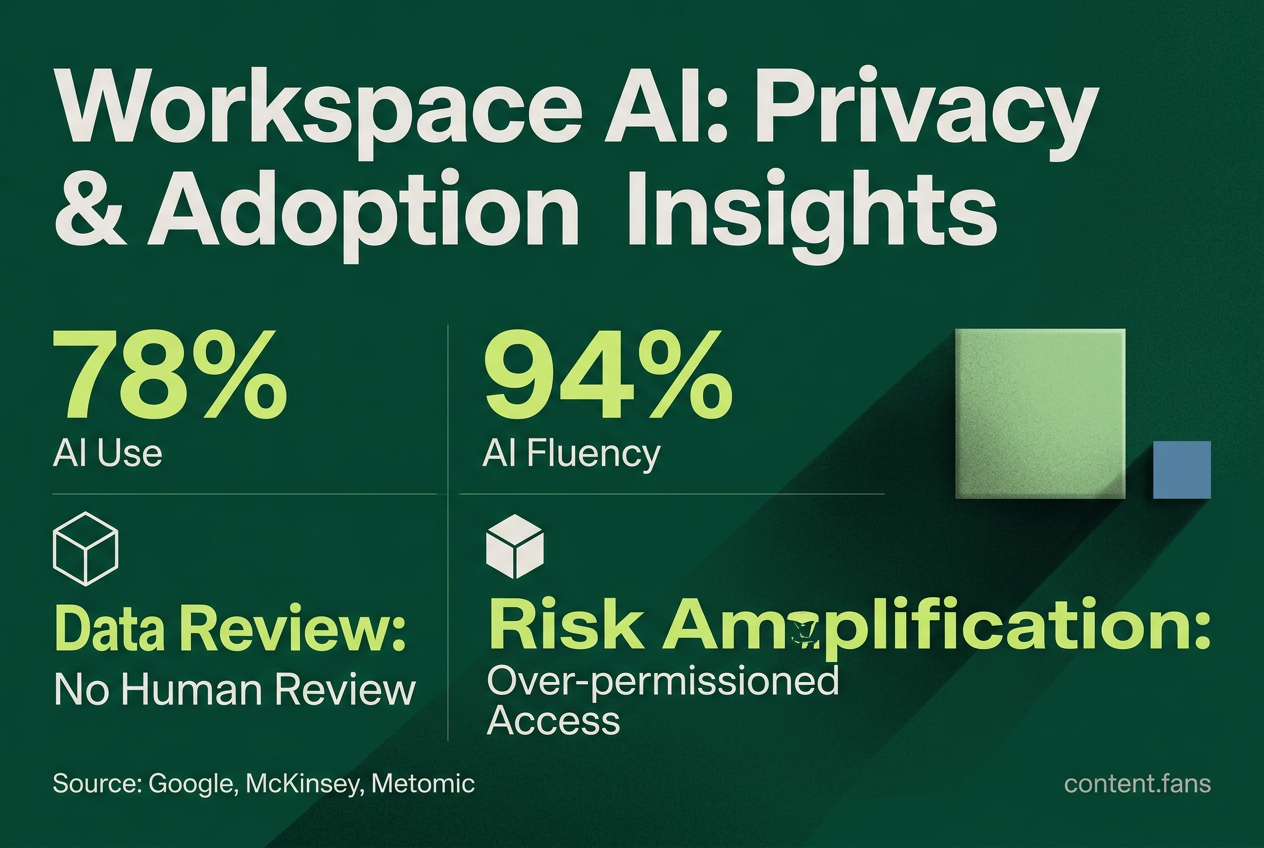
While Gemini can read and summarize any file a user can access, the main risk is pre-existing over-permissioned access, not the technology itself. If an employee has broad access to a shared drive, Gemini can rapidly surface sensitive data, amplifying existing security gaps. Google's policy states that customer data is not reviewed by humans or used outside your domain without permission (Google), but this does not mitigate internal exposure risks.
Furthermore, AI-generated summaries can create "shadow records," complicating data deletion and audits under regulations like GDPR or PIPEDA. Consequently, organizations must treat integrated assistants as part of their records, access-control, and compliance stack, which raises questions about retention and eDiscovery (Metomic). Regulatory guidance recommends a data-governance-first approach: classify information, disable non-essential logging, and regularly audit vendor settings to ensure accountability.
How Are Enterprises Adopting Generative AI Tools?
Enterprise adoption of AI is broad but often shallow. McKinsey's 2024 survey supports the 78% AI-use figure, but the workflow-redesign figure is not verified by the supplied original sources. This suggests most companies are in a "copilot" phase, using AI for task acceleration without changing underlying processes.
Security teams typically spearhead initial pilots, starting with low-risk content like internal FAQs before expanding access. Early adopters report that upfront governance reviews, while slowing initial deployment, prevent costly retrofits later when the assistant is used for official tasks like generating meeting notes or customer emails.
What New Skills Are Required for an AI-Powered Workforce?
As AI assistants become standard, AI fluency is an increasingly required competency. McKinsey's 2025 report says nearly all employees (94%) report having some level of familiarity with gen AI tools, but the original source shown here does not specifically say that many lack formal training to verify AI-generated content. Key upskilling areas include workflow design, prompt specification, and output evaluation.
A practical skill stack for knowledge workers now includes:
- Problem framing and task decomposition
- Prompt libraries that ensure repeatable results
- Tool integration across APIs and automation platforms
- Governance awareness around bias, privacy, and audit logs
- Continuous learning to keep pace with model updates
Studies show that productivity gains are largest when workers, especially those with less experience, master evaluation and feedback loops.
What Are the Design Imperatives for AI Product Teams?
For product teams building AI add-ons, context awareness and granular permission handling are more critical than flashy features. Best practices recommend identity-aware access control down to the row or cell level to prevent function overreach. Embedding robust audit hooks and allowing administrators to configure retention periods is key to meeting enterprise compliance demands.
This integration trend signals a long-term shift from tool-centric to process-centric software design. Ultimately, early case reviews suggest that privacy-aligned configuration determines whether an AI assistant becomes a welcomed productivity aid or triggers a costly data incident.