
Google Cloud's 2026 report spotlights 5 key AI agent trends
Serge Bulaev
Google Cloud's 2026 report suggests that AI agents may soon handle tasks without waiting for prompts and could run full workflows on their own.

As business leaders seek the next leap in productivity, new research from Google Cloud highlights five key AI agent trends set to reshape the enterprise by 2026. The AI Agent Trends 2026 report suggests a major shift is imminent, where AI agents will move beyond simple prompts to autonomously orchestrate entire workflows.
What are the 5 key AI agent trends for 2026?
Google Cloud's report outlines five core trends: embedding AI into daily work for all employees, prioritizing agentic workflows over models, delivering concierge-level customer experiences, shifting security from alerts to autonomous action, and a strategic focus on continuous workforce upskilling to manage these new systems.
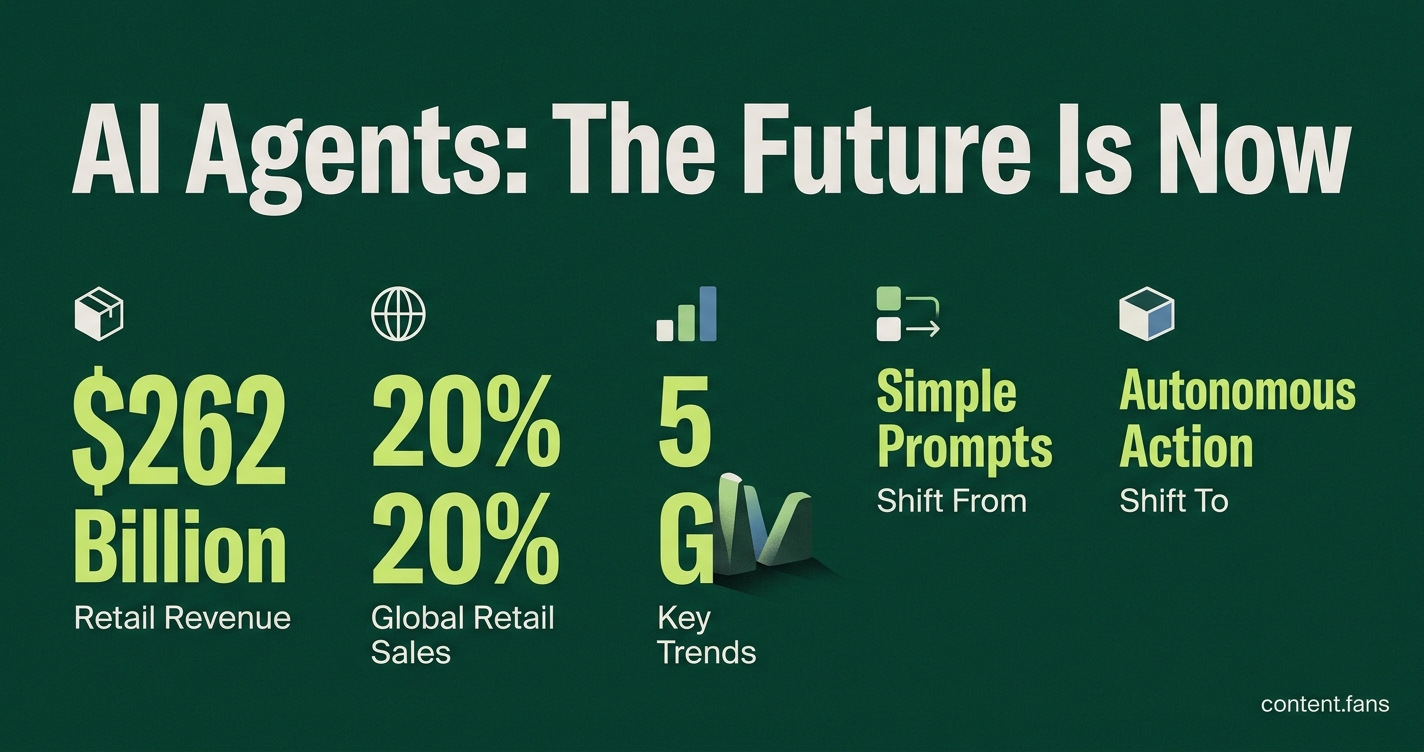
The report's central thesis is that "the era of simple prompts is over." This "agent leap" will see AI orchestrate complex, end-to-end processes with limited supervision. The five transformative shifts are:
- Productivity for Every Employee: AI agents will become integrated into daily work, moving beyond isolated tools to become continuous workflow assistants.
- Agentic Workflows Over Models: Competitive advantage will come from how organizations chain tasks and agents, not just from deploying powerful standalone models.
- Concierge-Style Customer Experiences: Hyper-personalized, proactive service will become the new baseline for all customer interactions.
- Security from Alerts to Action: Agents will supercharge security operations, enabling teams to move from passive monitoring to autonomous incident response.
- Continuous Workforce Upskilling: Companies will shift from one-off tutorials to recurring learning plans to build AI-ready teams capable of supervising agents.
How are AI agents impacting retail revenue?
The retail sector already shows concrete evidence of this transformation. According to Salesforce data, AI and digital agents drove 20% of global retail sales during the 2025 holiday season, generating $262 billion in revenue. This aligns with prior forecasts that AI recommendations would have a major impact.
Customer habits are changing rapidly, with many shoppers increasingly using retailer chat agents during peak shopping periods. Merchants that embedded their own agents saw stronger year-over-year growth compared to their peers.
What does an "agent-ready" infrastructure require?
To capitalize on this shift, organizations must prepare their technical infrastructure for what Talon.One calls "agentic commerce." This concept describes a future where AI agents handle the entire shopping journey from discovery to checkout.
To become agent-ready, merchants are advised to audit three key areas:
- API accessibility and response times
- Schema consistency across all systems
- Incentive fragmentation in loyalty and promotion programs
If offers and loyalty rules are not structured in a machine-readable format, agents cannot discover and apply them. To address this, standards like the Unified Incentives Protocol are emerging to standardize data for AI-driven commerce.
How are workforce skills and expectations evolving?
Enterprise priorities are aligning with these technical trends. The 2026 State of AI Agents Report from Anthropic shows that 81% of organizations plan to move beyond simple task automation in 2026. The biggest impacts are expected in software development (57%) and customer service (55%).
This move toward complexity underscores Google's emphasis on continuous training. The skills gap is structural, requiring recurring curricula so staff can learn to supervise multiple agents and validate their outcomes, rather than performing tasks manually.
What should executives prioritize for AI adoption?
The research positions 2026 as the year AI agents fundamentally reshape business. For executive planning, three core principles emerge:
- Prioritize Workflow Design: Competitive advantage lies in orchestration - how agents connect across business processes - not merely in the power of individual models.
- Evolve Governance Frameworks: As agents move from "alerts to action," human oversight must shift from direct execution to coordination and exception handling.
- Ensure Infrastructure Readiness: The speed of value creation depends on having prepared data and process architecture, from machine-readable incentives in retail to consistent APIs in enterprise systems.
The underlying shift is operational. The future workforce will increasingly supervise and coordinate autonomous agents rather than perform every task by hand.