
Bain 2026 report: AI raises code reviews 91%, shifts dev bottleneck
Serge Bulaev
The Bain 2026 report suggests that AI tools have made writing code much faster, but this speed may have moved the biggest challenge to code review and team collaboration. Code review time appears to have increased by 91 percent, showing that the main bottleneck is now making sure everyone understands and agrees on the design, not just writing code. New practices such as early design documentation, smaller code changes, and more automated checks may help teams keep up with the faster pace. The report also indicates that strong collaboration and clear communication are now more important than ever for building high-quality software.

The Bain 2026 report on AI's impact reveals that while code generation is faster, the true bottleneck has shifted to collaboration and design, with AI raising code review times by 91%. As large language models (LLMs) accelerate drafting, this analysis explains why software development's success now hinges on shared understanding and efficient feedback cycles, where coding is merely a byproduct of a collaborative design process.
"Programming is not typing" and why the bottleneck shifted
Martin Fowler's observation that "programming is not typing" has never been more relevant. The shift away from pure code generation is starkly illustrated by Bain's 2026 Global Technology Report, which found that while LLMs helped developers complete 21% more tasks, the time spent on code review soared by 91%. This is because raw code is no longer the scarce resource; validated human intent is. This trend is confirmed at scale by Google, where a significant portion of new code is reportedly AI-assisted, shifting the engineering focus from generation to quality assurance.
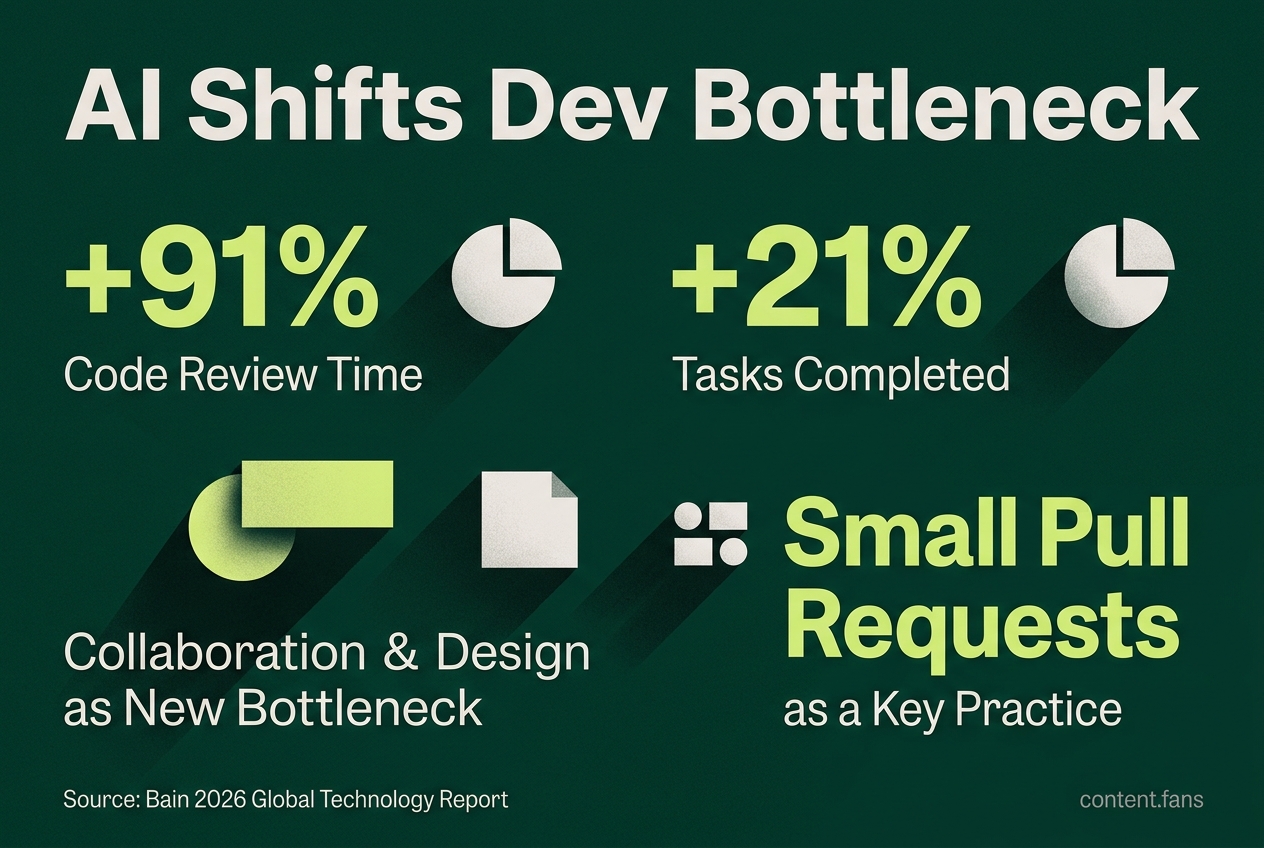
The software development bottleneck shifted because AI tools dramatically increased the volume of generated code, outpacing teams' ability to review it. While developers write code faster, ensuring its quality, security, and alignment with project goals requires significant human oversight, making collaborative review and validation the new chokepoint.
New practices for faster feedback
- Document Design Intent Upfront: Use lightweight Architecture Decision Records (ADRs) and clear acceptance criteria to provide essential context for AI tools and reduce cognitive debt.
- Create Small, Focused Pull Requests: Multiple studies confirm that smaller diffs are reviewed faster and more thoroughly, leading to better defect detection.
- Automate Pre-Review Checks: Implement static analysis and automated testing to run before human review, filtering out basic errors and handling the increased volume of AI-generated code.
- Adopt AI-Assisted Pair Programming: Rotate the "navigator" role, where the human acts as a planner and critic for the AI "driver." This approach, advocated by Stack Overflow, preserves mentorship and knowledge transfer.
- Measure and Optimize Review Cycles: Track key metrics like review turnaround time and defect escape rates. Data shows that teams who measure and tune their process can significantly cut down review cycle times.
Pair programming, design reviews, and shared artifacts
AI acceleration redefines collaborative practices like pair programming and design reviews. With an AI handling the "driver" role of typing code, human developers can focus on higher-level strategy, discussing edge cases, architecture, and system boundaries. This focus on oversight shows promise; many repositories using AI-assisted review report faster merge times with fewer defects post-merge. Similarly, design reviews are evolving. Freed from managing implementation churn, senior engineers can dedicate more time to architectural integrity, dependency management, and long-term maintainability, acting as integrators who validate quality and security.
Investing in clarity across artifacts
In this new paradigm, artifacts like documentation, tests, and specifications become as critical as the code itself. By prioritizing human-centered design and treating documents as living context, teams ensure AI-generated output aligns with user needs and domain language from the start, minimizing rework. This shift elevates engineering skills rather than diminishing them. While developers still write critical code and manage complex integrations, their primary impact now comes from strategic thinking, defining clear system boundaries, and orchestrating effective feedback loops.
Ultimately, the data shows a clear trend: when code generation becomes a commodity, the quality of collaboration becomes the primary differentiator. The teams that build durable, high-quality systems will be those who master shared understanding and rapid feedback, not just those who generate code the fastest.