
How "AI Interviewer" Prompts Cut Errors, Improve Task Completion
Serge Bulaev
Interview-style prompts for AI systems start with a simple request and let the AI ask follow-up questions to gather all needed details. This method may cut errors by making the model clarify ambiguous points and check facts step by step. Some studies suggest that guided questioning improves both task completion and user confidence, though direct evidence is still limited. This approach works best for tasks where requirements are different each time, like legal advice or tax help. Early users say it keeps prompts short and focused, and may help the AI give more accurate answers.

The AI Interviewer prompt is a powerful technique where users provide a simple request and then empower the AI to ask clarifying questions until it has all the necessary details. Instead of drafting long, complex prompts, this conversational approach lets the model drive the information-gathering process. This method of "context engineering" aligns with expert guidance that stresses providing focused, relevant information while leaving as little as possible to interpretation prompt engineering techniques.
Why an Interview-Style Prompt May Cut Errors
This conversational method reduces errors by forcing the AI to resolve ambiguities and gather precise facts before generating a response. By breaking tasks into a sequence of questions and answers, the model can validate information at each stage, preventing the accumulation of mistakes found in complex, single-shot prompts.
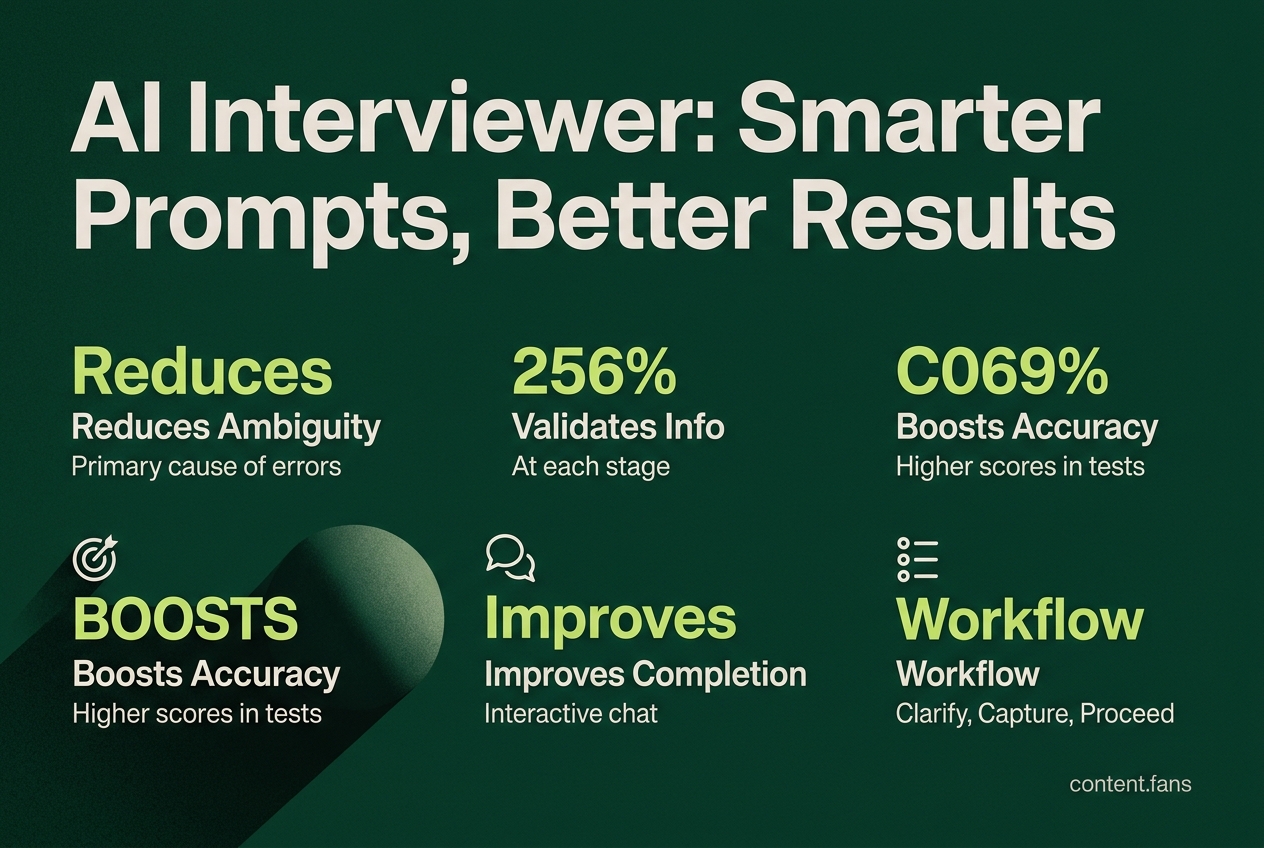
When the AI model leads the interrogation, each user response provides a precise, scoped piece of context. This directly counters ambiguity, which MIT Sloan EdTech identifies as a primary cause of model mistakes Effective Prompts for AI: The Essentials. Furthermore, this approach allows for chained verification; as Anthropic notes, breaking tasks into sequential steps helps validate outputs at each stage and reduces compounding errors best practices for prompt engineering.
While empirical evidence is still emerging, early results are promising. Developer studies suggest that interactive chat can improve the likelihood of task completion. Experiments focusing on writing assistance have shown participants using interactive prompt coaching achieve significantly higher scores than control groups. These findings indicate that guided questioning can boost both output accuracy and user confidence.
Practical Patterns Seen in the Field
This interview-first model is already proving its value in several industries. Customer support teams deploy conversational agents that use targeted questions to authenticate users and collect issue details before deciding whether to escalate to a human. This ensures tickets are routed correctly with just enough data, as described by CX Today.
Product researchers and tax professionals use a similar script. AI moderators conduct structured interviews to extract precise quotes and data points for analysis. Likewise, tax preparation bots can ask about filing status, income, and deductions before generating a draft return. In all cases, the workflow is the same: clarify, capture, and proceed.
A Lean Prompt Template
A concise and effective structure has emerged from practitioner guides:
- Task Request: Clearly state the final goal.
- Clarifying-Question Invitation: Explicitly ask the AI to ask questions (e.g., "Ask me anything you need first").
- Constraints & Format: Define any rules or the desired output structure.
The user answers each follow-up until the model confirms it has enough information. This iterative loop keeps the context window tight and highly relevant.
Where the Method Fits Best
Interview prompting excels in scenarios with high variability, such as generating legal summaries, resolving unique customer complaints, or preparing bespoke marketing copy. Tasks with fixed, repeatable requirements may benefit less, as structured examples already manage the variance.
For best results, experts recommend pairing the interview loop with other advanced techniques. Use few-shot examples when pattern recognition is important, and integrate retrieval-augmented generation (RAG) for tasks that depend on extensive external knowledge. These tactics keep the conversation focused while expanding the model's capabilities.
Early adopters describe the AI interviewer method as a transformative habit for engaging with large language models. By shifting the burden of context-gathering to the AI, users can create shorter prompts, reduce factual gaps, and produce outputs that are better aligned with real-world needs, all without drafting exhaustive checklists.