
Stack Overflow updates 'Stack Internal' for enterprise AI, launches Ingestion
Serge Bulaev
In 2026, Stack Overflow updated its Stack Internal platform to help companies use verified knowledge with AI tools. The new features may make it easier for admins to control access and for developers to connect with common knowledge sources. A new "Ingestion" tool, available for Enterprise users, appears to turn scattered documents into organized and trusted information inside company systems. These changes might reduce the risk of AI tools giving wrong answers by using only checked internal data. Future updates may focus on improving accuracy, security, and deeper connections with other AI agents.

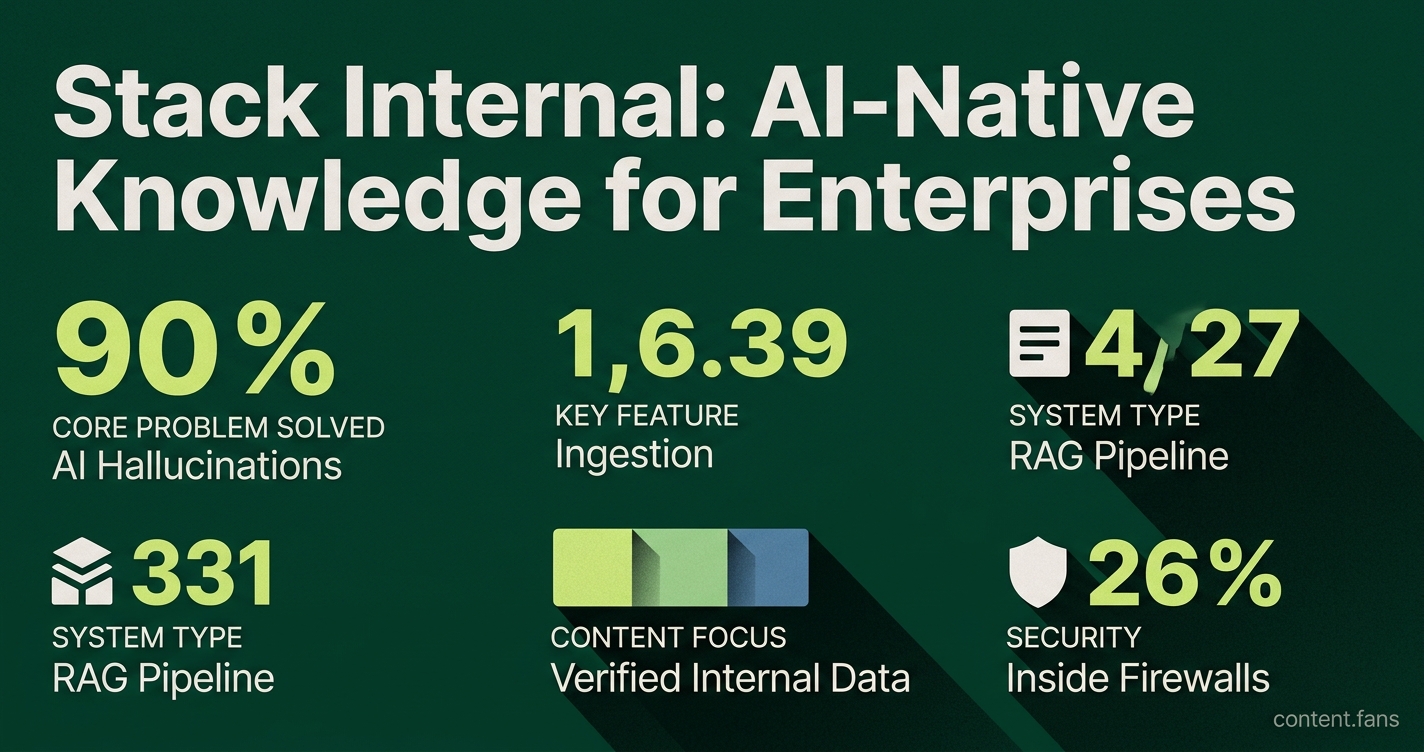
Stack Overflow has announced significant updates to Stack Internal, its enterprise knowledge platform designed to deliver verified internal content directly to AI tools and assistants. The enhancements center on a new AI-native platform experience and the launch of Ingestion, a premium feature that transforms scattered enterprise documents into structured, verified knowledge.
The core value proposition addresses a critical enterprise challenge: AI hallucinations caused by models relying on unverified external data. By creating a "trusted knowledge layer" that keeps proprietary information inside company firewalls, Stack Internal aims to ground AI responses in authoritative, curated content rather than speculative generation.
What is Stack Internal and how does it reduce AI hallucinations?
Stack Internal is an enterprise knowledge platform connecting AI tools to a company's verified, internal data. It serves as a trusted source within a Retrieval-Augmented Generation (RAG) system, forcing AI to base answers on approved documents, which significantly reduces the risk of generating inaccurate or "hallucinated" information.
It functions as a Retrieval-Augmented Generation (RAG) pipeline, where AI tools retrieve relevant passages from approved company documents before generating responses. The platform reduces hallucinations through several mechanisms:
- Curated knowledge bases - only vetted, company-specific content enters the system
- Access controls and governance - content is permissioned by user role and department
- Source citations - answers trace back to specific internal documents
- Abstention logic - the system can refuse to answer when evidence is insufficient
Research indicates that RAG systems built on verified internal sources can substantially reduce hallucination rates. Enterprise document intelligence systems have shown significant improvements in accuracy and search efficiency when using verified internal knowledge with citation tracking.
What is the new Ingestion feature and when was it released?
Ingestion is a premium add-on for Enterprise tiers designed to solve the "siloed content" problem facing large organizations by enabling them to automatically import, structure, and verify knowledge from disparate sources - turning scattered documents into AI-ready, searchable content.
The feature supports connectors to enterprise knowledge stores, allowing organizations to maintain their existing document repositories while making that content consumable by AI assistants, coding tools, and APIs. This addresses a common pain point where valuable institutional knowledge remains trapped in unstructured formats that AI cannot reliably access.
What changed in the platform update?
The platform update introduced a new platform experience described as an AI-native knowledge platform for enterprise decision-making. Key improvements include:
- Enhanced administrative security - stronger controls over who can access and modify knowledge
- Programmatic API control - deeper integration with developer workflows and external systems
- Developer portal integrations - smoother connections to existing enterprise tools
- Platform-wide accessibility improvements - broader usability across organizations
How does Stack Internal compare to other enterprise RAG solutions?
The enterprise RAG market has coalesced around several common patterns that Stack Internal exemplifies:
| Approach | Implementation |
|---|---|
| Verified internal sources | Curated, deduplicated, version-controlled content rather than broad indexing |
| Permission-aware retrieval | Access controls applied at the document chunk level |
| Citation requirements | Generated answers must reference source materials |
| Confidence-based routing | Low-confidence queries escalated to humans or refused |
| Continuous evaluation | Regular testing for faithfulness and answer relevancy |
Competing approaches include general-purpose RAG platforms, custom-built internal knowledge systems, and AI vendor native solutions. Stack Internal differentiates through its integration with Stack Overflow's existing developer community and specific focus on technical knowledge workflows.
Industry data suggests that many production RAG systems still fail on complex multi-hop queries, indicating that verified knowledge layers alone are not sufficient - retrieval design and evaluation frameworks remain critical.
What are the real-world benefits and risks of verified internal knowledge layers?
Benefits documented in case studies:
- Accuracy gains: Systems restricted to high-quality curated content show significant reductions in hallucination rates
- Metadata enrichment: RAG with structured metadata shows improved precision versus content-only approaches
- Security improvements: Chunk-level access control and identity integration prevent unauthorized information exposure
- Auditability: Source citations enable compliance review and incident investigation
Persistent challenges:
- Incomplete coverage: When internal knowledge bases lack relevant information, systems may still hallucinate unless designed to abstain
- Content staleness: Verified sources can still produce wrong answers if not kept current
- Implementation complexity: Multi-hop reasoning across documents remains difficult even with verified sources
- Cost and latency: Verification layers add processing overhead that enterprises often reserve for high-risk workflows
Successful implementations demonstrate the pattern of restricting AI support agents to "company-approved knowledge sources only" with regular authenticated content updates, eliminating web speculation entirely while maintaining accuracy and brand consistency.
What is the free Starter workspace and who can access it?
Stack Overflow introduced a free Starter workspace allowing individuals and small teams to create and share knowledge without enterprise licensing. This entry point includes basic ingestion capabilities and has been adopted by a growing number of organizations as part of Stack Overflow's broader enterprise ecosystem.
The Starter tier provides a pathway for organizations to evaluate verified internal knowledge approaches before scaling to premium Enterprise features with advanced governance, security controls, and expanded API access.