
Dell Expands AI Data Platform With Unified Semantic Layer, Knowledge Agents
Serge Bulaev
Dell has updated its AI Data Platform, adding a Unified Semantic Layer, an Enterprise Knowledge Graph, and Knowledge Agents. These features may help AI systems understand and use business data consistently, without copying or moving it. Dell says the semantic layer gives AI agents the meaning behind data, and the knowledge graph appears to map relationships between people, systems, and documents. The platform keeps data in place and integrates with open-source tools, which analysts say might reduce lock-in. Independent benchmarks have not been released, so it is not yet clear how well these new features will perform as data grows.
Dell Technologies has enhanced its AI Data Platform with a Unified Semantic Layer, Enterprise Knowledge Graph, and Knowledge Agents. These updates move the platform beyond high-performance storage, offering context-oriented tools to help enterprise AI agents understand, reason, and act on corporate data without moving or copying it.
Unified Semantic Layer: Providing Business Context
The new Unified Semantic Layer provides consistent business definitions across all data sources, from structured to unstructured. Dell states the layer gives AI agents critical "business meaning behind enterprise data," addressing a common gap in projects that rely solely on vector search. By drawing metadata from existing catalogs at query time, it ensures definitions remain synchronized across disparate data stores.
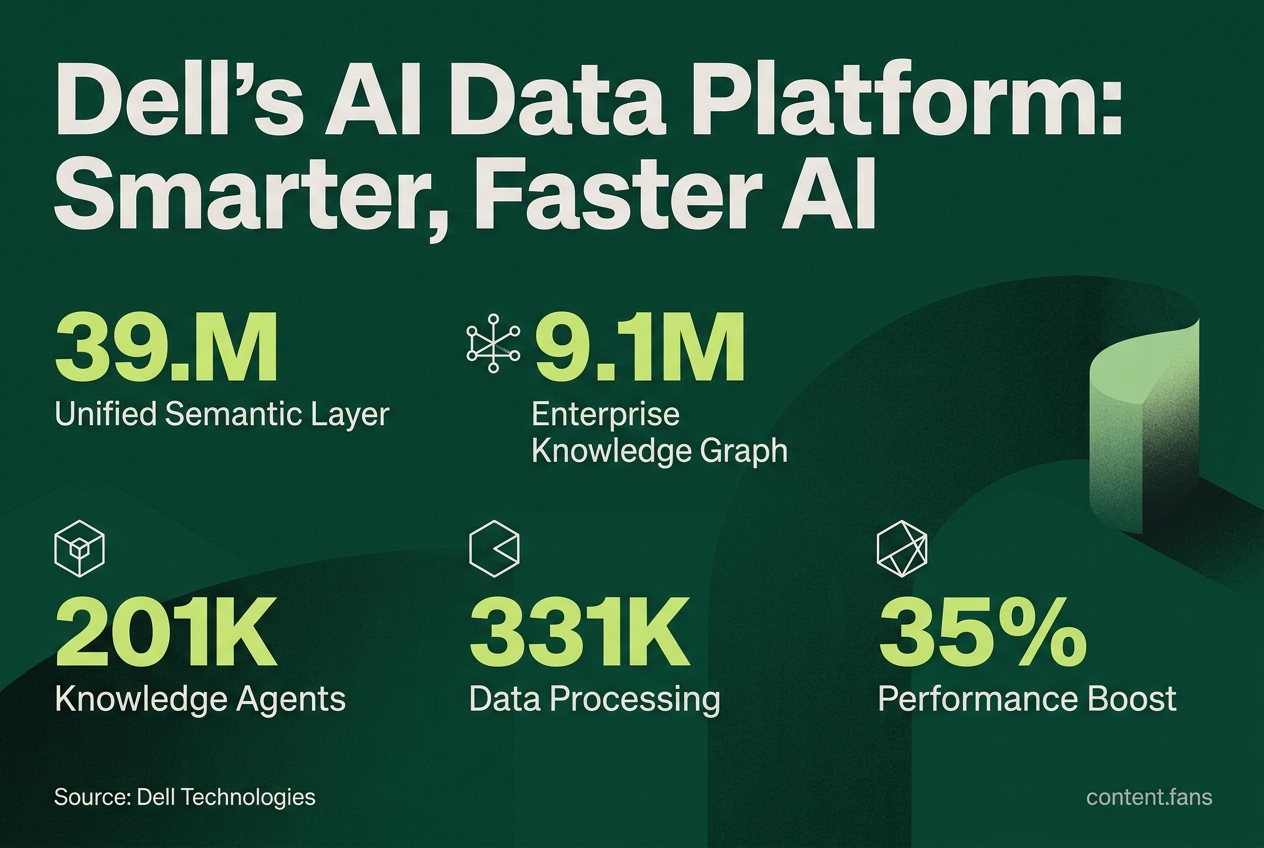
Dell's AI Data Platform update introduces a Unified Semantic Layer for consistent data definitions, an Enterprise Knowledge Graph to map data relationships, and Knowledge Agents for governed AI actions. The platform allows AI to query and process data in place, enhancing security and reducing data duplication.
Enterprise Knowledge Graph: Mapping Relationships Across the Estate
The platform's Enterprise Knowledge Graph connects people, processes, documents, and systems. Dell explains this allows agents to traverse complex relationships invisible in standard file layouts, such as tracing a purchase order from contract to shipment. Since the graph is generated from live metadata, it updates automatically as new data arrives.
Knowledge Agents, Performance, and Governance
The platform's Knowledge Agents operate within a framework that emphasizes governance and performance. Data processing is handled by Dell PowerScale and ObjectScale engines, which integrate NVIDIA acceleration for Spark and vector search to feed GPUs at high speeds. Key governance features include RBAC, encryption, and immutable snapshots for on-prem and cloud deployments. By querying data in place, Dell's architecture reduces duplication and streamlines data pipelines. The use of open components like Trino, Spark, and Delta Lake also signals a lower risk of vendor lock-in compared to fully proprietary stacks.
Market Context and Early Reception
Industry analysis suggests this update aligns with a market shift toward control-plane architectures that prioritize semantics and policy. Dell's focus on a semantic layer and knowledge graph differentiates it from lakehouse-centric competitors like Databricks and Snowflake, positioning it for hybrid environments where data migration is impractical. While no independent benchmarks are available, Dell's reference architecture with NVIDIA claims to accelerate RAG workloads. The platform's performance at scale will be a key area for observation.
What is Dell's Unified Semantic Layer and why does it matter for AI agents?
Dell's Unified Semantic Layer is designed to give AI agents "the business meaning behind enterprise data" - a critical capability since agents need more than raw rows and documents to operate effectively. Without consistent enterprise context, AI systems risk returning conflicting answers or taking inconsistent actions when the same metric or policy is defined differently across systems. This layer addresses one of the most cited barriers to enterprise AI adoption: inconsistent data definitions and semantics, which many organizations identify as a leading cause of delayed deployments.
How does the Enterprise Knowledge Graph improve AI reasoning?
The Enterprise Knowledge Graph "connects related entities across an organization," enabling AI systems to traverse relationships across people, systems, documents, and business objects. This structural approach helps overcome the challenge of enterprise data being "distributed across systems, inconsistently governed, and poorly aligned for AI use." Rather than treating data as isolated documents, the graph models how business concepts actually relate - essential for multi-step agentic workflows.
What are Knowledge Agents and how do they differ from standard AI implementations?
Knowledge Agents represent Dell's shift from basic data plumbing to "trusted context for AI agents" - combining data access, governance, and reasoning in a single layer. Unlike isolated AI tools that operate on disconnected data sources, these agents work within a unified framework that preserves security controls, RBAC, IAM integrations, auditing, encryption, and backup/recovery across the AI lifecycle. This addresses a critical gap in enterprise AI governance, where many organizations struggle to verify AI access in real time and detect when an agent exceeds its intended scope.
Why is Dell emphasizing semantics and knowledge graphs now?
Dell's positioning reflects a broader industry inflection point. The market is converging around "trusted context for AI" rather than raw model capabilities. Dell is explicitly differentiating through semantic layer + knowledge graph + knowledge agents - a combination that remains rare among infrastructure vendors. Most competitors either focus on lakehouse engineering (Databricks), governed warehouse analytics (Snowflake), or cloud-native ML platforms rather than this integrated semantics-plus-graph-plus-agent architecture.
What concrete benefits should enterprises expect from this platform?
Dell's architecture delivers measurable operational advantages:
| Benefit | Mechanism |
|---|---|
| Reduced data movement | Query and process data in place across existing systems without unnecessary duplication |
| Accelerated pipelines | NVIDIA-accelerated data preparation, retrieval, and reasoning |
| Hybrid deployment | Works across on-prem, cloud, and hybrid environments |
| Lower vendor lock-in | Built on open technologies: Trino, Elasticsearch, Spark, Iceberg, Delta Lake |
The platform specifically targets enterprises that have moved past pilot phases and now face scaling challenges - where clear rules and standards for access, action, traceability, and auditability become increasingly important, particularly in regulated industries.