
Salesforce, Google Cloud Expand Partnership for End-to-End AI Agents
Serge Bulaev
Salesforce and Google Cloud have expanded their partnership to offer AI agents across platforms like Slack, Google Workspace, and Salesforce CRM. These agents use connectors to interact with emails, files, and other tools, and rely on memory to keep track of user and project details. Studies from 2025-2026 suggest that better connectors and memory may boost productivity more than just improving the AI model itself. Experts warn that issues like outdated memories and mismatches between AI tools and company systems could still limit results. No company appears to have a perfect system yet, but improving these harnesses is becoming a key priority.

The expanded Salesforce and Google Cloud partnership for end-to-end AI agents marks a pivotal shift in enterprise automation, moving AI from simple chatbots to powerful tools that execute real work. While the AI model is important, this collaboration emphasizes that the "harness" - the connectors and memory - is equally critical. This joint effort promises seamless agent operation across Slack, Google Workspace, and Salesforce CRM with shared context, representing a significant development in enterprise AI integration.
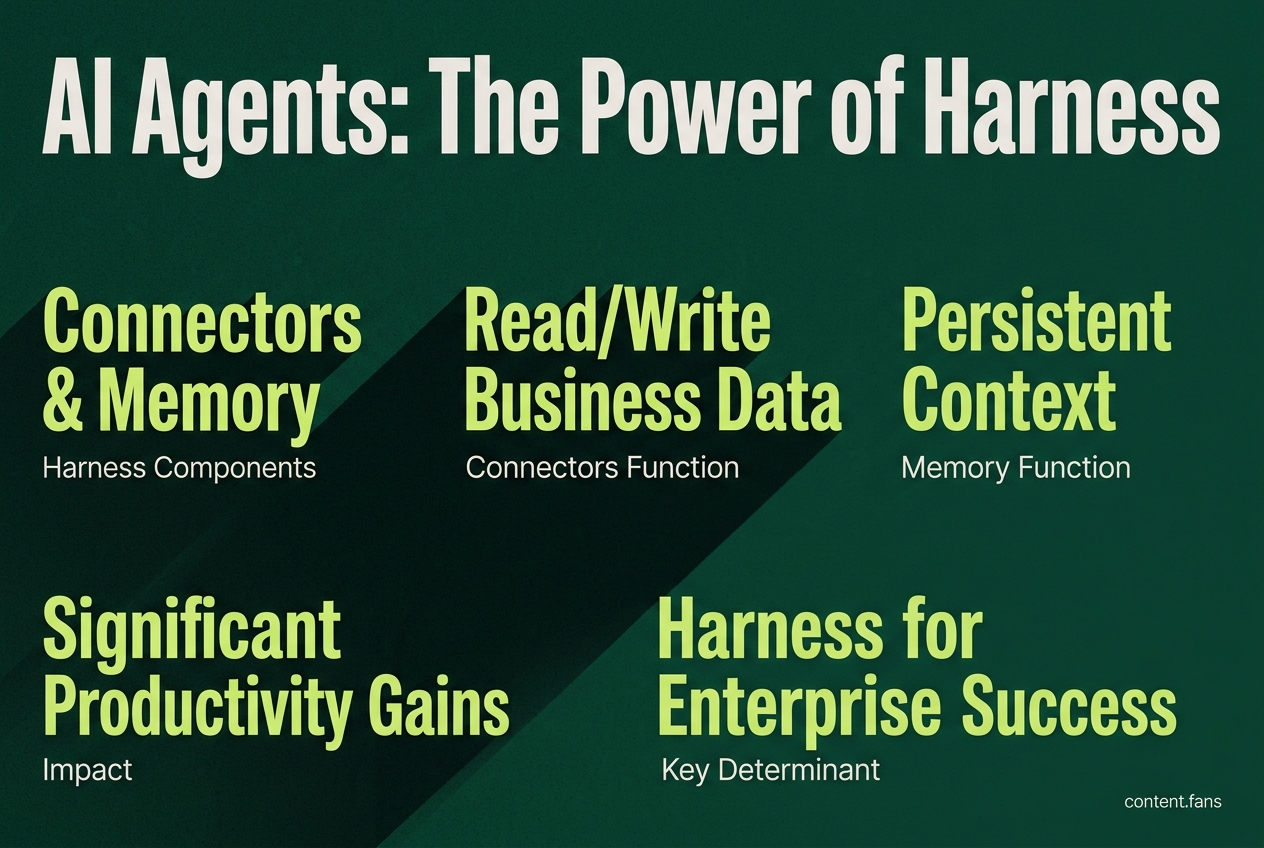
An AI harness consists of two primary components. Connectors enable a language model to interact with business systems by reading and writing data in emails, files, and support tickets. Memory provides persistent user and project context, preventing the AI from repeatedly requesting the same information. Slack describes this capability as "agent-ready access to conversational data," using its Real-Time Search and Model Context Protocol to expose data to external agents securely. Industry observations suggest that improving an AI's connectors and memory can yield significant productivity gains compared to simply upgrading to a more powerful language model.
Why Connectors and Memory Are Crucial for Enterprise AI
Connectors and memory, collectively known as the 'harness,' are critical for enterprise AI. They allow language models to perform concrete actions by reading and writing to business systems like email and CRM. This integration translates abstract reasoning into tangible productivity gains, often surpassing improvements from model upgrades alone.
Connectors are the bridge between an LLM's abstract reasoning and concrete business actions. For instance, Google's Gemini Enterprise can draft documents, analyze Sheets data, and schedule Calendar events within a single workflow. Similarly, Salesforce's Agentforce can surface deal alerts in Slack, allowing a salesperson to approve a discount without switching applications. These are advancements in orchestration, not just model capability.
The impact of these integrated systems is significant, with organizations reporting substantial improvements in task efficiency, benchmark performance increases when pairing models with specialized agent harnesses, and enhanced product velocity by using organizational memory to eliminate repetitive processes.
The Role of Memory in Creating Stateful AI
AI memory allows agents to maintain state and context across multiple interactions. For example, an agent can cache a Slack thread and use that summary to draft a follow-up email in Gmail that is already aware of the prior conversation. Industry reports highlight that these "application layers" are responsible for critical functions like routing, permissions, and evaluation, making the harness a key determinant of enterprise success.
Common memory design patterns in current deployments include:
1. Conversation memory: Stores prior messages with timestamps.
2. Working memory: Maintains the immediate context and KV cache for active generation.
3. Episodic memory: Logs completed tasks, allowing the agent to reference past outcomes.
4. Semantic memory: Indexes policies and knowledge bases for fast, vectorized retrieval.
A table illustrating common integration stacks:
| Center of gravity | Key platform | Typical flow |
|---|---|---|
| Slack front door | Slack RTS + MCP | User asks in Slack -> agent pulls Google Drive doc -> posts summary back |
| Google productivity | Gemini Enterprise | Email triggers agent -> reads Sheets -> drafts response in Gmail |
| CRM workflows | Salesforce Agentforce | Support ticket -> agent fetches policy PDF -> writes resolution note |
Future Challenges: Guardrails and Gaps
Experts identify two primary challenges that will impact ROI in enterprise AI deployments. The first is context drift, which occurs when stored memories become outdated. To mitigate this, vendors are implementing governance layers to timestamp and rank memory relevance. The second challenge is schema misalignment between AI tools and enterprise systems, which can disrupt automations. Adding validation steps and audit trails is the key solution being developed.
While no single vendor currently offers a perfect, all-in-one harness, the evidence is clear: upgrading an AI's connectors and memory can deliver significant efficiency gains compared to just upgrading the core model. This critical insight is elevating the AI harness from a technical detail to a strategic, board-level investment.