
Goldman Sachs, World Bank cut China's 2026 GDP growth forecasts
Serge Bulaev
China's economic growth appears to be slowing, with official numbers near 5% but some independent estimates suggesting 2-3% for recent years. For 2026, Goldman Sachs forecasts 4.8% growth while the World Bank projects 4.4%, both slightly below China's usual target. Differences in estimates may come from how inflation is measured, data smoothing, coverage of small firms, and adjustments for property market declines. Experts suggest that an aging population, property troubles, and weaker spending could hold back faster growth. China is putting more money into technology and innovation, but it remains uncertain if this will boost productivity enough to overcome these challenges.

Reflecting concerns over structural economic headwinds, both Goldman Sachs and the World Bank have cut China's 2026 GDP growth forecasts. While official figures target growth near 5%, independent analysis points to a more moderate expansion, highlighting a growing debate over the economy's underlying momentum and future trajectory.
The New Consensus: Slower Growth Ahead
The latest forecasting cycle shows a narrowing gap between official targets and external projections. Goldman Sachs projects 4.8% real GDP growth for 2026, crediting a rebound in exports and a slightly smaller drag from the property sector. The World Bank offers a more cautious outlook of 4.4%, citing weak domestic demand and lingering deflationary pressures. Both figures sit just below Beijing's long-running "around 5 percent" target, shifting the focus from data discrepancies to the drivers of underlying economic momentum.
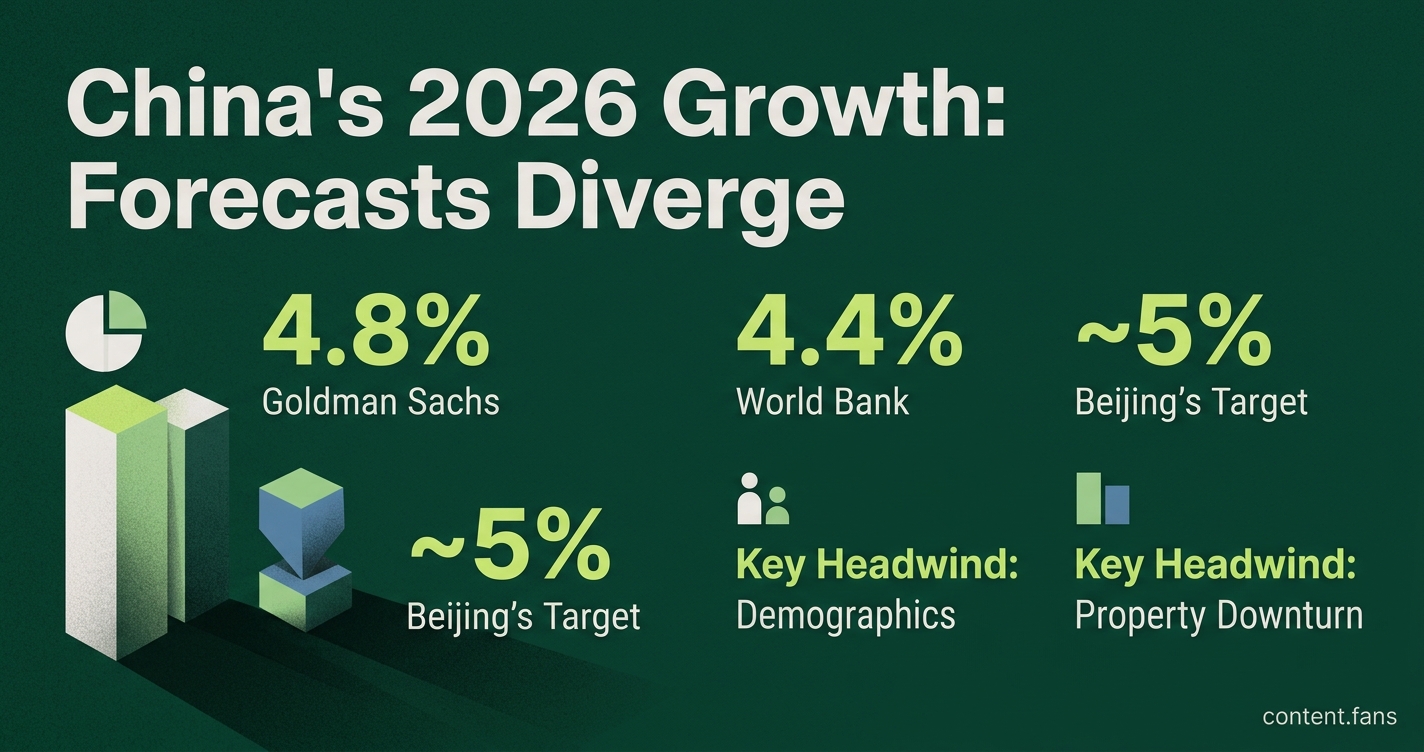
Independent analysts have revised China's 2026 GDP forecasts downward due to persistent weak domestic demand, a protracted property sector downturn, and the limits of an export-led recovery. Many projections signal slower momentum and greater underlying vulnerability than official statistics suggest.
Why Official and Independent Forecasts Diverge
While past debates centered on wide statistical gaps - with some private estimates putting growth significantly lower - the current divergence is more nuanced. Independent analysts emphasize qualitative weaknesses that official data may understate. Key factors contributing to these differing interpretations include:
- Price Deflators: Private analysts often apply higher inflation estimates for the service sector, which lowers real growth figures.
- Domestic Demand: Institutions like the World Bank flag that consumption remains significantly weaker than investment and export performance.
- Property Correction: External adjustments account for falling land sales and construction, a drag that official data may offset with other spending.
- Data Smoothing: Official quarterly series tend to show fewer sharp fluctuations than independent data sets.
Structural Headwinds Constraining China's Economy
China's slowdown is increasingly seen as a result of fundamental limits to its long-standing growth model. Key structural challenges include:
- Demographic Shifts: An aging population and a declining labor force are reducing the country's potential growth rate.
- Diminishing Investment Returns: The World Bank argues that the investment- and export-led model has "largely reached its limits." The European Central Bank has also noted that returns on investment are shrinking, particularly amid the property downturn.
- Productivity Stagnation: Despite massive R&D spending, economy-wide productivity growth has weakened, a central constraint highlighted by both the IMF and World Bank.
- Deflationary Pressures: Persistent weak demand has created deflationary risks, which could worsen debt burdens.
- External Constraints: Growing trade tensions and technology restrictions limit China's access to foreign markets and advanced technology.
Policy Response: A High-Stakes Pivot to Innovation
In response, Beijing is channeling significant fiscal and credit resources toward advanced manufacturing and R&D through a "new national system." While this industrial policy is achieving measurable results in resource mobilization, its impact on broad productivity remains uncertain.
- Achievements: China's total R&D expenditure was 3.6130 trillion yuan in 2024, up 8.3%; national science-and-technology spending in 2026 was planned to rise by 7.1%. These efforts helped China enter the top ten of the Global Innovation Index in 2025, according to the State Council Information Office.
- Weaknesses: The system excels at applied commercialization but lags developed economies in basic research. Rhodium Group research also points to efficiency concerns, such as misallocation from local policy competition. The critical translation of R&D spending into economy-wide productivity gains has not yet materialized.
Key Risks to the 2026-2027 Outlook
Analysts identify several interconnected downside risks that could push growth below current forecasts:
- Property Sector Contagion: While the drag is expected to narrow according to Goldman Sachs projections, a deeper correction could spread through local government finances and household wealth.
- Trade Policy Escalation: Industrial policies aimed at boosting exports risk worsening overcapacity and fueling international trade tensions, potentially constraining a key pillar of current growth.
- Persistent Deflation: Entrenched deflationary pressure could trigger a negative debt-deflation cycle, given the high levels of corporate and local government leverage.
- Delayed Structural Reforms: The World Bank's July 2026 update stresses the urgent need for reforms to rebalance the economy toward consumption, which have yet to be fully implemented.