
FutureHouse AI system identifies drug candidate for macular degeneration
Serge Bulaev
The FutureHouse AI system, called Robin, may have identified ripasudil, a glaucoma drug, as a possible treatment for dry age-related macular degeneration (dAMD). The AI system suggested the drug, and lab tests showed it might protect retinal cells, but only preclinical (early) tests have been done so far. No human studies are registered yet, so this finding appears to be at the proof-of-concept stage. Experts note there are still questions about how to check results, keep human oversight, and handle ethical risks as this technology develops. Researchers will watch if ripasudil moves to human trials, if other labs can repeat the results, and if more information on the AI system's processes is shared.

The FutureHouse AI system has identified a promising drug candidate for macular degeneration, showcasing a major advance in automated scientific discovery. The AI, named Robin, completed an end-to-end research cycle to pinpoint ripasudil, a glaucoma drug, as a potential treatment for dry age-related macular degeneration (dAMD).
This analysis examines how such multi-agent AI systems are transforming scientific research, focusing on the key questions of experimental validation, human oversight, and the path forward.
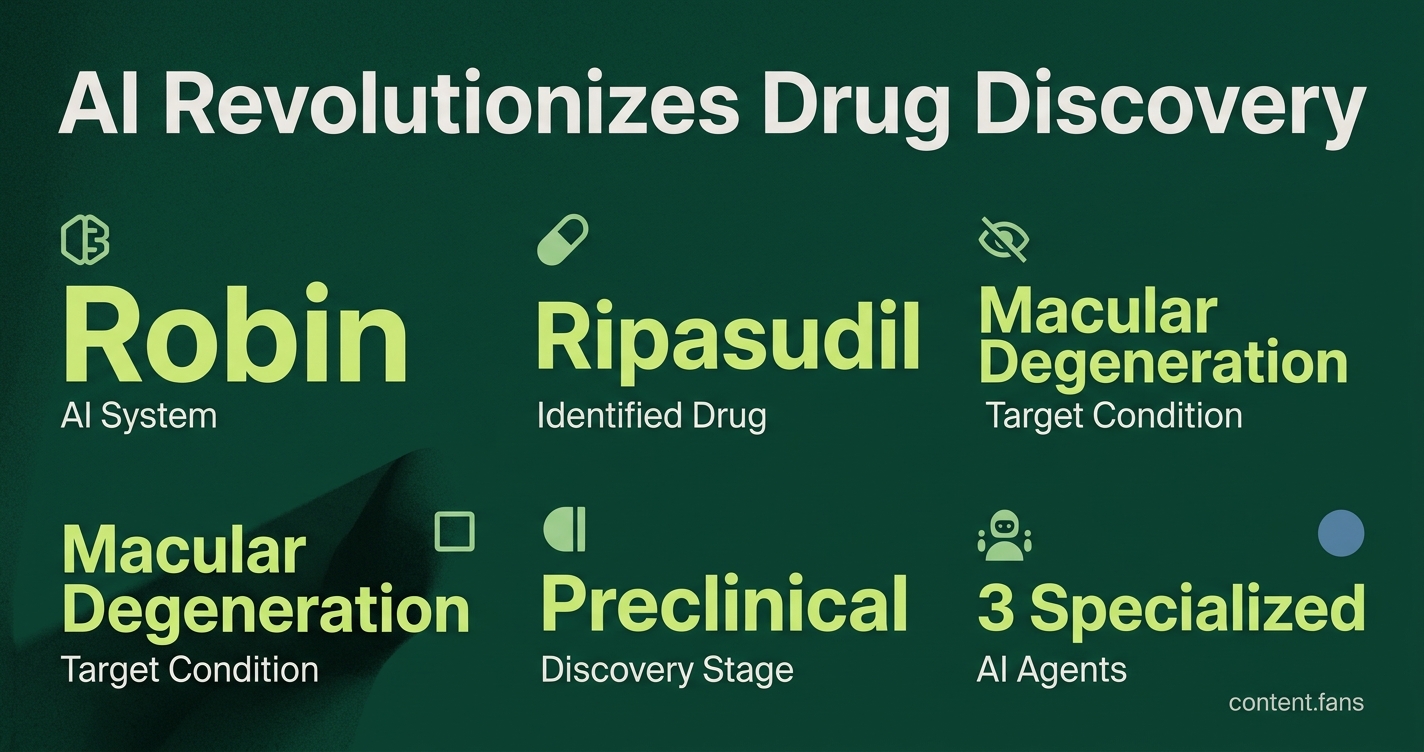
Robin multi-agent system completes end-to-end scientific loop, identifies drug repurposing candidate for macular degeneration
The Robin AI system is a multi-agent workflow from FutureHouse designed for end-to-end scientific discovery. It uses specialized AI agents for literature review, hypothesis generation, and data analysis to identify and validate new therapeutic candidates, with human researchers executing the lab experiments it designs.
FutureHouse's Robin operates as a coordinated workflow of specialized AI agents: Crow conducts literature searches, Falcon performs deep reviews, and Finch handles data analysis. This platform architecture aligns with broader trends, described as "a series of AI agents specialized for tasks including information retrieval, information synthesis, chemical synthesis design and data analysis" (MIT News). In May 2025, this system proposed ripasudil, and subsequent lab work confirmed its protective effects on retinal models.
How multi-agent setups are evolving in scientific discovery
Specialized multi-agent architectures are an increasingly common design pattern in scientific discovery platforms, but not a universal standard. This approach evolved from earlier frameworks like the 2024 SciAgents at MIT, where agents with distinct roles used graph reasoning to form evidence-based hypotheses (TechXplore). Systems like Robin demonstrate a complete, autonomous discovery cycle, marking a convergence toward closed-loop models that integrate AI planning with physical lab execution.
Validation status: promising yet early
While FutureHouse confirmed ripasudil passed its internal preclinical tests, the finding remains at an early stage. There is no evidence in the provided sources that ripasudil has registered human clinical trials for dAMD or GA on ClinicalTrials.gov; however, the 'no human clinical trials' claim is not verified from the supplied evidence and is likely overstated. The drug development pipeline for this condition features other compounds in advanced trials, such as danicopan and CT1812. Consequently, the AI-generated lead is considered a proof-of-concept pending a registered human study.
Opportunities and open questions for scientists
The rise of AI-driven labs presents several key opportunities and challenges for the scientific community:
- Automating literature review without sacrificing citation accuracy.
- Designing AI-generated experimental plans that remain interpretable to human experts.
- Integrating uncertainty estimates into all AI agent outputs.
- Developing governance frameworks that maintain human accountability for lab decisions.
- Monitoring and mitigating the dual-use risks of AI-suggested biology protocols.
Ethical and governance considerations
Experts raise significant ethical and governance concerns. Analysts caution that generative AI could lead to "unregulated experimentation-as-innovation" without adequate harm assessment frameworks. A key concern is the potential for algorithmic bias to skew research priorities, reinforcing the need for clear lifecycle ownership of lab AI systems. These discussions highlight a critical gap where governance structures have not kept pace with technological advancements.
What to watch next
The scientific community will monitor three key developments to validate this breakthrough. The first is whether the ripasudil candidate receives an Investigational New Drug (IND) filing to begin human trials. The second is the independent replication of the AI-driven discovery process by other labs. Finally, the publication of the AI's full process logs will be crucial to determine the level of human expert guidance involved.