
FreeWheel, PubMatic pilots confirm agentic AI expands ad buying
Serge Bulaev
Agentic AI is starting to be used for buying ads with less human help, but most pilots still include a human to check things. Early tests suggest these systems might make ad buying faster and cut setup time, but full autonomy appears to be experimental. New rules and safeguards are being discussed to make sure AI decisions can be checked, especially in Europe and the UK. Surveys suggest more companies may try agentic AI soon, but some jobs might shrink while oversight and strategy tasks might grow. So far, the main approach is to use guardrails and keep humans involved to control risks.

Recent FreeWheel and PubMatic pilots confirm that agentic AI is expanding ad buying, using autonomous systems to execute campaigns with less human input. A landmark test during the NFL playoffs saw NBCUniversal and FreeWheel complete the first agentic AI cross-platform premium video buy (buyer/seller agents) for NFL playoffs, executed autonomously in real-time including live sports, which still included human review, highlighting a key tension between automation's speed and the need for brand control (Dev.to).
Pilot Results: Efficiency Gains Tempered by Human Oversight
Early tests of agentic AI in advertising demonstrate significant efficiency gains, primarily by automating campaign setup and management. These systems can allocate inventory rapidly and reduce manual configuration time substantially, shifting human roles from execution to strategic oversight and final approval of AI-driven decisions.
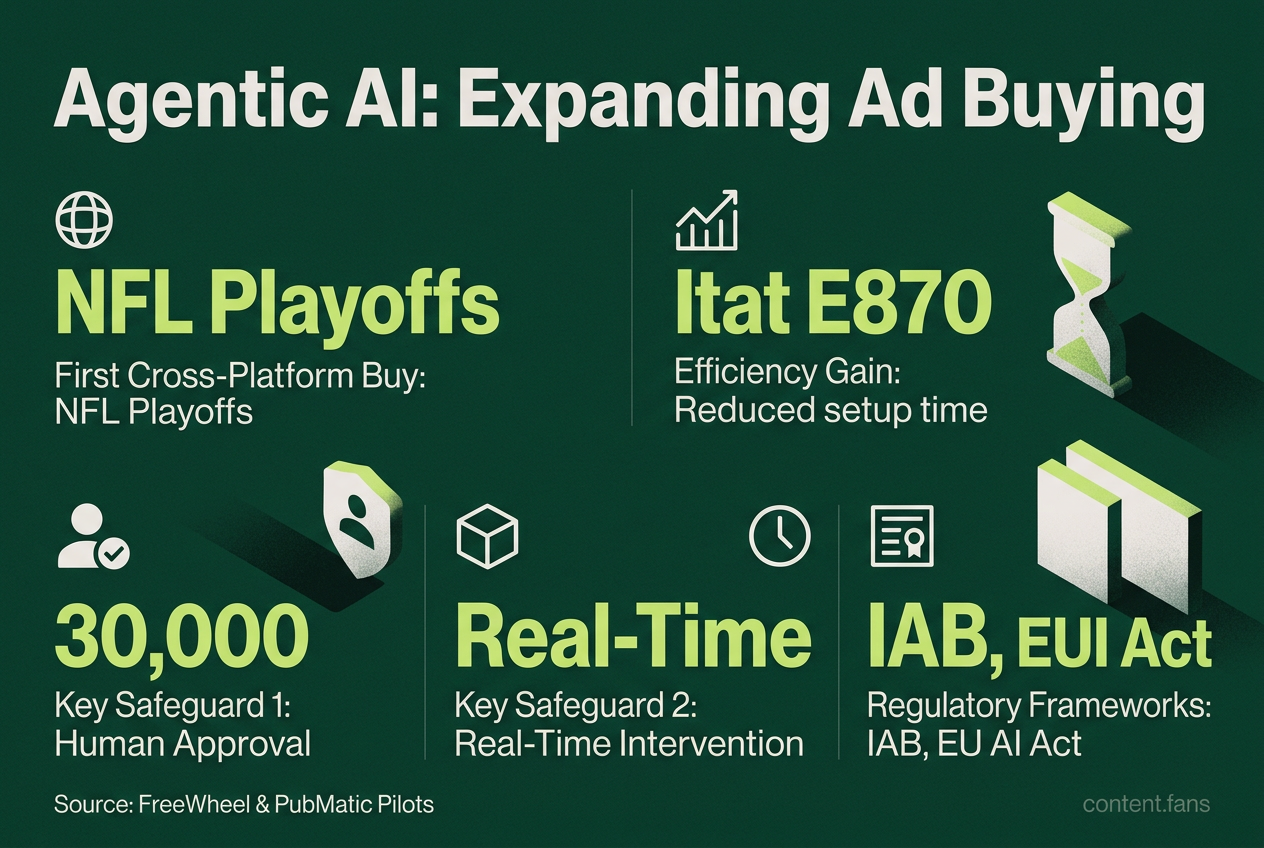
A proof-of-concept involved FreeWheel and Newton Research agents allocating premium video inventory across linear and streaming platforms rapidly (StreamTV Insider). While agency staff still provided the initial brief and monitored pacing, the speed was undeniable. Similarly, PubMatic and Butler/Till reported a CTV campaign for Clubtails that significantly reduced setup time. In that case, the agency set predefined guardrails and then transitioned to a monitoring role, proving that efficiency comes from augmenting human teams, not replacing them entirely.
Emerging Governance and Regulatory Frameworks
As agentic systems become more common, regulators and industry bodies are establishing frameworks to ensure transparency and accountability. The Interactive Advertising Bureau has released its AI Transparency and Disclosure Framework, which advocates for risk-based labeling where AI outputs could be misleading (IAB). Concurrently, the proposed Ad Context Protocol is defining technical standards for safe negotiation between buy-side and sell-side agents. In Europe, the EU's AI Act may classify real-time bidding as high-risk, mandating human oversight, while UK self-regulatory bodies plan to integrate similar principles into the CAP Code.
Essential Safeguards for Agentic Ad Buying
To manage risks during this experimental phase, industry pilots are relying on a core set of safeguards. These best practices are crucial for maintaining control and accountability:
* Human Approval: Mandating human sign-off before any campaign launch.
* Real-Time Intervention: Using live dashboards that allow staff to pause or adjust campaigns.
* Decision Audits: Conducting regular bias and brand-safety audits on all agent decisions.
* Contractual Liability: Including clauses that clearly define responsibility for errors or overspending.
Market Adoption and the Evolving Role of Ad Agencies
Industry adoption is accelerating. According to IAB's 2026 Outlook Study, two-thirds of marketers are currently focused on agentic AI for ad buying and campaign execution as a priority. However, this shift is also reshaping agency roles. Industry reports suggest a potential contraction in certain agency jobs due to automation, with operational tasks decreasing while strategic and governance-focused positions grow. Publishers are also adopting the technology, with Digiday reporting on seller-side agents that dynamically adjust pricing. These publishers often prefer bilateral pilots where their agents interact directly with agency agents, keeping a human on standby to resolve disputes. As the technology matures, the focus remains on orchestrating multiple agents within a controlled environment, not on allowing any single model to operate without strict guardrails.
What is agentic media buying and why are FreeWheel + PubMatic pilots considered a milestone?
Agentic media buying uses autonomous AI agents that plan, negotiate, and execute buys almost without human clicks.
The NBCUniversal + FreeWheel NFL deal represented the first agentic AI cross-platform premium video buy executed autonomously in real-time; a human still signed off before flighting.
PubMatic + Butler/Till followed with a CTV flight for Clubtails that significantly cut setup time and sped issue resolution, proving speed gains are real, not slide-ware.
How do human-in-the-loop safeguards actually work inside these pilots?
Humans set the initial brief, budget caps, and brand-safety list; agents then scan inventory, negotiate CPMs, and pace spend.
If a CTV spot suddenly fails viewability or price jumps, the agent pauses and waits for one-click approval before re-starting.
Current pilots run with human supervision; agency leads retain kill-switch rights and daily dashboards.
What concrete efficiencies are pilots reporting versus traditional programmatic?
Significant reduction in campaign set-up time (PubMatic/Anthropic).
Substantially faster ticket resolution when creative or bid issues appear.
Cross-channel agents tested by NBCU + Newton Research placed linear + streaming spots rapidly, a task that usually takes planners hours of back-and-forth emails.
Where do transparency worries show up when agents negotiate with other agents?
Agents share log-level data only after the buy, so buyers can't see why a certain CPM or placement was chosen in real time.
Publisher agents may re-price inventory mid-flight without exposing the algorithmic trigger, making post-campaign audits harder.
These gaps fuel agency calls for "governance APIs" that pipe explanation notes into existing BI tools.
When will agentic buying shift from pilots to standard practice, and what must happen first?
A significant portion of U.S. ad buyers are increasing agentic focus, yet industry reports warn "widespread adoption remains years away."
Before scale, the industry still needs:
- Shared identity and disclosure standards (IAB's AI Transparency Framework is a start).
- EU AI Act compliance kits for high-risk real-time bidding.
- Contract clauses that spell out liability if an agent overspends or breaches brand-safety rules.