
Fast Simon unveils AI personalization for brand merchandisers
Serge Bulaev
Fast Simon has launched an AI tool that may help brand merchandisers get real-time product insights without needing data science skills. The tool appears to work for Shopify brands and uses shopper behavior data while protecting personal information. Early reports suggest stores using it saw increased revenue and shopper conversion, but these results are still preliminary. Experts think this kind of AI could become a regular part of merchandising work, though whether it will lead to wider market use is not yet clear.

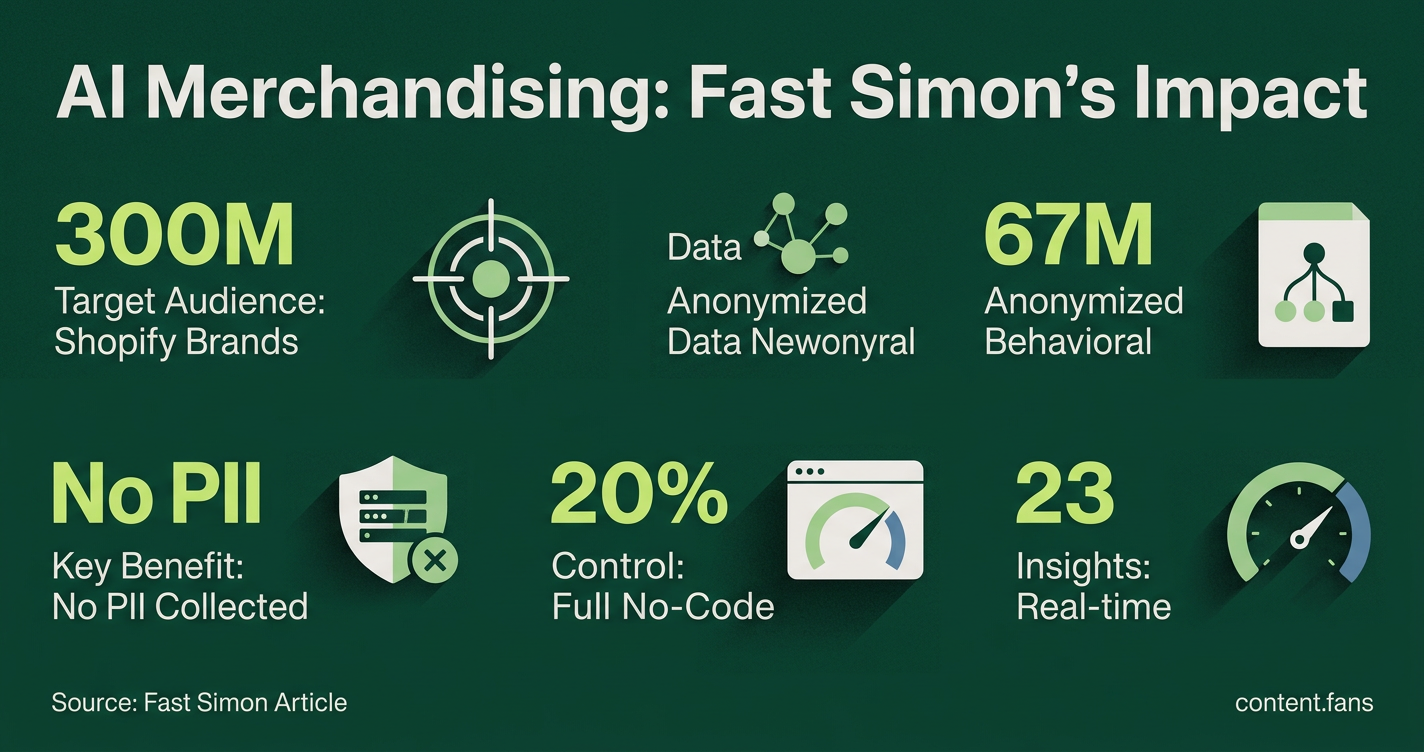
Fast Simon has launched a new platform for AI personalization for brand merchandisers, giving teams access to real-time product insights without needing data science expertise. The tool is designed for mid-market and enterprise Shopify brands and operates using anonymized behavioral data, ensuring personally identifiable information (PII) is not collected.
This approach is critical for merchandisers managing complex inventories, seasonal product drops, and evolving privacy regulations. Fast Simon's new module aims to streamline these workflows, empowering teams with data-driven tools while maintaining full control over their catalog strategy.
How the platform works
The platform analyzes shopper click-stream data to generate real-time performance insights. It uses this information to power smart collections, personalize search results, and suggest visual discovery options. The core engine identifies product trends and customer behavior patterns automatically, allowing merchandisers to optimize their catalog without manual analysis.
According to industry reports, early testing on client stores has shown promising results in revenue and conversion metrics, though specific performance data varies across implementations.
At-a-glance feature list
• Real-time product performance analytics that flag "winners," "duds," and hidden gems.
• Behavioral personalization without PII, helping compliance teams.
• Smart Collections with visual search and "Complete the Look" discovery tools.
• Opportunity-cost calculator that estimates short and long term impact of display decisions.
• Full no-code control for rules like exit intent or banner placement.
Early impact and market context
Early reports suggest the platform's ability to identify over-exposed products and recommend inventory adjustments quickly. While initial results are preliminary, industry experts suggest these improvements could signal a shift for merchandising AI from an experimental tool to a standard workflow component.
In the competitive landscape, Fast Simon differentiates itself from platforms like Bloomreach Discovery, which emphasizes NLP for large catalogs, and Rebuy's Smart Cart, which focuses on checkout upsells. By integrating search, visual discovery, and portfolio analytics into a single interface, Fast Simon offers a unified solution that appeals to brands aiming to reduce manual rule management and consolidate their tech stack.
What comes next
Fast Simon has focused on strategic partnerships with brands to drive adoption. Recent developments suggest a dual focus on expanding its agency channel and refining its long-term product roadmap. The impact of these strategies on market share will depend on future conversion data from a broader merchant base.
The company has also released analyses indicating its AI capabilities can improve product discovery conversion rates. If these figures are independently verified, they would support the claim that automated merchandising can yield higher order values. Retail teams considering AI solutions are now awaiting further case studies to confirm if these initial performance metrics can be sustained at scale.
What exactly does Fast Simon's new AI Personalization do for brand merchandisers?
Fast Simon gives shop-level merchandisers a full control dashboard to personalize search, collections, recommendations and visual discovery in one place. The platform runs on behavioral data alone (no PII), so teams can:
- Pin, boost or bury products in real time while the AI handles the heavy mathematics.
- Instantly spot winners, duds and hidden gems with live performance scores that even project short- and long-term opportunity cost for each move.
- Leverage AI capabilities to help manage assortments during flash drops while maintaining brand tone and override rules.
Fast Simon launched Personalization AI Embeddings in June 2024 for conversion optimization, though specific performance metrics vary across implementations.
How technical does a merchandiser need to be to use it?
Not at all. Every setting lives inside a no-code dashboard that feels like drag-and-drop merchandising. The AI stitches together color, image, text and location signals into Personalization AI Embeddings, so a merchandiser can:
- Launch a Smart Collection by selecting two rules - e.g., "highlight summer linen" and "boost margin >40 %" - and watch the AI continuously reorder the grid for each visitor.
- Insert promotional tiles with a few clicks, set triggers such as exit intent or time delay, and preview the experience instantly.
There is zero SQL, Python or data-science overhead.
Which e-commerce stacks does the solution plug into today?
The rollout is engineered for mid-market and enterprise Shopify brands first, with deep one-click connectors for:
- Shopify, Shopify Plus
- Headless (via GraphQL and REST store-front APIs)
Fast Simon partnered with Steve Madden in September 2024, with growing partnerships across multiple brands and regions. Additional e-commerce platform connectors are reportedly in development.
Does the AI ever override the merchandiser's strategy?
No - merchandisers keep strategic veto power. The system operates as an intelligent co-pilot: it proposes reranks, but any change can be locked, tweaked or undone in the same dashboard. Fast Simon's "balancing slider" even lets teams dial the ratio of AI influence vs. manual rule (70/30, 50/50, etc.) by collection or campaign.
What measurable impact can brands expect in their first quarter?
Based on early implementations, brands report various improvements in key performance indicators, though results vary by store and implementation. Common areas of improvement include:
| KPI | Reported improvements |
|---|---|
| Revenue | Varies by implementation |
| Shopper conversion rate | Varies by implementation |
| Average order value | Varies by implementation |
| Time saved on manual curation | Significant time savings reported |
Fast Simon released an analysis in May 2026 showing AI Shopper Agents can lift product-discovery conversion to 22%, though individual results may vary.