
Executives Prioritize AI Inventory, Governance to Avoid Failure
Serge Bulaev
Executives may be focusing more on AI inventory and governance to prevent project failures. Interviews suggest that leaders now discuss the quality of training data first and follow steps like mapping use cases to business goals, assigning clear ownership, and keeping a register of all AI systems. Common governance frameworks mentioned are the NIST AI Risk Management Framework and ISO-IEC 42001:2023. Many failures appear to come from poor data, unclear ownership, or pilot projects that never scale. There may also be resistance from some managers, suggesting that responsible AI training for staff could be important.

To avoid high-profile AI project failures, executives are prioritizing a robust AI inventory and governance framework as a foundational first step. Interviews with C-suite leaders reveal a strategic shift away from focusing on algorithms and toward data quality, reflecting expert guidance that urges firms to "start with visibility" through an end-to-end AI inventory (Atlan).
Why are an AI inventory and governance the first two actions executives must take?
Because you cannot govern what you cannot see and you cannot scale what you cannot govern. Industry sources show that enterprises which skip the inventory step experience significantly higher project failure rates. A living inventory reveals shadow AI and enables executives to apply correct, risk-tiered controls from recognized frameworks like the NIST AI RMF or ISO/IEC 42001:2023. This approach anchors projects in clear business objectives, reducing "AI for AI's sake" experiments (Databricks).
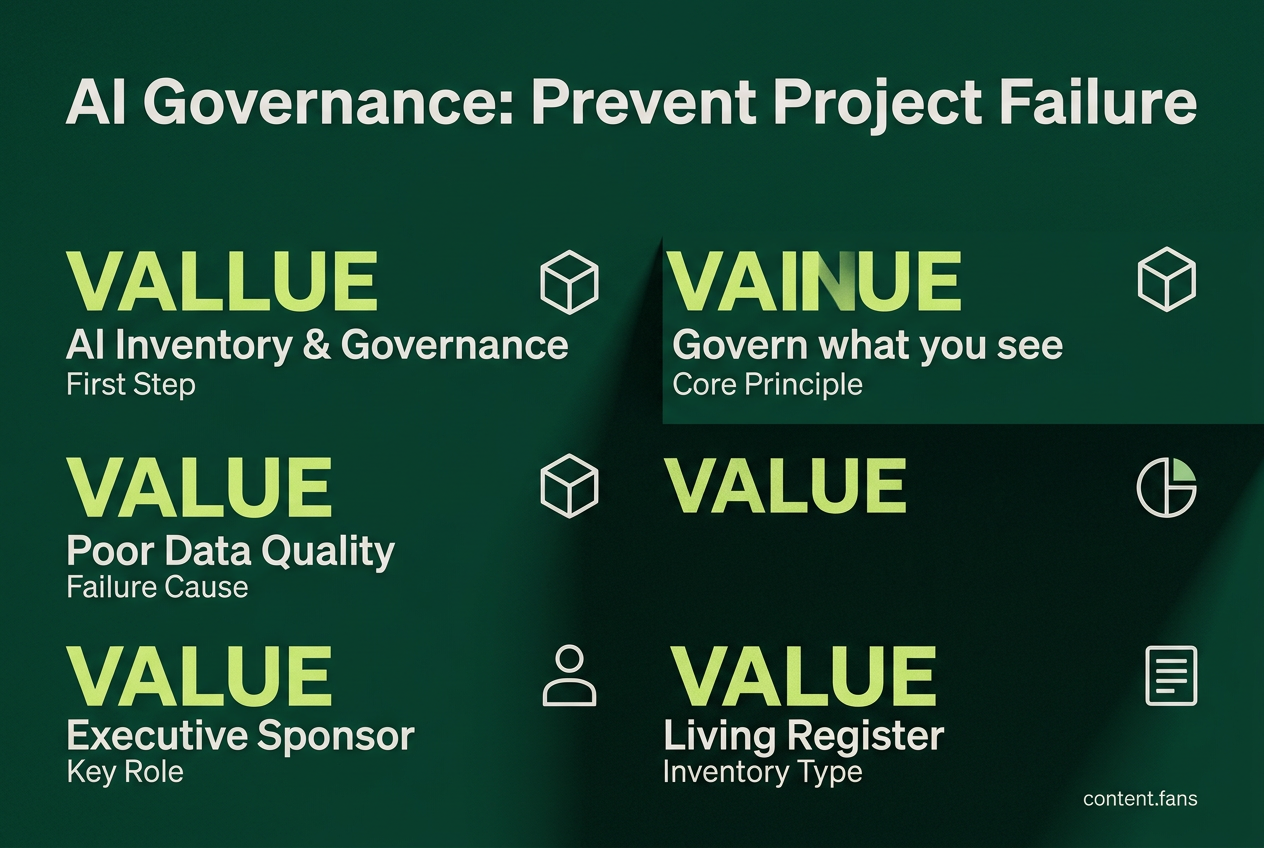
A comprehensive AI inventory provides total visibility into all models, data sources, and vendors, including those hidden in SaaS tools. A corresponding governance framework then applies risk-based policies and controls, ensuring that AI development is secure, compliant, and aligned with business goals from the start.
What does a practical AI governance framework look like?
A repeatable, six-layer model provides a clear structure for enterprise AI governance:
| Layer | Executive Action |
|---|---|
| Strategy | Tie every AI use case to a specific P&L metric. |
| Ownership | Name one executive sponsor and a cross-functional governance committee. |
| Inventory | Maintain a living register of all models, vendors, and data pipelines. |
| Risk Tiering | Classify each system by risk level (e.g., low, medium, high) and apply matching controls. |
| Controls | Mandate policies, documentation, bias testing, and security reviews before go-live. |
| Monitoring | Track model drift, incidents, and business KPIs; report results to the board quarterly. |
Operationalizing this framework within existing procurement and engineering workflows, rather than as a post-deployment check, is a critical shift for success.
Which common failure points does governance prevent?
Proactive AI governance directly addresses the most common reasons for project failure:
- Legacy-System Integration: Prevents delivery delays and ballooning costs by ensuring compatibility upfront.
- Poor Data Quality: Mitigates the leading cause of AI failure by enforcing data standards and lineage.
- Governance/Compliance Gaps: Protects the company from regulatory penalties and reputational damage.
- Unclear Ownership: Eliminates stalls in decision-making and issue resolution by assigning accountability.
- Pilot Sprawl: Curbs low-ROI experiments that never scale by tying projects to clear business value.
- Change-Management Neglect: Builds trust to counter employee resistance. This highlights that responsible AI training for staff is as critical as the technology itself.
What immediate checklist should every executive run before approving a new AI initiative?
Before funding the next AI project, use this checklist to ensure a foundation for success:
- [ ] Approve an AI policy that defines acceptable and prohibited use cases.
- [ ] Assign named accountable owners with decision rights for each system.
- [ ] Build or update the living AI inventory, including both internal builds and third-party vendors.
- [ ] Classify every use case by risk impact and apply matching controls.
- [ ] Require model cards, audit trails, and evidence collection for all high-risk systems.
- [ ] Establish board-level metrics, such as percentage of systems inventoried and incident-resolution time.
- [ ] Schedule quarterly governance reviews based on the NIST "Govern-Map-Measure-Manage" cycle.
Running this checklist before funding a pilot often proves that governance is cheaper than rework.