
EU court upholds Google's €4.1 billion Android antitrust fine
Serge Bulaev
The European Court of Justice has upheld Google's €4.1 billion antitrust fine for limiting competition on Android devices, ending eight years of legal challenges. Judges found that tying Google Search and Chrome to Play Store access denied other companies a fair chance to compete. New EU rules under the Digital Markets Act may require Google to give rival software and assistants better access to Android features. Google argues these changes might remove important user protections, while others say the rules could help new competitors reach users more easily. In the U.S., similar legal actions are ongoing, but no permanent solutions have been decided yet.

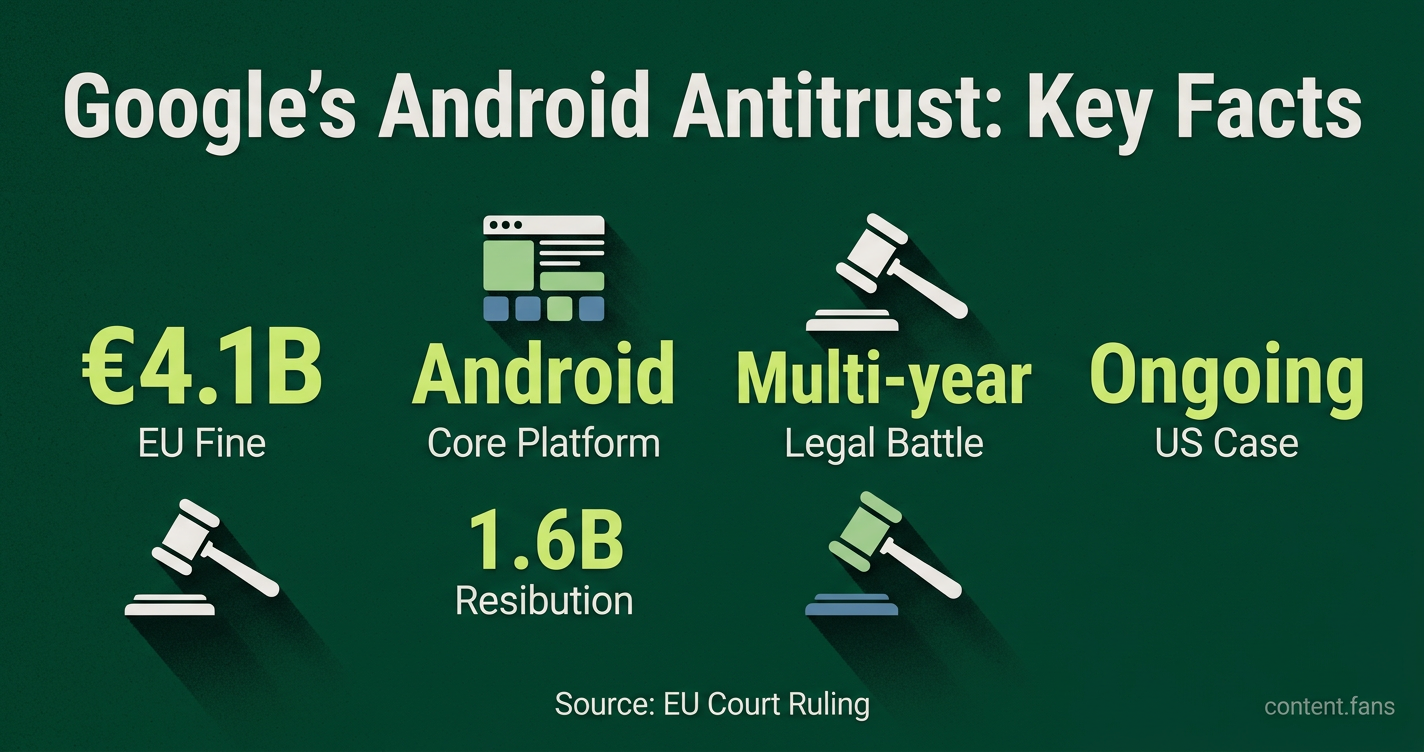
The European Union's top court has upheld Google's landmark €4.1 billion Android antitrust fine, dismissing the company's final appeal in a major victory for regulators. The ruling concludes a multi-year legal battle over rules that forced device makers to pre-install Google Search and Chrome. The European Court of Justice's decision leaves the record €4.125 billion penalty in place, and found that Google's "tying" practices illegally denied competitors fair market access.
This decision arrives as the EU's Digital Markets Act (DMA) continues enforcement. With Android designated a "Core Platform Service" under the DMA, Google's parent company, Alphabet, now faces significant forward-looking obligations in addition to this historic fine.
What the ECJ confirmed
The European Court of Justice confirmed the General Court's decision, finding that Google abused its dominant market position. By requiring manufacturers to pre-install Google Search and Chrome to get Play Store access, Google illegally restricted competition and denied rivals a fair chance to reach consumers.
DMA enforcement developments
As part of the DMA, the European Commission has initiated proceedings to define interoperability requirements for Android and third-party AI assistants. Draft rules would compel Google to grant rival AI services access to wake-word activation, screen context, app lists, and key hardware. Potential fines for non-compliance could reach significant amounts.
Impact on pre-installation and choice
The DMA introduces requirements mandating that users can uninstall pre-loaded apps, including Google Search and Chrome. Furthermore, official guidance confirms that third-party apps must receive the same background execution privileges as Google's native software. This change aims to dismantle the structural advantages that cemented Android's dominant market share in Europe, with the Commission aiming to restore market "contestability."
Google's response and industry concerns
Google has publicly argued that the proposed DMA obligations would force it "to remove legitimate safeguards" protecting users from security threats. Some hardware manufacturers echo these concerns, citing potential privacy risks from opening features like hot-word detection to third-party apps. Conversely, rival search providers view the rules as a crucial and overdue opportunity to compete on a level playing field.
Parallel action in the United States
In a parallel case in the United States, the Department of Justice secured a liability ruling against Google for monopolizing search distribution. Legal proceedings continue as both parties navigate the appeals process. The U.S. case notably addresses exclusive bundling contracts for Google Search, Chrome, and Assistant, reflecting key aspects of the EU's regulatory strategy.
Financial weight vs. strategic cost
While the €4.1 billion fine represents a significant penalty, the strategic cost of compliance may be far greater. Under the DMA, Google is required to publish transparent, non-discriminatory access rules for Android and permit rival app stores to be set as the default. EU officials have warned that future violations could trigger substantial penalties.
What exactly did the ECJ rule and why does the €4.1 billion figure matter?
The European Court of Justice rejected Google's final appeal, cementing the €4.125 billion fine from 2018. The ruling is historic as it represents one of the largest EU antitrust fines ever upheld and establishes a legal precedent: dominant companies cannot illegally bundle services like an app store with a mandatory search engine and browser.
Which Android practices did the Commission decide were abusive?
The Commission identified three key anticompetitive practices:
- Illegal Tying: Forcing phone manufacturers to pre-install Google Search and Chrome to license the essential Play Store.
- Exclusionary Payments: Offering revenue-sharing agreements to manufacturers and mobile operators for exclusively pre-installing Google Search.
- Anti-Fragmentation: Using "anti-forking" agreements to prevent manufacturers from developing devices that run on alternative versions of Android.
The ECJ agreed these tactics illegally "tied" services together, shutting out competitors from the crucial pre-installation stage on new devices.
How does the ruling interact with the newer EU Digital Markets Act?
The ruling strongly reinforces the principles of the Digital Markets Act (DMA), which already prohibits gatekeepers from such self-preferencing tactics. As Android is a designated "Core Platform Service," Google is now explicitly obligated to:
- Allow users to uninstall pre-loaded applications, including its own.
- Provide interoperability for competing services, such as giving third-party AI assistants access to wake words and other system resources.
- Ensure fair treatment for all apps regarding background processing rights, removing hidden advantages for its own products.
Could Android stop being "free" for device makers?
It's a possibility. Industry analysts expect Google may offset lost advertising revenue by introducing licensing fees for the Play Store or its suite of apps in Europe. As early as 2018, CEO Sundar Pichai noted that the "free" Android model was subsidized by this bundling. While Google has not announced new licensing terms, this ruling makes such a change more likely.
Will ordinary phone users notice any difference?
Yes, although the changes may be gradual. European users buying new devices can expect to see:
- Search engine choice screens during device setup, offering alternatives like DuckDuckGo or Ecosia.
- The ability to uninstall pre-loaded Google apps without affecting device performance.
- More prominent alternative app stores from companies like Samsung and Amazon.
Over the long term, experts forecast this could lead to increased competition in the search market in the EU.