
EU AI Act fines drive enterprise AI governance to 3% of turnover
Serge Bulaev
The EU AI Act may require companies to pay fines of up to 3 percent of their global turnover if they do not follow strict AI governance rules. Enterprises appear to be making AI policies a core part of their operations because of these possible fines. Experts suggest that companies should base their policies on six key principles, track all AI uses and risks, and use strong budget and enforcement controls. Real-time controls and clear ownership may help prevent violations. Regular reviews and updates to these frameworks might be needed to keep up with new regulations.

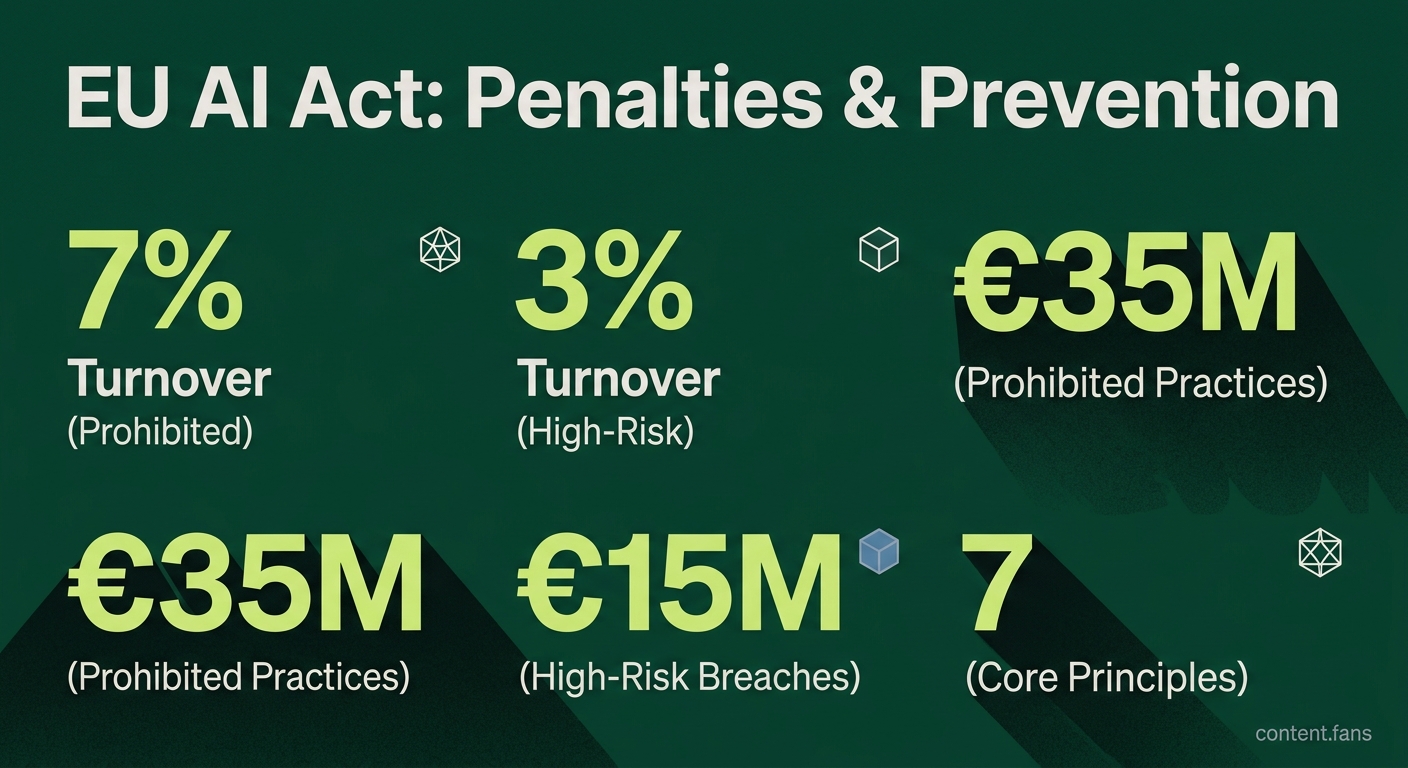
The threat of significant EU AI Act fines is transforming corporate AI governance from an optional guideline into a critical operational mandate. With maximum fines reaching up to €35 million or 7% of total worldwide annual turnover for prohibited practices, and up to €15 million or 3% of global annual turnover for high-risk system breaches, boards and CIOs are demanding robust controls to prevent compliance violations and uncontrolled budget spend. This playbook outlines the proven framework large enterprises are adopting to align AI policy, budget controls, and enforcement mechanisms with emerging regulatory standards.
Anchor on core principles before writing any policy
Effective AI governance frameworks are built upon standard principles that typically include human oversight, transparency, accountability, safety, fairness, robustness, and data quality. These principles, codified across leading models analyzed by Elevate Consult, should guide the creation of every policy and rule to ensure each one demonstrably advances at least one of these foundational values.
Enterprises can achieve compliance by establishing a governance framework anchored in core ethical principles. This involves creating a comprehensive inventory of all AI systems, classifying them by risk level, implementing strict budget and spend controls, and assigning clear ownership for every tool to ensure continuous accountability.
Build an inventory, then tier every use case by risk
A fundamental regulatory principle is that you cannot govern what you cannot classify. The first step is to conduct a thorough discovery of all AI systems, including "shadow AI" operating at the browser and desktop level. For each system, record the model, vendor, data source, and business owner, then map it to the official EU AI Act risk tiers. Incomplete documentation can itself constitute a violation, so it is critical to store detailed lineage and human-in-the-loop checkpoints within the inventory.
Select a budgeting model and wire spend controls to it
Enterprises typically implement various AI budgeting approaches, commonly involving centralized governance structures with different allocation methods based on organizational needs and risk tolerance. The specific approach varies significantly across organizations depending on their size, industry, and AI maturity.
Real-time controls are essential for effective budget management. Industry reports suggest that preventive controls are significantly more effective than reactive expense audits for maintaining compliance and budget discipline.
Choose enforcement strength on a spectrum
Enforcement mechanisms exist on a spectrum. Soft limits, such as monitoring and alerts, offer flexibility but risk budget overruns. In contrast, hard limits - like API caps or per-user spend ceilings - guarantee cost predictability but can stifle experimentation. The risk of delayed enforcement is significant, as many organizations have experienced budget depletion faster than anticipated when proper controls are not in place.
Automate guardrails and immutable audit trails
For high-risk AI systems, automated guardrails are non-negotiable. These models must undergo mandatory pre-deployment reviews, log all decisions, and protect sensitive data in real time. Following guidance from Hottopics, audit trails must be immutable, allowing regulators to reconstruct a model's decision-making process at any time.
Assign ownership and measure performance
Clear accountability starts with a cross-functional AI Governance Committee, chaired by a senior executive, to oversee the charter. Every AI system must have a named owner who holds statutory liability. Industry best practices recommend monitoring unauthorized usage rates, as higher rates indicate policy or tooling gaps. Key performance indicators (KPIs) should also include budget variance, incident response time, and fairness drift.
Review cadence keeps the framework living
A dynamic governance framework requires a consistent review cadence. Establish quarterly checkpoints to reconcile spending data, update risk classifications, and analyze performance trends. Ad-hoc reviews should be triggered by the introduction of new models or changes in regulation. This iterative process ensures the framework remains aligned with strategic roadmaps and financial plans without hindering innovation.
Why are EU AI Act fines driving enterprise AI governance investment?
Regulators now classify many enterprise AI tools as high-risk under the EU AI Act. Fines up to €15 million or 3% of global annual turnover apply to GPAI providers for intentional/negligent infringement, non-compliance with information requests, or obstruction of evaluations, while prohibited practices can result in fines up to €35 million or 7% of total worldwide annual turnover. Many finance committees are implementing significant AI governance budgets as internal guardrails against these potential penalties.
What budgeting model lets teams stay agile without breaching compliance?
A credit-based pool controlled by finance is emerging as a popular approach. Business units access credits after appropriate risk review processes; when a significant portion of the annual pool is consumed, new requests trigger additional executive review. This maintains agility while ensuring compliance oversight.
Which enforcement style gives the fastest ROI: soft alerts or hard API blocks?
Industry reports suggest that real-time technical controls deliver significantly better compliance outcomes compared to monitoring-only approaches. Hard blocks also boost vendor negotiation leverage because procurement can demonstrate controlled demand.
Who should own the AI governance budget and compliance risk?
The board-level AI Governance Committee owns the policy and the liability. Day-to-day enforcement sits with engineering (technical guardrails) and finance (budget keys), but statutory accountability is assigned to one named C-suite leader per the EU AI Act's "clear responsibility" clause. Best practice involves allocating a significant portion of the total AI budget to governance and compliance functions.
How often should governance rules be reviewed?
Best practice involves quarterly audits and reviews with regular board reporting. KPIs tracked include unauthorized AI usage (with benchmarks showing significant employee usage rates), model drift incidents, and compliance audit results. If unauthorized usage exceeds significant benchmarks or governance gaps are found, controls should be tightened promptly, with many organizations implementing regular audit drills to test response capabilities.