
Enterprises Formalize Shadow AI, Cut Hours, Shorten Cycles
Serge Bulaev
Generative AI tools are being used in many workplaces before official rules are set, which may boost productivity but can also increase risks if not managed. Some evidence suggests that when companies formally add approved AI tools and train their teams, they can save time and shorten work cycles. However, these benefits might not be fully realized unless leaders change roles and track how time saved is used. There are also signs that sharing AI successes openly helps build trust and reduces employee resistance. Overall, the text suggests organizations should guide and measure AI use to balance innovation with security and compliance.

As enterprises look to formalize shadow AI, they must address a critical reality: generative models are already embedded in daily work, far outpacing official policies. Teams are using unapproved chatbots, copilots, and code assistants to boost efficiency. Industry experts urge leaders to integrate generative AI into their company rather than view it as a passing trend.
This dynamic creates a clear imperative: while unmanaged AI activity boosts individual productivity, it also elevates organizational risk. A successful strategy must therefore unite governance, targeted training, and performance metrics to harness AI's benefits safely.
Your teams are using AI whether you're ready or not: choosing control over chaos
Shadow AI, the unsanctioned use of AI tools by employees, introduces significant security and compliance vulnerabilities. To mitigate these threats, organizations must establish clear governance, approve specific tools, and implement standardized guardrails. This approach shifts the enterprise from uncontrolled experimentation to a formal, managed AI strategy.
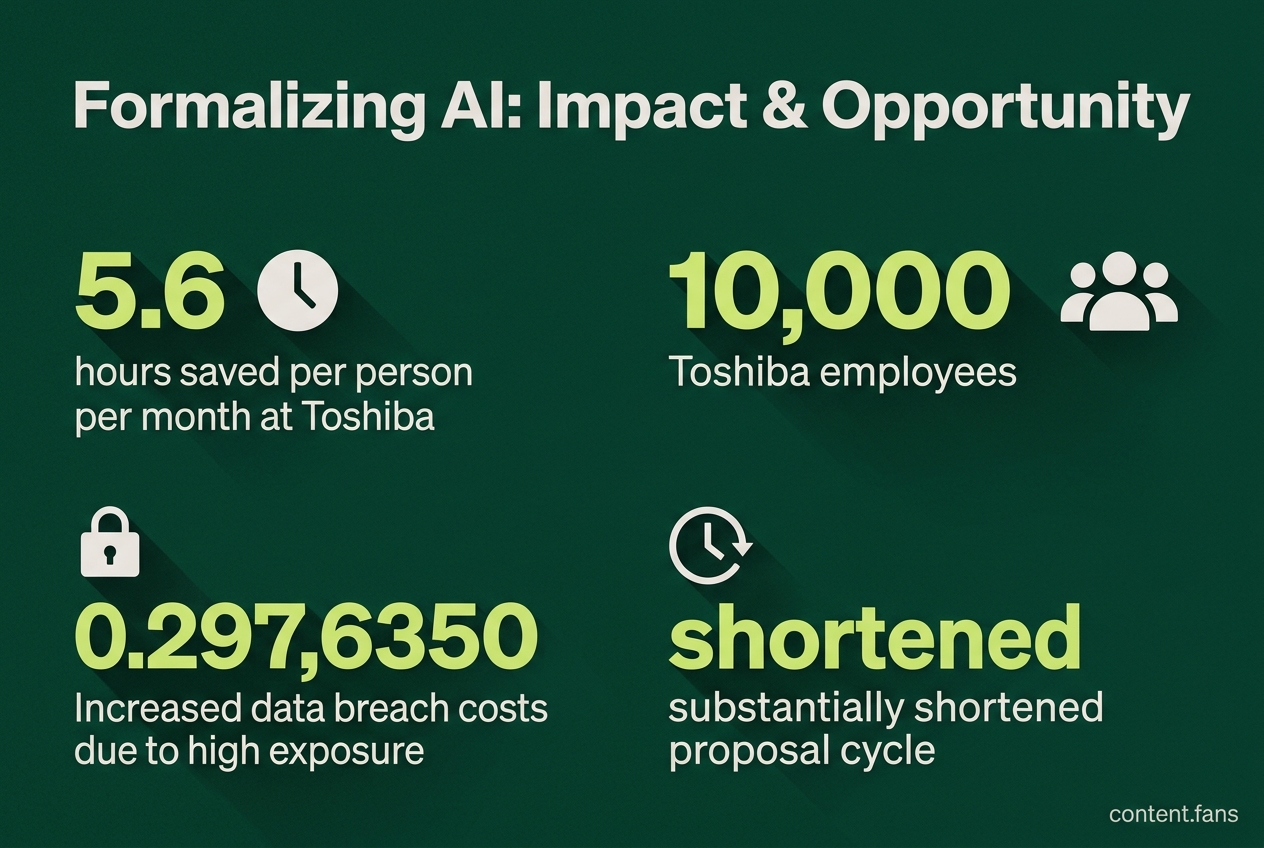
The proliferation of shadow AI is well-documented. According to industry reports, high exposure can significantly increase average data breach costs. Likewise, ISACA audits reveal how confidential data in unapproved tools leads to "unmonitored information flows," violating privacy regulations. Experts recommend a proactive approach: identify tasks employees already automate, then formalize their efforts by standardizing prompts and guardrails within sanctioned workflows. This strategy maintains a human-in-the-loop for final review, minimizing risks like AI hallucination while preserving efficiency gains.
From pilot to production: evidence that scale is possible
Leading enterprises demonstrate the powerful outcomes of moving AI from isolated pilots into core systems under a clear governance framework.
- Toshiba saved 5.6 hours per person per month by deploying Microsoft 365 Copilot to 10,000 employees, detailed in a Microsoft customer story.
- Volvo Group achieved significant reductions in manual document processing hours using Azure AI Document Intelligence.
- Guardian Life substantially shortened their proposal cycle process, a move MIT CISR defines as scaling from pilot to production.
These cases reveal a common thread: measurable benefits arise from deeply integrating AI into existing platforms like CRM and ERP, not from isolated experimentation.
Turning time saved into higher value work
Industry experts caution that productivity gains from AI are only realized when leaders strategically redesign roles and workflows. Without a plan, saved hours evaporate. As autonomous agents handle routine tasks like report generation, human focus must shift to higher-value decisions and strategic analysis. To convert time saved into tangible enterprise value, leaders should follow a clear action plan:
- Map: Identify repetitive tasks already being addressed by shadow AI.
- Select: Choose approved tools and embed them within existing systems.
- Train: Equip users with official prompt libraries and data privacy rules.
- Review: Assign owners to validate AI outputs for accuracy and bias.
- Track: Monitor outcome-focused metrics like hours saved, cycle time reduction, and revenue impact.
As seen in Microsoft's Toshiba engagement, continuous usage analytics can also uncover new bottlenecks, creating a virtuous cycle of optimization.
Transparency and trust keep adoption sustainable
Sustaining AI adoption requires building trust through transparency. Industry experts argue that consistently sharing milestones - both successes and failures - is crucial for reducing employee resistance. When leadership clearly communicates how an AI tool improves a process, such as a chatbot accelerating supplier queries, employees begin to view AI as an ally rather than a threat. This open communication reinforces formal guardrails by clarifying expectations and celebrating documented wins.
The path forward requires a balanced approach: foster innovation, formalize proven tools, and rigorously measure business outcomes. This allows organizations to capitalize on grassroots AI adoption while controlling security, data, and performance risks.
What exactly is Shadow AI and why is it spreading so fast?
Shadow AI is the use of any unapproved AI or machine-learning tool with company data. Its rapid spread is driven by employees seeking immediate productivity gains. With a growing number of employees using personal AI tools for work and a significant surge in sensitive data input, they are bypassing IT to get faster results in drafting, coding, and analysis. This creates a hidden layer of activity that compromises security, compliance, and intellectual property.
How do we move from scattered AI pilots to enterprise-wide value?
According to industry best practices, the key is to treat AI as a core operational capability, not a series of side projects. This requires embedding AI into existing ERP and CRM systems, linking every initiative to measurable business goals like cycle-time reduction, and fostering trust by transparently sharing performance data. Leading companies exemplify this by substantially reducing their proposal processes after moving AI from a pilot to a scaled, enterprise-wide practice.
What guardrails cut risk without killing speed?
Effective governance balances risk and speed with three lightweight controls:
1. Standardized Tools: Provide approved AI models and prompt libraries to ensure accuracy and compliance.
2. Human Oversight: Implement human-in-the-loop reviews for critical outputs. Toshiba used this method in its 10,000-employee Copilot rollout, saving 5.6 hours per person monthly while maintaining quality.
3. Continuous Monitoring: Use telemetry to track usage, data flows, and model performance, which can significantly reduce data breach cost impacts according to industry reports.
How do we turn AI time-savings into higher-value work?
Capturing the productivity gains requires deliberate workflow redesign. The proven method is to:
- Map tasks now automated by AI (e.g., report drafting).
- Reallocate freed-up employee hours to high-value work like strategic analysis, customer innovation, and complex exception handling.
- Update KPIs to reward teams for AI-enabled business outcomes, not just activity. For example, Shell scaled AI to 10,000 assets while upskilling engineers for predictive maintenance, turning saved time into higher-margin services.
What early metrics prove that formalization is working?
From month one, track three key performance indicators to validate your strategy:
1. Cycle Time Compression: Measure the time reduction in AI-assisted workflows. Leading companies have achieved substantial reductions in manual processing hours by scaling AI solutions.
2. Output Reuse Rate: A high percentage of AI outputs used without major rework indicates effective training and prompts.
3. Risk-Adjusted ROI: Calculate savings minus potential compliance and breach costs. With AI-related incidents carrying substantial costs according to industry reports, even modest risk reduction justifies governed deployment.