
Enterprises cut LLM costs and risks with new governance strategies
Serge Bulaev
Enterprises using large language models (LLMs) may face high costs and risks if they do not have strong controls. Governance strategies suggest that tracking model changes, using approved models, and monitoring spending can help reduce wasted budgets and manage risks. Protecting data through automatic masking, encryption, and location controls appears important for privacy. Security measures like role-based access and logging every prompt are recommended, and regular security reviews may help uncover new risks. Following these practices might help companies use LLMs more safely and affordably as rules around AI become stricter.

Enterprises integrating large language models (LLMs) are discovering that without robust controls, unchecked use can rapidly escalate costs and expose sensitive data. Implementing new LLM governance strategies is crucial for aligning AI initiatives with budget discipline, data privacy, and security standards, preventing costly overruns and compliance breaches.
A reliable governance program treats the LLM stack as a production system, not an experimental tool. Industry consensus confirms that establishing ownership, minimizing data exposure, and enabling continuous monitoring are the foundational pillars for all other controls.
Cost discipline starts with version control
Effective LLM governance reduces costs and risks by treating the AI stack like a production system. This involves establishing clear ownership, implementing data minimization policies, and using continuous monitoring to track spending, secure data, and ensure compliance with emerging regulations.
Treating prompts and model configurations as code by managing them through Git workflows ensures every change is traceable and reviewed. A central registry of approved models is essential to prevent shadow AI, while dedicated production and pilot environments stop test queries from inflating production costs. Furthermore, robust observability tools that attribute spending to specific models and versions are critical for accurate cost allocation and incident analysis.
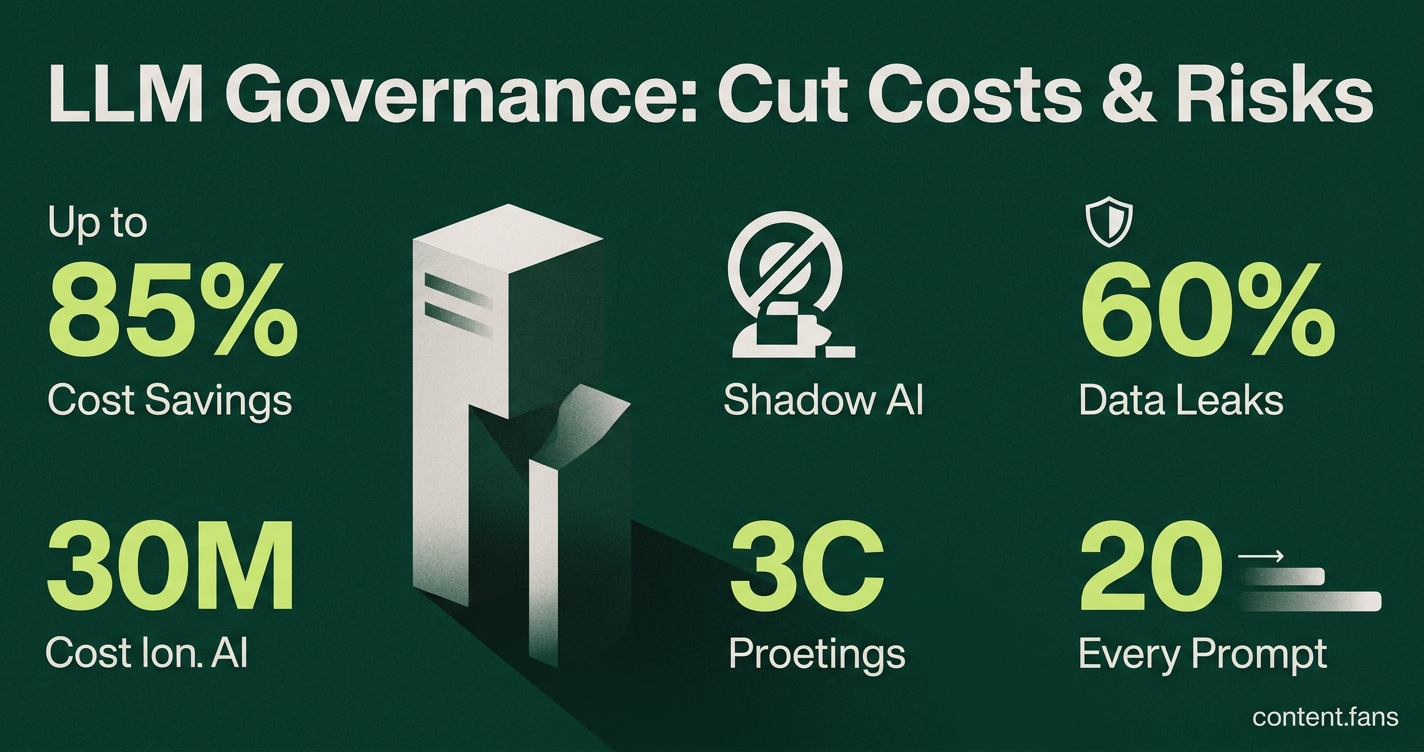
According to industry reports, early LLM deployments can waste a significant portion of token budgets. A key optimization is intelligent routing: using powerful frontier models only for complex queries can slash costs by up to 85% while maintaining near-equivalent quality for most tasks.
Data privacy hinges on sanitization and locality
As highlighted by security experts at the Lasso Security blog, sensitive data can leak through prompts, embeddings, and logs. To mitigate this, automated redaction or masking is a strong recommended control for sensitive-data protection before inference, though implementation approaches may vary based on specific deployment requirements. For data that must be processed, GDPR and data residency laws may require appropriate safeguards and controls, which could include encryption and geographic restrictions depending on the specific circumstances.
Key data privacy controls include:
- Automated redaction of PII or PHI before inference
- Strict retention limits for prompts, outputs, and logs
- Comprehensive audit trails that capture user, timestamp, and model version
- Mandatory privacy impact assessments for high-risk use cases
- Vendor contracts that explicitly define data-use restrictions and subprocessor lists
Security assumes every prompt is an attack surface
A zero-trust security posture requires treating every prompt as a potential attack vector. Foundational defenses include strict role-based access control (RBAC), the principle of least privilege, and comprehensive logging of all prompts. To prevent data leakage and hallucinations, retrieval-augmented generation (RAG) systems must be restricted to vetted knowledge sources, and regular red-team testing is vital for finding vulnerabilities like prompt injection that automated tools often miss.
Effective governance requires organizational structure. Following advice from firms like Knostic, leading enterprises establish cross-functional governance boards comprising security, legal, data, and engineering leaders. A well-defined RACI matrix clarifies responsibilities, while embedding security checkpoints throughout the AI lifecycle - from data collection to deployment - ensures continuous oversight.
Operating model and tooling landscape
To standardize governance, compliance teams can map controls to established frameworks like the NIST AI RMF and the emerging ISO/IEC 42001 standard. Automation is key to scaling these controls; tools like redaction gateways and prompt allowlists significantly reduce manual effort. For performance and cost observability, platforms such as Langfuse or Datadog's LLM monitoring tools provide essential logs on token usage, latency, and model versions, facilitating rapid optimization and anomaly detection.
Key considerations for enterprise deployments
- Inventory all LLM use cases, data sources, and third-party dependencies.
- Centralize and approve models/prompts; block unauthorized assets at the gateway.
- Enforce RBAC and log all prompts with complete user and model metadata.
- Automate sensitive data masking and establish firm log retention policies.
- Monitor daily spend against budgets; tune routing and caching aggressively to control costs.
High-profile incidents of pilot projects exceeding substantial costs in token usage underscore the urgency of robust governance. Budgetary guardrails are not optional; they are as critical as privacy and security controls. By integrating comprehensive cost observability with data-centric security, enterprises can build a foundation to scale LLM adoption responsibly and sustainably, staying ahead of evolving AI regulations.
What budget guardrails stop runaway LLM costs before they hit seven figures?
Hard quotas, rate limits, and a centralized API gateway are the first line of defense.
Uncontrolled pilots have burned through substantial token costs; after such incidents, enterprises now set daily or monthly spend caps tied to project codes and automatically suspend keys when 90 % of the cap is reached.
Pairing the cap with real-time alerting (via Slack, PagerDuty, or your SIEM) gives finance a chance to intervene before the meter spins into the red.
Who should own the approval workflow for new LLM use cases?
A three-person ticket is the minimum:
1. Security verifies data-classification rules and redaction logic.
2. Finance confirms the cost center and budget cap.
3. Legal signs off on vendor data-handling clauses and residency requirements.
Only after all three check the box in the governance board portal does the DevOps team receive the scoped API key. This RACI model keeps shadow AI deployments from slipping through.
How do you keep sensitive source code or PII from leaving the building?
Strip or mask every prompt before it leaves the VPC. Enterprises that implemented automated redaction pipelines saw significant reductions in flagged logs that once contained live credentials.
For highly regulated workloads, prefer private single-tenant deployments behind your own VPC; the extra infra cost is typically a small fraction of the savings from avoiding a single data-breach disclosure.
Which logs must be kept to prove compliance when regulators come knocking?
Store every prompt, output, model version, user ID, and timestamp for at least the minimum retention period required by your jurisdiction.
Logs should be immutable (WORM storage or equivalent) and exported to the same SIEM used for firewalls so correlation is painless.
Enterprise implementations have demonstrated that comprehensive LLM audit trails can support regulatory compliance when properly integrated with existing access control systems.
What toolkit stack stops prompt injection and banned terms in real time?
Put an inline content-filter proxy between your app and the model endpoint.
Open-source combos like Langfuse + a custom allow list can effectively block prompt-injection attempts in real-time during security testing.
Pair the filter with retrieval-augmented generation that only pulls from pre-approved knowledge bases; this approach can significantly reduce hallucination complaints in production environments.