
Enterprises Adopt New Playbooks to Manage Foreign AI Model Risks
Serge Bulaev
Enterprises are making new plans to handle the risks of using foreign AI models, which may include security, legal, and compliance problems. Experts suggest that issues like hidden data tracking, cross-border data sharing, and copying models raise many concerns. Companies are now using guides and frameworks to check and track all outside AI models, and are updating contracts and technical controls to better manage these risks. Reports suggest that watching for unusual network activity and strong vendor rules may help spot and stop problems early. It appears that combining technical, legal, and contract steps is becoming important for strong AI risk management.

To effectively manage foreign AI model risks, enterprises are adopting comprehensive new playbooks. The security, compliance, and legal threats posed by third-party AI have escalated from niche concerns to board-level priorities. High-profile disputes highlight how hidden telemetry, unregulated cross-border data access, and model cloning create overlapping intellectual property and security vulnerabilities. This guide offers a unified strategy, distilling current frameworks and best practices into actionable checkpoints for security, legal, and engineering teams.
Establish a Governance Baseline
A robust governance strategy starts with established frameworks. The (NIST AI RMF) provides a globally recognized structure through its MAP-MEASURE-MANAGE-GOVERN cycle. This enables organizations to inventory every external model, assign risk tiers, and track controls. Similarly, the (EU AI Act overview) mandates continuous risk assessment for high-risk systems, including those from foreign vendors. Complementary standards like ISO/IEC 42001 provide additional layers of control.
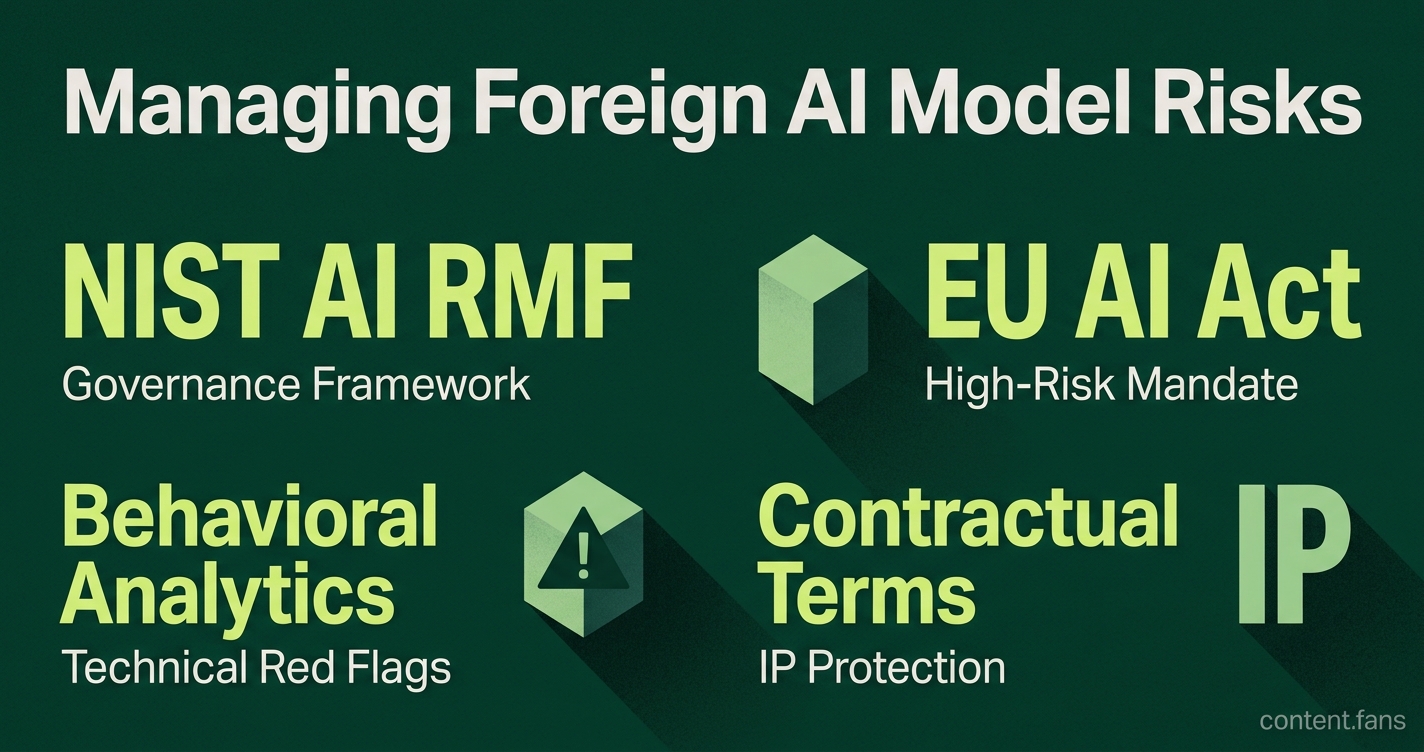
Enterprises manage these risks by integrating technical, legal, and governance controls. This involves adopting frameworks like NIST's AI RMF, implementing continuous network monitoring to detect anomalies, strengthening contractual terms to prohibit model distillation, and maintaining a centralized registry of all approved third-party AI applications.
Identify Technical Red Flags and Shadow AI
Static blocklists are insufficient for detecting modern "shadow AI" threats. Security teams must prioritize behavioral analytics and correlate telemetry from networks, endpoints, and logs. Key technical red flags include:
- Unusual DNS lookups to newly registered or low-reputation domains hosting AI services.
- Encrypted outbound traffic bursts and sudden spikes that deviate from established baselines.
- Metadata anomalies, such as files with sensitive names ("Q3_financials.csv") being sent to external LLM endpoints.
- Hidden telemetry from browser extensions and plugins, which often forward data to external models without clear disclosure.
Strengthen Contractual and IP Protections
Since copyright law offers limited leverage against model distillation, legal defenses must be built into contracts. Robust Terms of Service (ToS) and End-User License Agreements (EULA) are critical. These agreements should explicitly prohibit using model outputs to train competing systems, with breaches triggering contract claims. When procuring external models, enterprises must negotiate for specific clauses covering data use restrictions, anti-distillation rules, and full audit rights. As a more durable defense, organizations should also explore patenting proprietary training pipelines and model architectures.
Implement Continuous Technical Controls
Effective risk mitigation requires a layered technical defense. Organizations should implement comprehensive visibility architecture that combines network detection, endpoint telemetry, and log aggregation to maintain visibility even if one layer is compromised. Key controls include:
- Sandboxing all foreign models behind egress-filtered proxies.
- Running provenance checks on model hashes before production deployment.
- Using behavioral monitoring and SIEM integrations to flag any outbound calls not on an approved inventory.
- Deploying Data Loss Prevention (DLP) systems to detect and block covert data leakage.
Enhance Vendor Due Diligence
With a growing number of GenAI applications running in large enterprises - many of them unmonitored "shadow AI" - rigorous vendor due diligence is essential. Vendor questionnaires must be updated to demand full transparency on:
- Data sourcing and geographic storage locations.
- Policies on reusing customer outputs for model training.
- Procedures for monitoring model drift, bias, and vulnerability patching.
To combat shadow AI, enterprises must establish a centralized, approved-model registry and route all new tool requests through a formal vetting process.
Unify Security and Legal Playbooks for Supply Chain Defense
Ultimately, managing foreign AI risk requires a converged supply chain security strategy where technical, legal, and governance playbooks are unified. Technical audits identify threats, while legal teams codify vendor duties in contracts. Best practices include adding AI-specific addenda to SOC 2 reports, mandating audit rights, and requiring immediate notification of changes to training data that includes customer content. This integrated approach ensures that contracts, technical controls, and governance frameworks reinforce one another, creating a multi-layered defense that does not rely on any single point of failure.