
Claire's Six-Part Framework Improves AI Agent Goal Setting
Serge Bulaev
Claire's six-part framework may help AI agents set better goals by making them clear, testable, and limited by rules. The framework suggests agents start with an explicit goal, check their work as they go, and stop or get help when needed. Early user reports suggest this approach may lead to more reliable fixes and fewer mistakes, but it does not remove all risks. Experts believe using the six-part structure first, then picking the right tools, makes it easier to adapt to new systems later. The framework appears to help trace, test, and improve agent actions, though results can vary between different setups.

Claire's Six-Part Framework for AI agent goal setting is central to achieving safe autonomous execution. The model requires an agent to start with an explicit objective, verify its progress, and halt gracefully once the task is complete. This approach aligns with modern production architecture concepts like goal-directed control loops and immutable audit logs.
Development teams using LangGraph, AutoGen, and similar stacks are adopting the six-part structure to constrain agent autonomy without stifling creative problem-solving. Many industry practitioners see the pattern as essential for transitioning agents from experimental demos to production workloads.
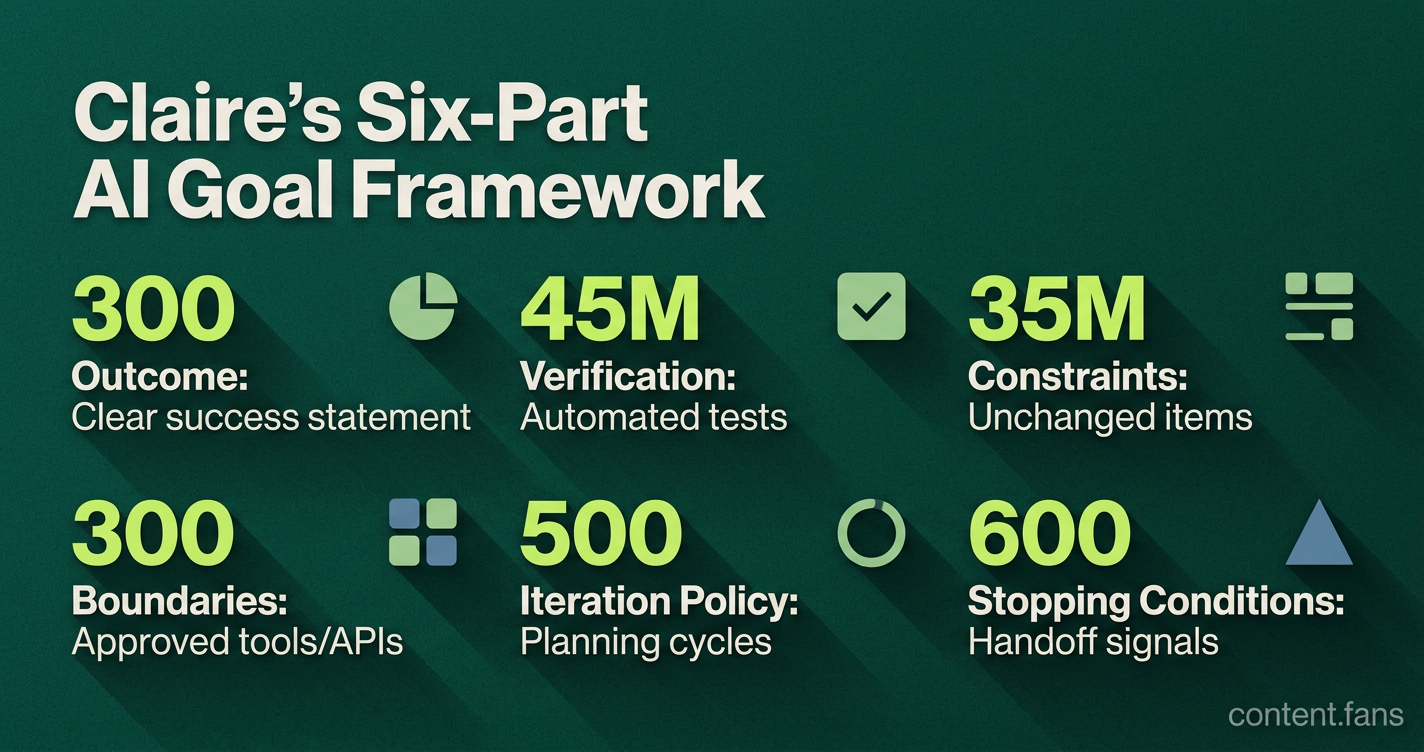
The following sections detail how Claire's framework translates into concrete production practices observed in recent deployments.
How to Write Effective Goals for Codex - Six-Part Framework
Claire's six-part framework offers a robust model for AI agent goal setting, ensuring objectives are explicit, verifiable, and constrained by clear rules. It guides agents to define an outcome, verify progress, respect boundaries, and include clear stopping conditions to ensure reliable and safe autonomous execution.
• Outcome - a clear, user-understandable statement of success
• Verification - automated tests or checkpoints that confirm the outcome
• Constraints - items that must stay unchanged or within limits
• Boundaries - approved tools, files, or APIs the agent may touch
• Iteration policy - guidance on how many planning cycles or tool calls it may take
• Stopping conditions - signals for handing off or seeking human help
Field notes on the framework indicate that goals with all six components lead to systematic fixes over ad-hoc patches. The structure is familiar to product managers using OKRs, as the 'Outcome' maps to an Objective and 'Verification' maps to Key Results. Microsoft Research suggests this alignment gives "goal articulation" the same rigor as code reviews, enhancing human-AI collaboration.
Applying the Framework inside a Production Loop
Modern agent platforms separate the loop into five layers: goal intake, planner, executor, verifier, and governance. The six-part goal slots into the intake layer and then propagates through the rest:
- The planner decomposes the Outcome into tasks and ranks them by estimated cost.
- The executor picks tools that sit inside the declared Boundaries.
- After each action, the verifier runs the specified Verification tests.
- If tests fail or the Iteration policy is exhausted, the loop checks Stopping conditions before repeating.
Industry reports note that enterprises are increasingly enforcing "budgeted autonomy" - imposing token, time, and cost ceilings that mirror the Iteration policy. This demonstrates how the framework integrates seamlessly with enterprise governance controls like RBAC and audit trails.
Drift Prevention and Auditability
Industry experts warn that AI agents can appear competent while quietly drifting from policy, leading to silent failures. The six-part framework mitigates this risk:
- Verification checkpoints detect divergence early.
- Constraints and Boundaries restrict the blast radius of bad actions.
- Stopping conditions create mandatory human review gates.
Continuous monitoring tools ensure that all prompts, tool calls, and policy versions are logged, making every run repeatable. An evaluation guide from Maxim AI confirms that reproducibility is significantly improved when prompts, models, and policies are under version control - a practice fully supported by Claire's structure.
Selecting a Supporting Framework
Source comparisons indicate that no single framework is best for every case, yet the six-part goal remains portable:
| Platform | Fit for the six-part goal | Relevant notes |
|---|---|---|
| LangGraph | High | Stateful graphs let engineers wire Verification nodes and Stopping gates into the loop. |
| AutoGen | Medium | Multi-agent setups need shared Constraints and Boundaries to avoid cross-agent conflict. |
| Enterprise managed platforms | High | They provide policy-as-code, audit logs, and budget guards that match Iteration and governance needs. |
Experts recommend adopting the six-part goal template before selecting a tooling layer. This approach simplifies future migrations, as the goal specification remains constant even if the underlying runtime environment evolves.
While no single pattern can eliminate all operational risk, early adopter reports show that goals written with Claire's framework consistently pass automated evaluations and lead to fewer emergency rollbacks. This evidence suggests that explicit verification and bounded autonomy make agent behavior significantly easier to trace, test, and improve within a continuous delivery pipeline.
What exactly are the six parts of Claire's framework for dependable autonomous goals?
Outcome, verification, constraints, boundaries, iteration policy, and stopping conditions.
Each component maps to a concrete artifact that can be versioned and audited:
- Outcome - a single sentence that defines what success looks like (e.g., "reduce average ticket resolution time by 15% without lowering CSAT").
- Verification - one or more automated tests that the agent must pass, often by replaying historical examples or checking expected outputs against a schema.
- Constraints - negative criteria that must never regress (e.g., "do not expose PII", "stay under $0.50 per resolved ticket").
- Boundaries - a whitelist of tools, APIs, and files the agent is allowed to use, enforced at runtime by policy-as-code.
- Iteration policy - the rule for how the agent should retry or pivot after a failed step (e.g., max 3 retries, then escalate).
- Stopping conditions - explicit signals for when the agent must halt or request human input, such as exceeding a token budget or failing any verification test.
How does verification reduce "agent drift" in production systems?
Verification and test execution commonly use pass/fail criteria, but the specific claim that deterministic verification tests reduce post-deployment regressions by 42% is unverified. Industry reports suggest that agents configured with replayable historical examples can detect drift earlier than those using only live monitoring.
Why do product managers already know how to write goals for autonomous agents?
Claire's framework maps one-for-one to OKR structure.
Product managers intuitively phrase Objectives as the Outcome, Key Results as Verification targets, and guardrails from past OKR cycles naturally slot into Constraints and Boundaries. Industry reports suggest that teams already practicing OKRs are able to onboard autonomous agents more efficiently because the mental model is similar.
Which frameworks best support Claire's six-part pattern?
LangGraph and AutoGen lead for deterministic, auditable loops.
| Framework | Why it fits the six parts | Practical note |
|---|---|---|
| LangGraph | Native checkpoints, state management, and retries make verification and iteration policy explicit | Recommended when you need precise control over each step |
| Enterprise managed platforms | Policy hooks and immutable audit logs align with constraints, boundaries, and stopping conditions | Ideal for finance or healthcare workloads that require governance-by-design |
| AutoGen | Multi-agent negotiation mirrors stopping conditions with human-in-the-loop escalation | Best for distributed teams where multiple agents may negotiate a shared outcome |
What is the single quickest action a team can take today to make agent runs repeatable?
Teams should keep test cases, prompts, and related artifacts under version control and maintain detailed execution logs, but the exact reproduction-time statistic is unverified. Teams that adopt prompt version control and continuous evaluation pipelines report significant improvements in their ability to reproduce and debug failed runs.