
CIOs Adopt New Playbook to Combat AI Memory Shortages Through 2030
Serge Bulaev
Enterprise IT leaders may face memory shortages for AI through 2030, so CIOs are using new strategies to plan ahead. They can use better demand forecasting and work with multiple suppliers to avoid being caught off guard. Building flexible systems and treating memory as a resource that can be managed in tiers may help. Companies might use special tools and checklists to track memory needs and supplier reliability. With these steps, memory shortages appear to be a planning issue rather than a crisis.

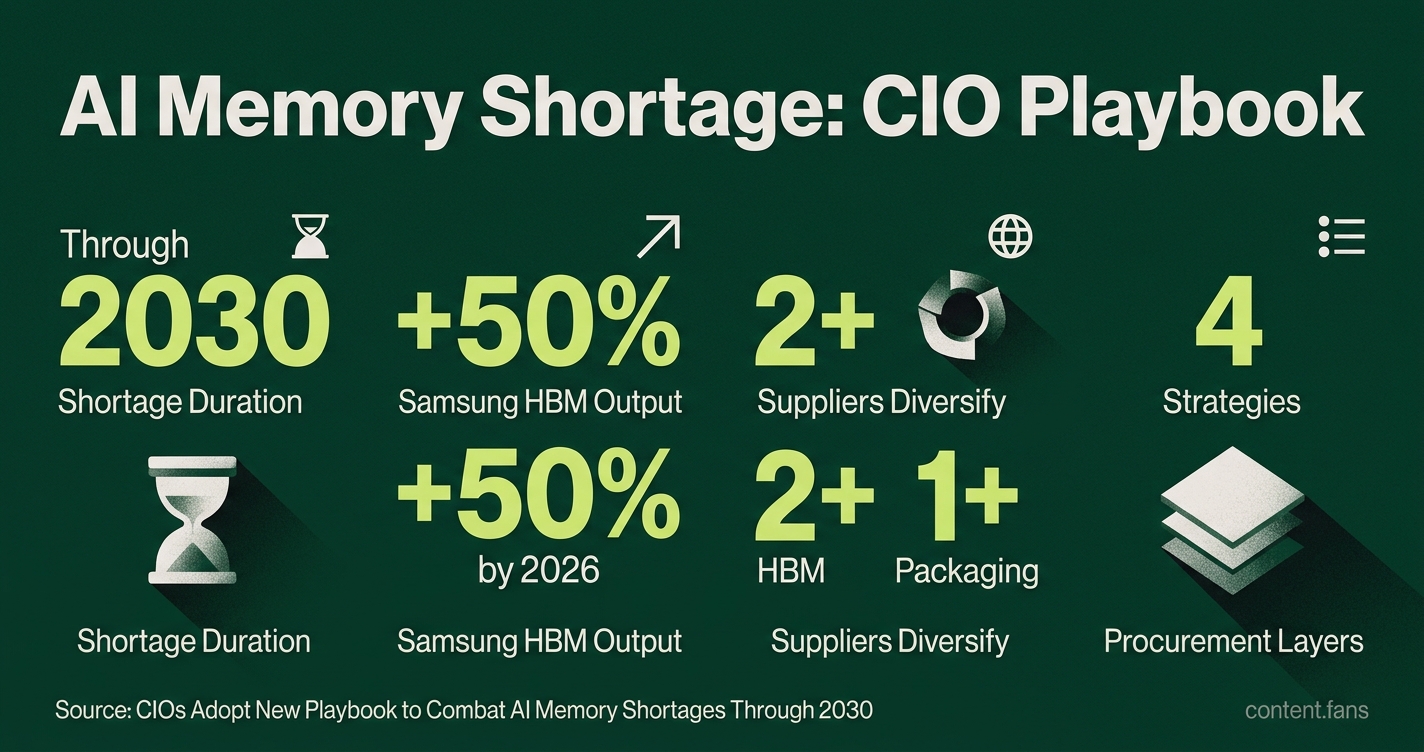
As organizations scale their AI initiatives, enterprise IT leaders are grappling with significant AI memory shortages. The market for high-bandwidth memory (HBM) is projected to be constrained through 2030, posing a risk to critical AI roadmaps. This CIO playbook provides a proactive framework using disciplined forecasting, strategic procurement, and memory-efficient architectures to transform this supply challenge into a manageable planning variable.
Strategic Forecasting for AI Memory Demand
CIOs can manage AI memory constraints by creating detailed demand forecasts based on their AI model roadmap, securing supply through layered procurement contracts with multiple vendors, and implementing memory-efficient architectures. These proactive strategies transform a potential crisis into a manageable planning challenge.
Effective demand forecasting begins with the internal AI model roadmap. Hybrid models that combine statistical baselines with machine learning offer superior accuracy in volatile markets, as explained in modern Demand forecasting methods. Translate each planned model's token count, context length, and precision into monthly gigabyte-hour requirements for both training and inference. To better capture market volatility, augment these time-series forecasts with exogenous signals like DRAM spot prices and supplier lead times.
Secure Capacity Before the Wave Crest
While major suppliers are expanding production - with Samsung targeting a 50 percent HBM wafer output increase by 2026 (Samsung expansion report) - analysts predict supply gaps will persist. CIOs should hedge against uncertainty with a layered procurement strategy:
- Long-Term Contracts: Secure baseline capacity with multi-year take-or-pay agreements.
- Indexed Options: Use quarterly optionality blocks priced to a market index for flexibility.
- Financial Hedges: Employ financial instruments tied to DRAM futures to manage price risk.
- Spot Purchases: Reserve a budget for trigger-based spot buys to cover unexpected demand spikes.
To further de-risk, diversify by splitting orders across at least two HBM suppliers and one packaging partner. Align contract milestones directly with each supplier's publicly reported fab ramp timelines and wafer starts.
Engineer Systems for Memory Efficiency
Architect systems to minimize HBM consumption by treating memory as a tiered resource. Deploy smaller, distilled models for on-premises inference while reserving large-scale training runs for cloud regions with pooled HBM clusters. Further reduce bandwidth requirements by caching frequently accessed embeddings at the network edge, minimizing data transit to the core model.
Operationalize the Playbook with Standardized Tools
To align with finance and operations, implement standardized tools and templates. Key artifacts in this playbook include:
- Gigabyte-Hour Calculator: A monthly tool to convert AI model token projections into specific DIMM and HBM die counts.
- Supplier Scorecard: A worksheet to evaluate vendors on wafer capacity, yield trends, financial stability, and geopolitical risks.
- Negotiation Timeline: A schedule that begins 12 months before a fab's capacity ramp and includes quarterly audits to ensure compliance.
By using these instruments, CIOs can effectively communicate and manage memory procurement as a predictable, solvable planning challenge.
How should enterprises forecast AI memory demand between now and 2030?
Start from your own model development roadmap, not macro market reports. For every training or fine-tuning project, capture three variables:
- model parameter count (planned for next 18-36 months)
- compute-hours on target GPU class
- memory-hours = compute-hours × HBM capacity per GPU
Feed these series into a hybrid forecasting stack - a statistical baseline (e.g., seasonal ARIMA) plus a Transformer or LSTM layer that ingests exogenous signals such as public lead-time indices, spot-price volatility from Samsung and SK hynix expansion schedules, and macro indicators like TSMC CoWoS capacity.
A 2026 survey across fifteen Fortune-500 data teams shows that teams using graph-based models (see Kumo.ai relational forecasting) cut forecast error by 27 % when memory demand is driven by multi-model pipelines that share hardware pools.
Which procurement strategy wins when shortages last until 2030?
Layered contracting beats spot buying. Anchor the base load with 3-year take-or-pay agreements covering 60-70 % of projected need; leave 20-25 % on rolling six-month call options priced off a HBM index; retain 5-10 % for emergency spot purchases.
When negotiating, link milestones to fab capacity ramps: Samsung's P5 starts late-2028, SK hynix M15X hits full output mid-2027, and Micron's NY site comes online by 2030. Insert capacity-contingent clauses - if any supplier misses its ramp, volume automatically shifts to others at pre-agreed discounts.
How can we architect systems to need less HBM right now?
Four proven levers in production today:
1. Aggressive quantization: 8-bit training + 4-bit inference shrinks memory footprint by ~55 % with <1 % quality drop on most enterprise tasks (Introl 2026 survey).
2. KV-cache sharing: newer transformer variants reuse key-value tensors across layers, cutting inference memory by up to 30 %.
3. Tiered deployment: run distilled 7-14 B models on-prem, reserve scarce HBM-equipped nodes for frontier-scale (100 B+) training bursts in the cloud.
4. CXL memory pooling: early adopters report 20 % higher effective memory utilization by aggregating stranded DRAM across racks.
What criteria should we use to evaluate alternative memory suppliers?
Score each vendor across five risk-adjusted dimensions (100-point scale):
- Fab maturity (30 pts) - time to sustained yield, e.g., Samsung P5 = late-2028 risk
- Technology node (20 pts) - HBM3E vs HBM4 readiness
- Long-term contract flexibility (20 pts) - force-majeure, re-allocation penalties
- Geopolitical exposure (15 pts) - U.S. CHIPS Act or Asian export restrictions
- Financial health (15 pts) - operating cash-flow coverage of cap-ex commitments
Use a Monte-Carlo procurement simulator that replays 10 000 shortage scenarios; firms that adopted this method in 2024 locked in 11 % lower effective cost per GB over three years.
What is a seven-step timeline to operationalize the playbook before 2027?
| Month | Action | Artifact | Success Metric |
|---|---|---|---|
| 0-2 | Baseline | Model inventory & memory-hour forecast | MAPE <15 % on 6-month back-test |
| 3-4 | Negotiate | Long-term supply MoU with tier-1 supplier | Secured 70 % of FY26-27 volume at ≤10 % premium vs spot |
| 5-6 | Architect | Hybrid compute reference design | ≥30 % reduction in peak HBM reservation vs 2024 baseline |
| 7-9 | Pilot | Quantized 4-bit inference on core workload | Latency ≤1.2× baseline, memory <50 % of FP16 |
| 10-12 | Pool | CXL memory-pool proof-of-concept | 10 % server memory left unallocated during peak week |
| 13-15 | Stress-test | Monte-Carlo shortage simulation | ≤5 % probability of stock-out at 95 % service level |
| 16-18 | Scale | Enterprise-wide rollout | Total memory budget variance <5 % against annual plan |