
Bristol Myers Squibb Integrates Anthropic's Claude AI for Drug Discovery
Serge Bulaev
Bristol Myers Squibb is working with Anthropic to use Claude AI in drug discovery and other business areas. This partnership may help BMS choose which projects to focus on by predicting what will work before spending resources. Claude's tasks include helping with research, making documents for trials, and solving problems in manufacturing. Experts suggest that using AI like this might make drug discovery faster and lower costs, but the exact benefits are still uncertain. The results of this partnership could become clearer as BMS measures how well Claude improves their work and how quickly new projects move forward.
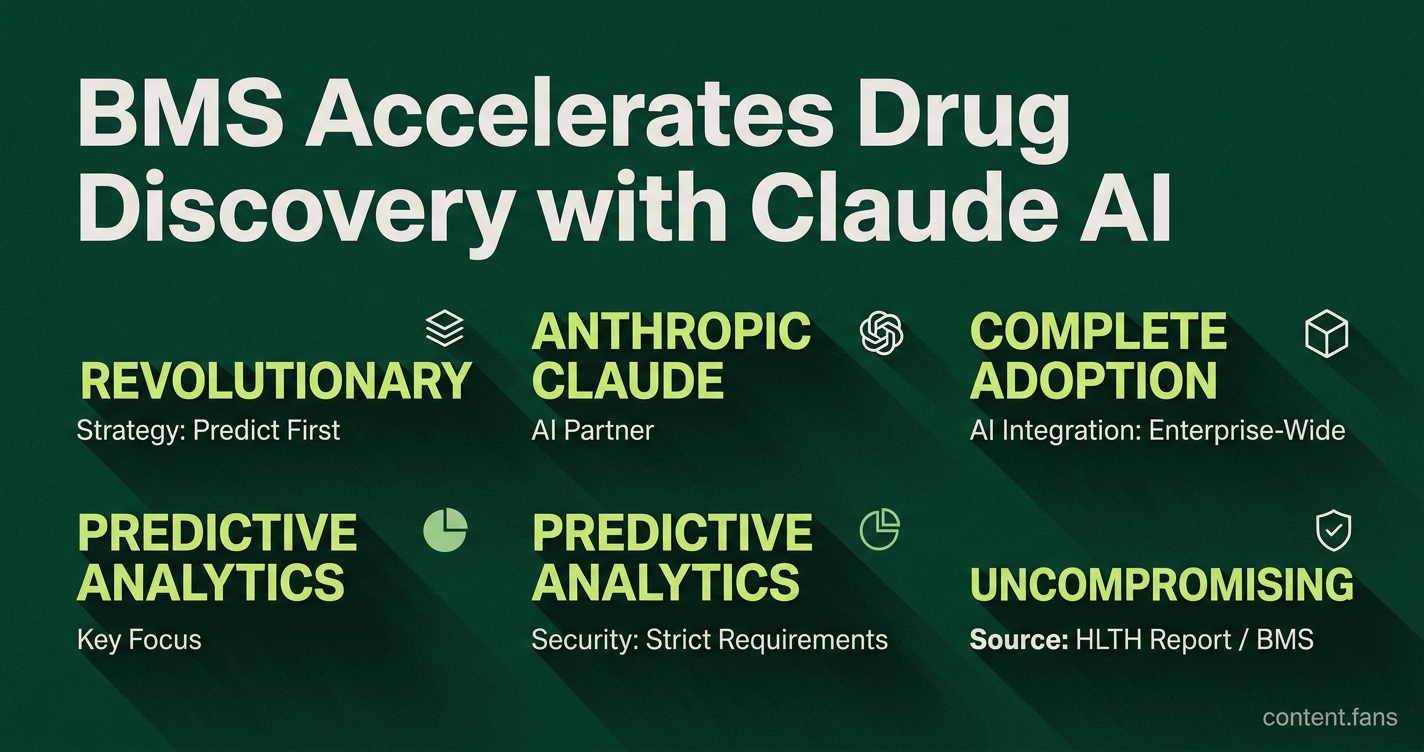
To accelerate drug discovery, Bristol Myers Squibb integrates Anthropic's Claude AI, providing a new digital foundation for its R&D and operational workflows. This partnership expands BMS's "predict first" strategy, using AI to identify promising molecules and processes early, thereby optimizing resource allocation. The agreement, detailed in a HLTH report, embeds Claude's AI capabilities across research, manufacturing, clinical development, and commercial departments.
How Will Claude AI Accelerate BMS Operations?
The partnership tasks Claude AI with key responsibilities including synthesizing research literature, drafting clinical trial documents, guiding manufacturing investigations, and retrieving internal knowledge for medical and commercial teams. This integration aims to accelerate workflows from early-stage target optimization through to regulatory approval and commercial support.
According to HLTH coverage, Claude's initial assignments include:
- Literature Synthesis: Generating hypotheses for target optimization.
- Regulatory Documentation: Drafting trial documents and submissions.
- Manufacturing Support: Guiding root-cause investigations and Corrective and Preventive Action (CAPA) files.
- Knowledge Management: Surfacing institutional data for medical and commercial affairs.
BMS executives state the platform's "agentic capabilities" can connect internal systems while upholding strict security requirements.
Building a Predictive Biopharmaceutical Company
This collaboration is a key component of BMS's ambition to become a fully predictive biopharmaceutical firm. The company's strategy is to use predictive analytics before committing lab resources. On the company's "Predictive molecule invention" page, Head of Digital Discovery Payal Sheth confirms that scientists are "predicting before we synthesize on the majority of the molecules." This approach, which uses virtual screening and mechanistic modeling, extends to commercial operations. The BMS technologies page notes that AI-driven commercialization is designed to enhance engagement with healthcare professionals and speed up internal decisions.
A Portfolio of Strategic AI Partnerships
The Anthropic deal complements a growing portfolio of AI-focused collaborations designed to enhance BMS's capabilities. This strategy involves using Claude for enterprise-wide knowledge integration while leveraging specialized partners for specific design challenges. Key alliances include:
* AI Proteins: A research and option deal for miniprotein design.
* Menten AI: A completed project focused on peptide macrocycle generation.
* PathAI: An alliance for pathology algorithms to support translational research.
* Evinova: A rollout of Study Designer software across its global clinical trial portfolio.
This multi-partner approach allows internal teams to focus on validation and scaling promising discoveries.
What are the Expected Industry-Wide Benefits of AI?
The push for AI integration is driven by significant potential gains. Available sources suggest AI may cut some early discovery steps by about 50-70% in best-case examples, with specific AI programs reaching preclinical candidates in roughly 12-18 months, but these figures vary by company and stage. Industry reports suggest AI-guided approaches could substantially decrease small-molecule discovery costs and timelines, though specific benefits depend on implementation and application.
While these projections are estimates, they highlight the substantial commercial and clinical incentives for pharmaceutical companies investing in advanced digital strategies.
Key Milestones for Measuring Success
The effectiveness of BMS's AI strategy will become evident by tracking several key performance indicators:
1. Improved Cycle Times: Measurable reductions in time for target triage and clinical protocol drafting.
2. Manufacturing Efficiency: The speed and scale of deploying AI tools, like CAPA documentation, across manufacturing facilities.
3. Pipeline Progression: The rate at which new programs designed with AI, such as miniproteins and peptide macrocycles, advance into clinical trials.
These milestones will serve as crucial indicators of how well the company converts its AI investments into tangible pipeline progress and new patient therapies.
What specific tasks will Claude AI perform for BMS scientists and teams?
Bristol Myers Squibb plans to deploy Claude as an end-to-end enterprise agent that reaches far beyond traditional discovery work.
Key tasks confirmed by the company include:
- Research & target optimization - literature synthesis, hypothesis generation and data extraction
- Clinical development - automated drafting of trial protocols, investigator brochures and regulatory submissions
- Manufacturing quality - root-cause investigations, CAPA documentation and data-driven batch-release decisions
- Commercial & medical affairs - rapid internal knowledge retrieval and customer-facing content generation
In short, Claude will act as a secure knowledge layer that spans the entire value chain, from first scientific question to post-marketing support.
How does this partnership fit into BMS's broader AI strategy?
The Anthropic deal is the cornerstone of BMS's "predict first" transformation, a company-wide push to predict molecule success before any lab work.
- BMS already screens the majority of new molecules in silico before synthesis, with industry reports suggesting significant reductions in early discovery timelines
- Claude will now extend predictive power into manufacturing, regulatory and commercial arenas, aiming to make BMS "the first truly predictive biopharmaceutical company"
- The model complements existing specialized discovery pacts (AI Proteins, Menten AI) and positions Claude as the enterprise orchestration layer that connects all external and internal data systems.
Have other pharma companies seen measurable gains with Claude?
Yes - documented wins are emerging across the industry, though specific metrics vary by implementation and company reporting practices. Several pharmaceutical companies are running Claude across drug discovery, oncology programs and regulatory compliance, citing faster go/no-go decisions. Early results suggest both speed and accuracy gains when Claude is deployed at enterprise scale, though comprehensive benchmarking data remains limited.
What pipeline or timeline benefits can BMS realistically expect?
A safer summary is that AI has been reported to reduce certain early discovery timelines to roughly 1-2 years and, in some case studies, to 13-18 months for preclinical candidates. Claims about universal savings and success rates should be treated cautiously unless backed by the original studies.
BMS declined to publish program-specific targets, but the company notes that even modest acceleration per candidate compounds to significant portfolio advantages over time.
Is Claude replacing scientists or augmenting them?
Augmentation, not replacement. BMS's leadership emphasizes a hybrid intelligence model where AI acts as an extension of the lab bench.
"We have integrated AI, machine learning and the human component as part of our drug-discovery fabric." - Payal Sheth, BMS (Science Firsthand)
"Anthropic's Claude gives us agentic capabilities and security necessary to put collective knowledge in the hands of every BMS employee to accelerate innovation for patients." - BMS statement on HLTH
In practice, scientists will continue to drive mechanistic understanding, experimental design and ethical oversight, while Claude handles data-heavy, repetitive or documentation tasks.