
AWS, Strac.io Detail AI Security Checklist for Data, Model Protection
Serge Bulaev
AWS and Strac.io suggest that early, structured steps in AI security may help prevent data leaks and audit problems. They outline a five-step data governance model and recommend combining automated and manual checks, since automated tools may mislabel sensitive data. For AI models, risks like data poisoning might be hard to catch, so ongoing monitoring and strict controls appear important. Experts highlight that even strong defenses can miss some attacks, and updating backup and response plans for AI-specific threats may reduce harm if incidents happen.

An effective AI security checklist for data and model protection, informed by guidance from AWS and Strac.io, is essential for balancing innovation with robust safeguards. Without strong governance, critical data can be exposed in weeks, long before models enter production, leading to urgent compliance and security remediation. Achieving meaningful risk reduction requires structured, tactical actions, not just abstract principles.
Data governance - from discovery to accountability
Structuring AI data governance involves establishing a clear framework for data discovery, classification, and access control. Teams should implement protections for data in transit and at rest, maintain comprehensive audit trails for all operations, and manage the security lifecycle of third-party vendors and models to ensure compliance.
Strac outlines a governance approach based on three channels (browser, endpoint, MCP) and a data layer strategy, with AI governance built on five components: Model inventory, Risk/impact management, Data management, Model verification, and Observability. This framework allows security teams to pinpoint vulnerabilities quickly while supporting iterative model development. A federated access model enables business units to set specific rules under a centralized security umbrella.
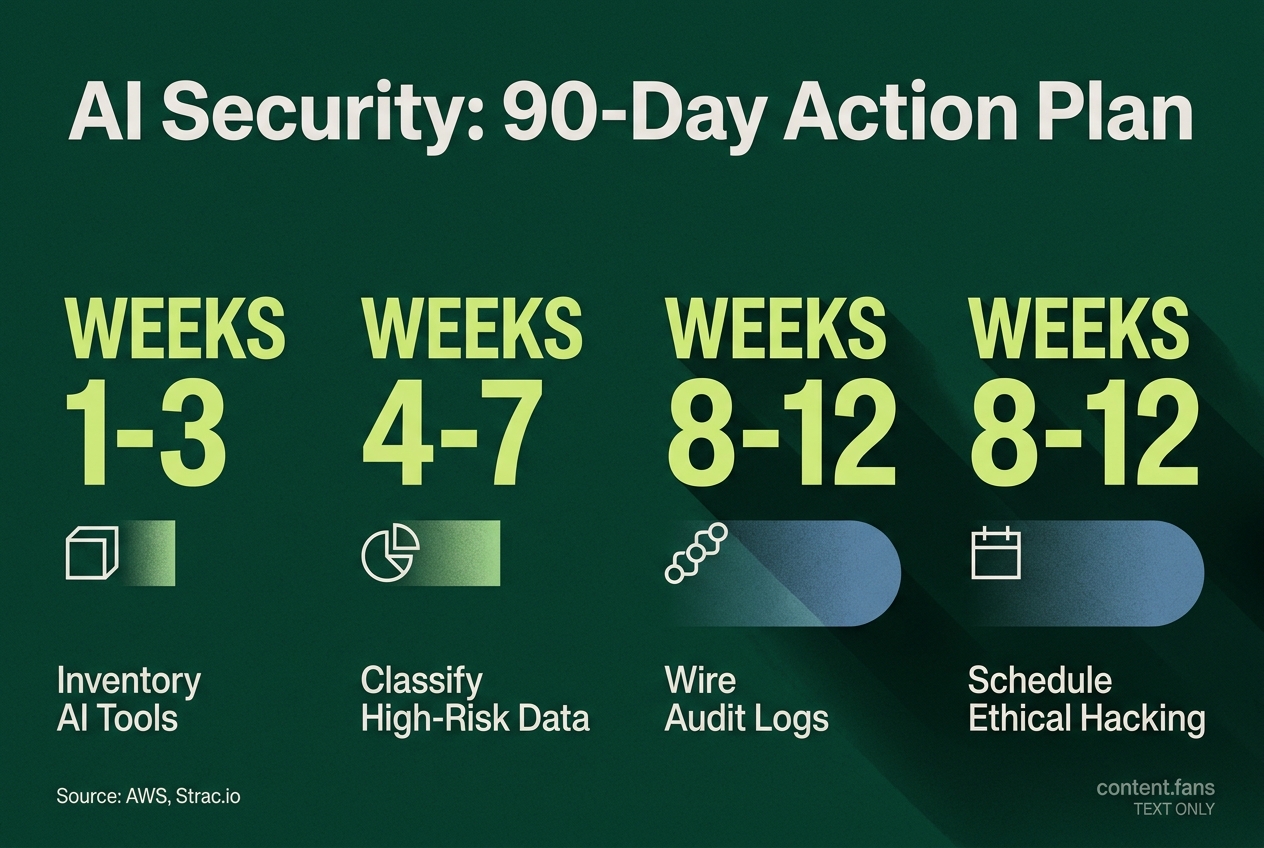
Key controls for the first 90 days include:
- Inventory each AI tool and data flow (Weeks 1-3)
- Apply automated discovery plus human review to classify high-risk fields (Weeks 4-7)
- Wire audit logs to an existing SIEM and schedule external ethical hacking tests (Weeks 8-12)
However, automated scanners often misclassify sensitive data like biometric or EMR records. Manual verification is crucial, as it can correct a significant portion of these automated alerts, reinforcing the need for human oversight.
Model security - guarding against poisoning and prompt tricks
Data poisoning is a significant threat that can be difficult to detect. To counter this, teams must implement rigorous data provenance checks and use checksum-secured pipelines to flag unauthorized changes before training. Security guidelines recommend anomaly filtering and strict access controls on training data.
For production models, continuous telemetry is non-negotiable. The Cloud Security Alliance recommends implementing anomaly detection on model outputs, adversarial training (prompt injection defense), and model inversion protection via the AI Controls Matrix and DSP guidelines. While adversarial training can improve robustness, the Cloud Security Alliance notes it is only effective when combined with systematic attack-surface mapping, explaining why many organizations still struggle with evasive attacks.
Resilient backups and incident playbooks
AI-driven ransomware detection is increasingly used in modern backup systems to detect threats before data corruption occurs. A growing number of enterprises plan to adopt autonomous, AI-driven backups in the coming years. Product capabilities vary significantly; for example, Dell PowerProtect provides basic anomaly detection, whereas Commvault Metallic offers advanced classification capabilities. Leading backup vendors include Rubrik, Cohesity, and Veeam, each offering different approaches to real-time threat analytics.
Regardless of the platform, a comprehensive strategy must include immutable, air-gapped storage and an incident response playbook tailored to AI-specific threats. Traditional runbooks often lack procedures for rolling back a poisoned model or its vector database. Updating these playbooks with clear steps for model de-poisoning and adversarial re-testing is critical for minimizing recovery time after an incident.
How should teams structure data governance to secure AI workloads without slowing innovation?
Adopt a five-component model:
1. Model Inventory - Automatically catalog AI models and their data dependencies.
2. Risk & Impact Management - Enforce role-based and purpose-based controls through tools like AWS Lake Formation.
3. Data Management - Encrypt data moving between training clusters and vector stores.
4. Model Verification - Pipe AI logs into your existing SIEM/GRC stack.
5. Observability - Track third-party models with quarterly security reviews.
A 90-day rollout pattern works: inventory every AI tool and data flow in weeks 1-3, deploy classification and prompt-level redaction in weeks 4-7, then wire audit hooks and continuous monitoring by week 12 - see the Strac.io playbook for step-by-step guidance.
What concrete steps stop data poisoning and adversarial attacks on models?
- Data provenance checks: checksum every training file, store versions in an immutable repository, and reject any record that fails statistical outlier tests.
- Adversarial training pipeline: inject synthetic attacks during each training run and measure degradation; retraining triggers when accuracy drops significantly.
- Runtime guardrails: filter inference inputs with a safety classifier and red-team the model regularly - organizations that conduct regular red-teaming reduce successful poisoning incidents significantly.
- Least-privilege build environments: only automated CI/CD service accounts may push training images; human researchers get read-only access.
Which backup and recovery solutions protect petabyte-scale AI data with built-in anomaly detection?
Leading backup vendors include Commvault Metallic, Rubrik, and Cohesity, while Dell PowerProtect adds basic anomaly scanning but lacks advanced AI-driven features. Selection considerations:
| Need | Recommended |
|---|---|
| Cloud-native SaaS with advanced classification | Commvault Metallic |
| Air-gapped ransomware vault | Rubrik |
| Hybrid-cloud with cyber vaulting | Cohesity |
| Cost-effective on-prem solution | Veeam Backup & Replication |
A growing number of enterprises expect to run autonomous backup workflows - pick a vendor that exposes REST APIs for this roadmap.
How do we monitor models and data pipelines at production scale?
- Model telemetry: stream prediction latency, confidence scores, and drift metrics to a managed Prometheus stack; page on-call when KL-divergence exceeds thresholds.
- Data quality gates: add policy-as-code scripts in your training DAG that halt the build if too many rows are duplicates or nulls.
- Prompt/response redaction: mask PII and credentials before logging to long-term storage; this significantly reduces sensitive data leakage.
- Incident response playbook: extend runbooks with AI-specific steps - isolate poisoned checkpoints, redeploy last known-good model, and replay recent inputs through a sandbox.
What roles and timelines keep the governance program accountable?
- Week 1: Set up an AI Ethics Board (legal, security, data science, product) that meets bi-weekly to approve new datasets and model releases.
- Week 2: Assign Data Quality Stewards in each domain - e.g., Finance, HR, Clinical - responsible for tagging sensitivity levels and approving transformations.
- Week 4: Contract an external red team to run a model poisoning simulation; fix findings within 30 days.
- Continual: Track OKRs - "Data classification coverage ≥95 %", "Model drift alert MTTR <30 min", "Backup restore validation success rate =100 %" during quarterly reviews.