
Anthropic, Parasoft guidance forms new enterprise AI code safety checklist
Serge Bulaev
Enterprises using autonomous coding tools may need to follow a new checklist to make sure agent-written code is safe and meets legal and security standards. The checklist suggests steps like human review, layered testing, restricted agent permissions, and careful logging of changes. Legal and audit needs appear to require storing evidence for every action, and the rules for liability and copyright of AI-generated code are not fully settled yet. Pilot programs and graduated reviews might help reduce risk as organizations adopt these tools. These practices are meant as a starting point and can be adapted as needed.

Enterprises adopting autonomous coding agents require a robust enterprise AI code safety checklist to ensure agent-authored software meets critical security, legal, and engineering standards. Drawing from expert guidance, this framework emphasizes layered verification, human oversight, and comprehensive audit trails for every AI-generated action.
Enterprise checklist for safe deployment of agent-authored code
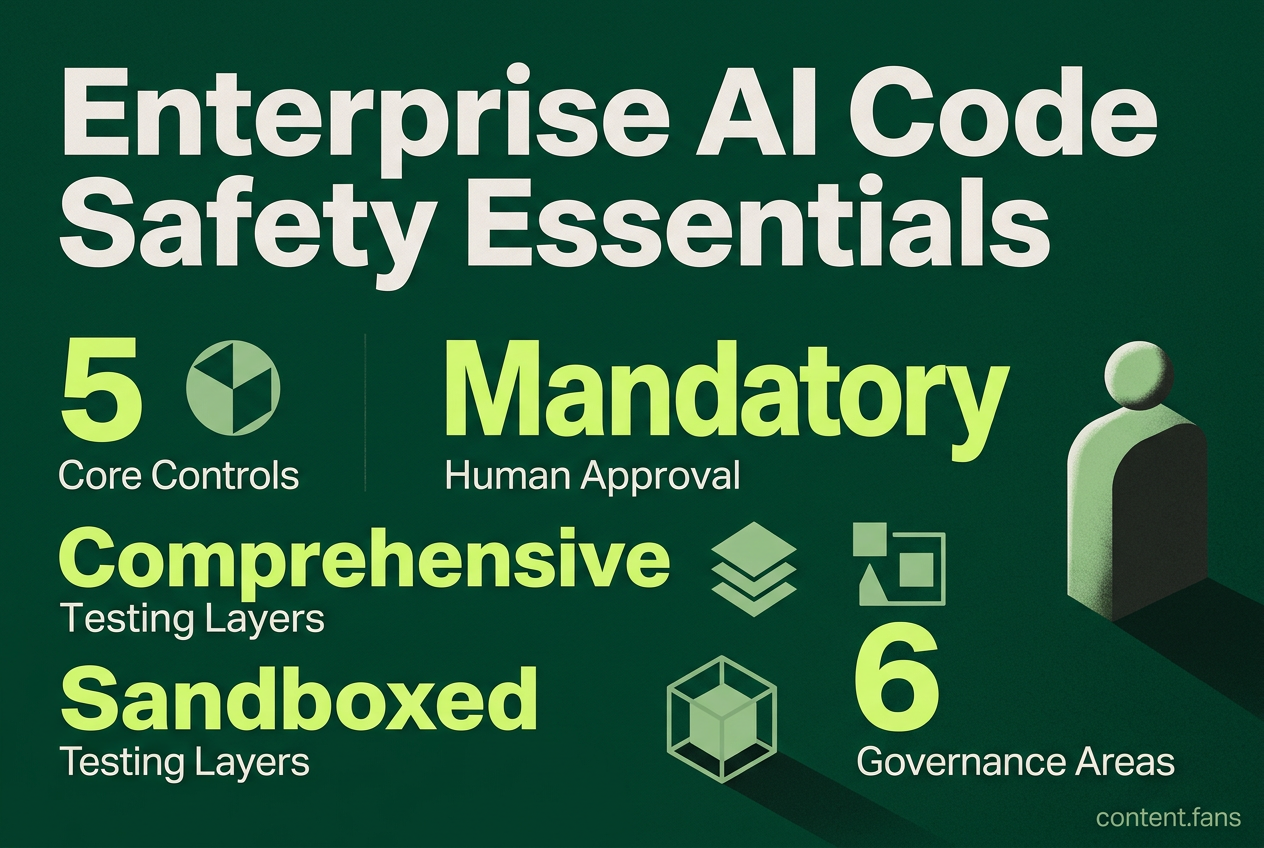
An effective safety checklist for AI-generated code integrates five core controls. These include mandatory human approval for sensitive changes, a multi-layered testing pipeline, sandboxed agent execution environments, detailed provenance logging for every action, and enforcing least-privilege access to tools and systems to minimize potential impact.
- Human Approval Gate: All security-sensitive code changes must be approved by a qualified engineer before being merged or released, a practice advised by Anthropic (Trustworthy agents in practice).
- Layered Testing Pipeline: Every AI-generated change must pass through a comprehensive testing suite, including static analysis, unit, integration, and regression tests, as recommended in Parasoft's guidance (annual software testing trends).
- Sandboxed Execution: Agents must operate within restricted file system and network scopes, preventing them from acting outside their designated task.
- Provenance Logging: To meet transparency rules like the EU AI Act, each change record must capture the model ID, prompt, test results, and reviewer details.
- Least-Privilege Tool Access: AI agents should only be granted the minimum permissions necessary for their tasks, combining role-based access controls with runtime monitoring.
Testing and audit evidence
Parasoft emphasizes that teams must treat generated code as a preliminary draft, not a release candidate, requiring comprehensive scans before acceptance. This creates a system of evidence where maintaining test artifacts alongside code enables auditors to trace defects back to the exact prompt and model version. Every commit should link to static analysis reports, provenance data, and immutable logs.
In regulated industries, many organizations are implementing stricter documentation and review cycles for high-impact systems. Best practices involve embedding security architecture from the start and leveraging AI agents to assist in reviewing large volumes of generated code for potential vulnerabilities.
Security architecture from day one
Leading enterprise pilots utilize a control table to track six key governance areas: provenance, static security, functional validation, agent safety, monitoring, and governance. By assigning evidence types and review owners to each area, organizations create a dynamic document that streamlines both engineering and compliance audits.
Integrating legal and contractual safeguards
With legal liability for autonomous agent behavior still unsettled, legal teams must update contracts to define indemnity, audit rights, and rollback procedures. Furthermore, obligations for transparency and human oversight under regulations like the EU AI Act are already enforceable, requiring that detailed logs and approval records be readily available for regulators.
Copyright ownership for purely AI-generated code also remains a legal gray area. A practical mitigation strategy is to meticulously store original prompts and model identifiers, which enables clear provenance tracking if copyright infringement claims arise.
Operational rollout pattern
To minimize risk, enterprises should begin with pilot programs in non-production environments. This approach allows controls to mature before a full rollout. Implementing risk-tiered review gates - with stricter scrutiny for systems impacting safety or financial data - is a recommended pattern. Post-release, continuous runtime monitoring and immutable log retention are essential.
The checklist practices above provide a foundational baseline for safe AI code generation. While teams should adapt and extend them with industry-specific controls, every control must map to a verifiable evidence artifact. This ensures that compliance attestation becomes a seamless part of the daily engineering workflow.
What makes agent-authored code different from human-written code when it comes to safety?
Agent-authored code is produced by non-human actors that can iterate thousands of lines in seconds, so traditional spot reviews no longer scale. Industry reports indicate that the same agents can also introduce subtle security regressions faster than any human, making layered verification and mandatory human sign-off the new baseline instead of an exception.
Which checkpoints should every enterprise enforce before an agent's pull request reaches main?
According to industry reports, five non-negotiable gates are recommended:
1. Static analysis for insecure patterns
2. Unit and regression test coverage linked to requirements
3. Dependency and secrets scan
4. Traceable provenance (model, prompt, reviewer ID)
5. Human approval for any change that touches security or compliance boundaries
Teams that skip any of these steps show a significantly higher defect escape rate in regulated deployments.
How can we prove compliance if regulators ask for evidence months later?
Build an immutable audit trail that captures:
- exact model version
- prompt text
- test results
- approver identity
- deployment timestamp
Anthropic's public framework calls this a "system of evidence" and stores it in queryable logs, while Parasoft suggests exporting the bundle to your artifact repository so every release package carries its own compliance capsule.
Do internal pilots really lower risk, or is that just corporate folklore?
According to industry reports, pilot-first teams significantly reduce critical incidents compared with teams that jump straight to production. The safest pattern is:
1. Run agents inside sandboxed staging
2. Restrict file system and network permissions
3. Enforce two-level human review for any output that will face customers or handle sensitive data
Only after three successful sprints with zero unreviewed agent commits should the guardrails be relaxed for production adjacent environments.
What happens if an agent writes code that later infringes a license or leaks personal data?
Legal responsibility still rests with the deploying organization. Industry guidance stresses that data protection liability cannot be off-loaded to the model provider, and legal experts warn that copyright ownership of purely AI-generated snippets remains unsettled in most jurisdictions. The practical shield is provenance tracking plus a pre-flight scan for license conflicts and personal data before any agent output is merged.