
Anthropic, OpenAI, Google Discuss AI Safety Standards Body for 2026
Serge Bulaev
Anthropic, OpenAI, and Google have held private talks about creating an AI safety standards body, with discussions becoming public in September 2026. The companies are considering voluntary safety rules and shared benchmarks for AI systems, but no final decisions or formal commitments have been made. Reports suggest that these efforts might help large buyers and regulators review risks and could lead to industry-led standards that may influence future laws. The companies appear to be reviewing existing safety frameworks and might include shared safety labels, testing, and reporting tools. However, many details, including rules and enforcement, are still undecided and talks are ongoing.
Leading AI firms Anthropic, OpenAI, and Google are discussing the creation of an AI safety standards body, a private effort that became public in September 2026. These early-stage talks, which began in July 2026, aim to establish voluntary safety rules and common benchmarks for risk review before powerful new AI models are released.
What the September reports say
The discussions focus on creating voluntary safety rules and shared benchmarks for advanced AI systems. While no formal commitments have been made, the goal is to provide a common framework for enterprise buyers and regulators to assess and manage potential risks associated with frontier AI models.
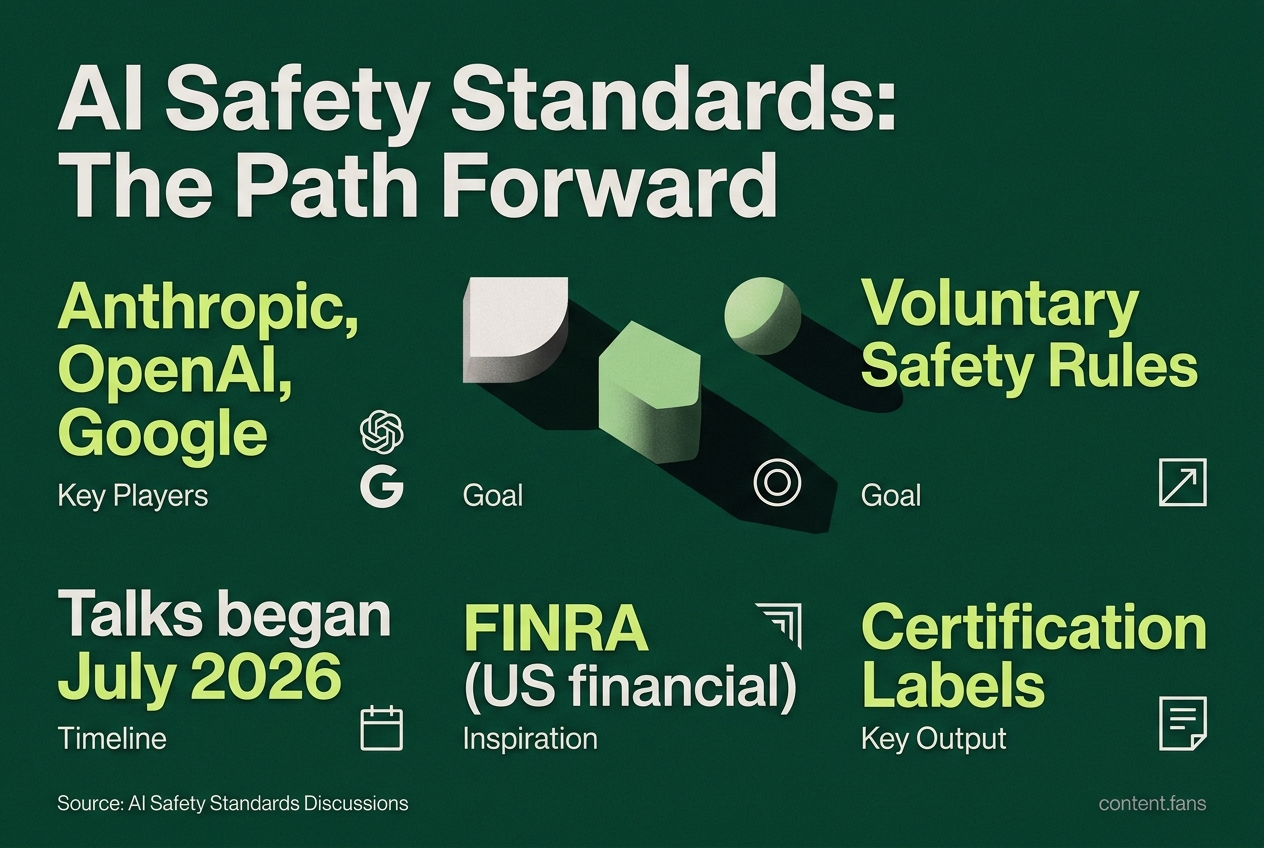
According to Reuters, the talks drew comparisons to the U.S. financial industry's self-regulatory body, FINRA. CNN reported that the firms were consulting external organizations on concrete standards and would share more details soon. Other outlets confirmed that key details like a charter, membership rules, and enforcement mechanisms are still undecided.
Draft scope under consideration
The discussions are reportedly drawing from existing frameworks like the International AI Safety Report 2026, which emphasizes model testing, red teaming, and incident reporting. Potential outputs being considered include:
- Shared benchmarks that quantify jailbreak resistance, bias and hallucination rates
- Standardized pre-release safety reviews with independent evaluators
- Confidential incident reporting channels for post-deployment harms
- Certification labels that signal baseline compliance to enterprise buyers
- Red-teaming playbooks with scope, severity ratings and remediation timelines
The goal would be to consolidate practices already used internally by the companies - such as OpenAI's Preparedness Framework and Anthropic's Responsible Scaling Policy - into a unified, external standard.
Why procurement teams care
For enterprise customers, a standardized AI safety certification could function similarly to existing compliance standards like ISO/IEC 27001 or SOC 2. Procurement teams currently struggle to compare the different safety documents from each vendor. A shared standard would provide a common baseline for internal risk reviews, suggesting that commercial demand for a harmonized checklist is a key driver for these talks.
Interaction with regulators
An industry-led body could significantly influence future regulation. While most AI risk management is currently voluntary, governments like the EU are planning to formalize controls. A ready-made template from the industry could accelerate policymaking. In the U.S., NIST's AI Agent Standards Initiative is similarly mapping private frameworks to public standards. However, critical questions about the proposed body's membership, transparency, and enforcement power remain unanswered.
Benchmark design lessons
Designing effective safety benchmarks is complex, as current tests for fixed tasks don't guarantee general safety. Best practices suggest that benchmarks should include threat models and detailed metrics to ensure results are interpretable. Multi-factor evaluations like the RAIL 2026 index, which scores models on dimensions like hallucination and bias, are becoming standard. Any shared benchmark from these tech giants would likely adopt similar conventions.
As discussions are still ongoing, the companies have not announced a formal timeline or made any official commitments.
What companies are involved in the proposed AI safety standards body?
Anthropic, OpenAI, and Google are the three companies reportedly holding confidential discussions about forming an industry-led AI safety standards body. According to reporting from The Information, representatives from these companies have been meeting since at least July 2026 to explore the initiative. While the talks have been described as ongoing and collaborative, no formal commitments or public announcements have been confirmed as of September 2026.
What specific standards and practices are being discussed?
The working groups have explored several concrete outputs that could harmonize safety practices across the industry:
- Shared benchmarks for evaluating model capabilities and risks
- Testing protocols including structured red-teaming guidelines
- Incident reporting mechanisms to collect evidence of real-world failures
- Pre-release safety reviews and independent evaluations
- Certifications and standardized model-testing practices
These elements align with emerging 2026 frameworks. The International AI Safety Report 2026 identifies benchmarks, red-teaming, and incident reporting as core components of AI risk management. Industry benchmarks like MLCommons AILuminate already cover 12 hazard categories with over 24,000 test prompts, demonstrating how standardized evaluation tools are becoming the norm.
Why are these companies pursuing self-regulation now?
The timing reflects dual pressures: mounting regulatory scrutiny and the accelerating pace of frontier model development. Coverage frames the talks as both a response to external pressure and an attempt to shape standards before governments impose them.
According to the International AI Safety Report 2026, "Industry commitments to safety governance have expanded," with many companies publishing or updating Frontier AI Safety Frameworks in 2025. However, the report also notes that "most risk management initiatives remain voluntary," creating space for industry-led bodies to establish norms before formal regulation crystallizes.
The initiative also draws inspiration from FINRA, the U.S. financial industry's self-regulatory body, with industry reports suggesting interest in establishing a similar framework for AI safety standards.
How could an industry-led body affect procurement and regulation?
An industry standards body could reshape the AI ecosystem in three significant ways:
For procurement, enterprise buyers currently rely on incompatible vendor frameworks - Anthropic's Responsible Scaling Policy, OpenAI's Preparedness Framework, and Google's internal protocols. A shared standard would give procurement teams a common baseline to cite in internal risk reviews rather than comparing apples to oranges.
For regulation, industry standards often function as a bridge to formal law. Most initiatives remain voluntary, but some jurisdictions are formalizing requirements; under current EU guidance, high-risk AI systems apply from 2 December 2027, and legacy GPAI models must comply by 2 August 2027.
For vendor competition, standardized requirements could raise barriers to entry. Larger labs with existing safety infrastructure may benefit first, while smaller firms face relatively higher compliance costs.
What governance concerns surround this initiative?
Despite its potential benefits, the proposed body raises significant governance questions:
- Membership: Who can join and who is excluded?
- Enforcement: How would standards be binding without legal authority?
- Transparency: Will deliberations and safety incidents be publicly disclosed?
- Stakeholder inclusion: Will civil society, academia, and affected communities have meaningful representation?
These concerns are amplified by the confidential nature of the current talks. As one analysis noted, the companies are "discreetly building their own AI standards body" - a framing that highlights tension between industry self-regulation and democratic accountability.
According to industry reports, the companies may share more details in the coming months, though the timeline and scope remain uncertain.