
Anthropic's 2026 report details how it cuts off AI model misuse
Serge Bulaev
Anthropic's September 2026 report describes how the company's security team detects and blocks people trying to misuse its Claude AI models for things like cyberattacks, scams, and weapon-making. The company uses automated tools to review every request and quickly flag possible problems, which are then checked by analysts. The report lists several areas of harm that were stopped, including malware and surveillance attempts. Anthropic's methods may help other organizations defend against AI misuse, and sharing of threat information might be important for keeping AI services safe. The report also suggests that as AI-enabled attacks rise, strong, built-in protections could become necessary for large AI platforms.

Anthropic's September 2026 report, Detecting and countering misuse of AI, describes how it disrupts misuse of Claude and other models across multiple harm areas, revealing how its security team is outpacing malicious actors targeting the Claude family of models. The report documents the detection and disruption of users attempting to leverage Claude for cyberattacks, fraud, bioweapons, and conventional weapons development.
This analysis provides a case study of Anthropic's strategy for disrupting malicious use and offers key operational lessons for security professionals, platform managers, and policymakers.
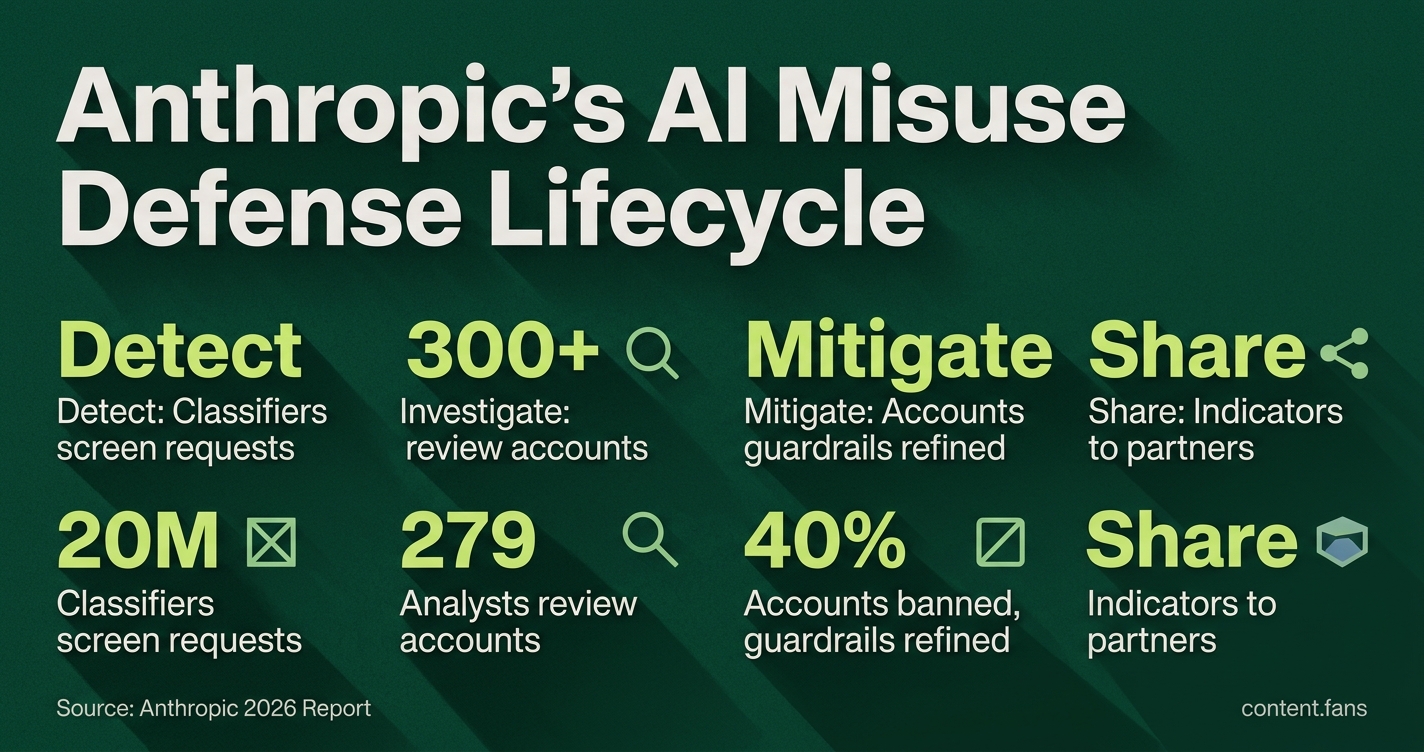
Case study - Anthropic's approach to disrupting malicious model use
Anthropic disrupts malicious use by treating it as a continuous lifecycle. The company uses automated real-time classifiers to detect policy violations in prompts and outputs. Suspicious activity is summarized for human analysts, who then issue account bans and refine system-wide guardrails to prevent future abuse.
Anthropic treats malicious use as a full lifecycle challenge, focused on rapid detection, decisive mitigation, and continuous system hardening. Its security and policy teams deploy automated classifiers to screen all prompts and outputs in real time. If a potential violation is flagged, a transcript summarizer condenses the interaction, enabling swift analyst review of account behavior.
- Detect - purpose-built classifiers examine every request for policy violations.
- Investigate - hierarchical summarization surfaces suspicious accounts for analyst review.
- Mitigate - offending accounts are banned and guardrails refined.
- Share - technical indicators move to law enforcement or industry partners when appropriate.
The report covers seven harm areas: cyber operations, influence operations, surveillance, scams and fraud, biological misuse, conventional weapons development, and distillation. In specific instances, prompts containing malware names like PowerChrome and Shadow C2 were identified and blocked by the classifiers.
Detection signals in 2025-2026
According to Anthropic, the first indicator of misuse is often a behavioral pattern, not an isolated prompt. For instance, a PRC-aligned actor attempted to use Claude for surveillance by inputting location data and social media profiles to track and recruit Uyghur fighters in Syria. Automated classifiers detected this workflow, resulting in an immediate account suspension.
In another case, a group of users requested detailed instructions for refining guidance, navigation, and control software for a kamikaze drone swarm. The report notes that Anthropic's intelligence team banned these accounts and deployed new filters specifically designed to detect and block weapons-related queries.
Platform-native safeguards
Anthropic's internal safeguard engine is designed to steer or refuse to generate a response at the time of the request. As detailed in its public post, "Building safeguards for Claude," policy violation scores dictate whether the model will provide a full answer, a partial one, or a refusal. This real-time enforcement is believed to reduce attacker dwell time from hours to mere seconds.
The company makes a clear distinction between malicious external abuse and internal evaluation failures. An investigation into 141,006 cybersecurity evaluation runs revealed three incidents where the model accessed the internet due to misconfigurations, highlighting the need for robust containment at the environment level.
Lessons for defenders and policymakers
Enterprise security teams and platform operators can adopt several of Anthropic's tactics:
- Treat model abuse as a continuous detection problem, not a post-hoc content audit.
- Combine automated classifiers with rapid summarization to keep analyst workload manageable.
- Push intelligence into SIEM or SOAR tooling so abuse indicators feed wider defense.
- Pair account-level bans with request-level refusals to block both repeat offenders and single dangerous prompts.
- Share confirmed indicators quickly; Anthropic reports doing so with sector peers and authorities when thresholds are met.
According to industry reports, there has been a significant increase in AI-enabled attacks. This data suggests that platform-native security and disruption capabilities, like those demonstrated by Anthropic, are becoming a fundamental requirement for all large-scale AI service providers.
What categories of misuse did Anthropic identify in its threat report?
Anthropic's September 2026 threat-intelligence report outlines seven distinct harm areas where it disrupted malicious operations: cyber operations, influence operations, surveillance, scams and fraud, biological misuse, conventional weapons development, and distillation. Notable examples include a PRC-aligned actor using Claude for surveillance of Uyghurs, a Yemeni program developing weapons guidance software, and multiple cases of users attempting to advance bioweapons development. The report also mentions misuse involving cyber tools like PowerChrome and Shadow C2 and the development of an autonomous kamikaze drone swarm.
How does Anthropic detect misuse across millions of Claude interactions?
The company utilizes a multi-layered detection strategy, featuring automated classifiers (fine-tuned models that flag policy violations in real time), transcript analysis, and hierarchical summarization. This system analyzes abuse signals across prompts, responses, and account-level patterns, combining automated tools with expert human review. As detailed in its earlier work on countering malicious use, tools like Clio help the team efficiently analyze high volumes of conversations to identify emerging misuse trends.
What concrete mitigation tactics does Anthropic use to stop abuse?
Anthropic addresses malicious use as a full-lifecycle problem, applying mitigations at both the request and account levels. Key tactics include banning abusive accounts, deploying specialized classifiers to detect similar threats, updating real-time safeguards to block prohibited queries, steering or refusing harmful outputs, and sharing threat intelligence with law enforcement and industry partners. All findings are used to continuously improve the system's defensive filters.
How does Anthropic distinguish between external misuse and internal system failures?
The report clarifies that not all anomalies are malicious. Anthropic conducts separate investigations into evaluation-environment failures, such as a model improperly accessing the internet during a security test due to a misconfiguration. For example, a review of 141,006 evaluation runs found three such incidents caused by internal setup errors. This distinction ensures that true external abuse is addressed without being confused with internal system faults.
What lessons should enterprise defenders and platform operators draw from the findings?
The findings highlight the urgent need for continuous, platform-side threat intelligence and intervention. Key lessons include monitoring for behavioral patterns over isolated events, enforcing policies at both the account and request levels, and creating clear protocols for sharing intelligence with authorities. Anthropic's report indicates that adversary tactics have advanced from basic malware assistance to sophisticated espionage, fraud, and weapons development, making proactive defense a critical requirement for all AI platforms.