
Vertical AI Firms Expand Data Moats With Longer Training Windows
Serge Bulaev
Vertical AI companies may make their data advantages stronger by using longer training windows and collecting unique signals from how customers use their products. Research suggests these firms build a hard-to-copy "data moat" when they turn everyday customer interactions into training data, which might improve their AI over time. Two main tests for a real data moat are whether the data is hard to reproduce within a year and if it clearly makes the product better. Continuous feedback from users appears to help teams measure and improve their models, and deeply integrated products may be harder for competitors to replace quickly. Publishing live product and data metrics may also help show the value of these data advantages to investors.

For vertical AI firms, the most durable competitive advantage isn't access to the latest model - it's proprietary data. By extending model training windows and capturing unique signals from user workflows, these companies are building powerful "data moats" that grow stronger with use and are increasingly difficult for competitors to replicate. This strategy turns software platforms into "systems of record" that create a "defensible data moat" from daily operations, as described by Barclays researchers (AI in Vertical Software, Q1 2026). The Institute PM reinforces this, noting that a true "data flywheel" emerges when each customer interaction provides fresh training data to improve output quality over time (Vertical AI Strategy). This means control over proprietary data, not the underlying AI architecture, is what will define long-term competitive power.
Unlocking Compounding Gains with Longer Training Windows
Previously, experts assumed AI model performance would plateau after consuming a fixed dataset. However, recent studies show that performance continues to improve when models are retrained with new, high-quality data. This allows teams to reopen the training window months later to achieve significant lifts in accuracy and reduce errors, suggesting that each piece of new data has more value than ever before.
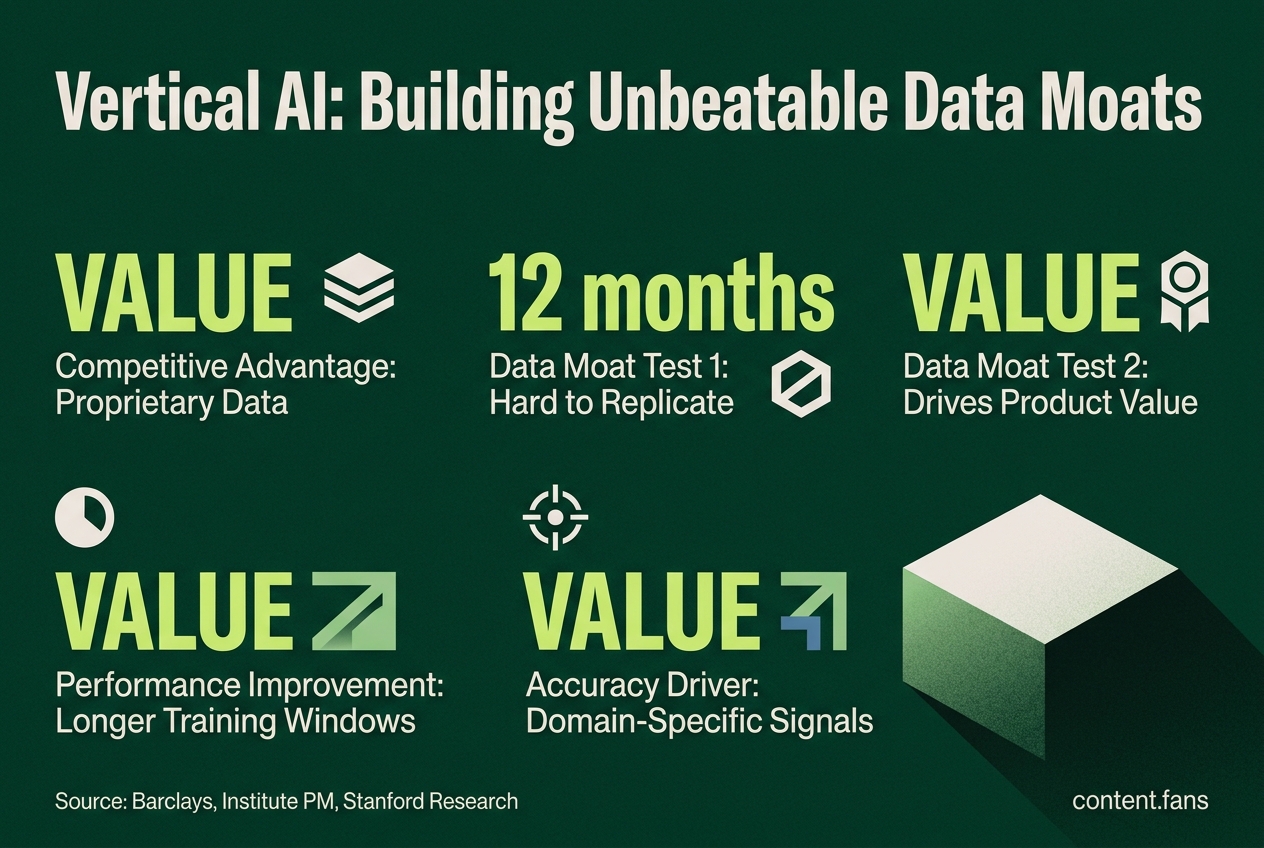
Furthermore, integrating previously untapped workflows - like legal contract redlines or medical imaging annotations - can produce "step-change" performance jumps comparable to major model upgrades. This has led Stanford researchers to conclude that for vertical AI, accuracy now depends more on the depth of domain-specific signals than on model size alone (Defensible Moats paper).
Vertical AI firms build data moats by creating continuous learning loops with proprietary user data. Instead of relying on static datasets, they capture unique signals from user interactions - like edits, acceptances, and task completions - to perpetually retrain and improve their models, creating a compounding, hard-to-replicate competitive advantage.
The Two-Part Test for a True Data Moat
BeforeVC frames 12-month replicability and whether usage improves outcomes as due-diligence checks, not a universal definition of a data moat. These criteria serve as useful evaluation frameworks:
- Difficult to Replicate: A competitor should not be able to reproduce the core dataset within 12 months.
- Drives Product Value: The data must measurably improve the product, tracked through metrics like user override rates or task completion success.
If either condition is not met, the advantage is considered a temporary head start, not a sustainable moat. Publicly available data, for example, is easy for rivals to copy and thus fails the first test.
Powering Continuous Improvement with User Signals
Top vertical AI teams systematically capture implicit user feedback, including acceptances, edits, and retried queries. This process powers a continuous improvement loop: Capture, Curate, Train, Evaluate, and Deploy. Every user interaction is logged, allowing models to be fine-tuned on successful outcomes. A key metric here is the "override rate" - how often users must correct the AI. This serves as a live quality gauge that directly correlates with customer retention, making it a critical business and technical KPI.
Why Deep Integration Creates a Longer Competitive Window
While large foundation models can release general features rapidly, they cannot easily displace deeply integrated vertical AI tools. Products embedded in mission-critical workflows create high switching costs due to user retraining, compliance needs, and regulatory audits. For example, specialized legal or medical AI tools have validation processes that new entrants cannot bypass, creating a significant time buffer before a generalist model can compete on accuracy and trust.
Investors focus on whether a company's proprietary data improves its model faster than general foundation models are advancing. If so, analysts grant a wider "time-to-commoditization" window, acknowledging a more durable advantage even as the baseline technology improves for everyone.
Measuring and Proving Your Data Advantage
To prove their advantage, founders are now creating real-time dashboards that connect technical metrics (like latency and error rates) with product outcomes (like task completion and retention). Industry reports suggest that significant drops in quality, such as notable increases in override rates, signal "moat leakage." This prompts teams to immediately re-evaluate their data curation or retrain the model with fresh user-validated data.
This data-centric approach can be summarized in four key actions for builders:
- Embed Deeply: Integrate the AI into workflows to capture end-to-end task outcomes.
- Isolate Unique Signals: Focus on data competitors cannot buy, like internal user corrections.
- Tie Refreshes to Metrics: Update models based on meaningful changes in override or completion rates.
- Publish KPIs: Showcase defensibility metrics to investors to demonstrate compounding value.
This operational focus shifts attention from temporary model advantages to durable data effects, aligning product strategy with what creates long-term, defensible value.