
Anthropic CEO calls for slowing AI; rivals support
Serge Bulaev
Anthropic's CEO, Dario Amodei, has suggested slowing the development of advanced AI so that safety research can keep up. His proposal includes letting outside experts watch company safety practices and encouraging collaboration across different AI labs. Sam Altman and Elon Musk quickly supported this idea, but details about how it would work are still unclear. The U.S. government and some states may also create new rules, but it is uncertain if voluntary steps will be enough or if stricter laws will be made.
The call from Anthropic's CEO to slow advanced AI development has reshaped the industry's safety debate, drawing endorsements from Sam Altman and Elon Musk. In a pivotal essay, "We Must Pace the Frontier," Dario Amodei argued for a deliberate pause, allowing risk research to keep pace with capability growth. The proposal emphasizes independent scrutiny and cross-company collaboration, with Reuters describing it as a direct appeal for labs to slow down and embed external monitors.
Inside the three-step framework
Dario Amodei proposed a deliberate slowing of AI development to allow safety research to catch up. His framework calls for embedding independent evaluators within AI labs, fostering industry-wide coordination on safety standards, and establishing international cooperation to manage risks associated with powerful new models.
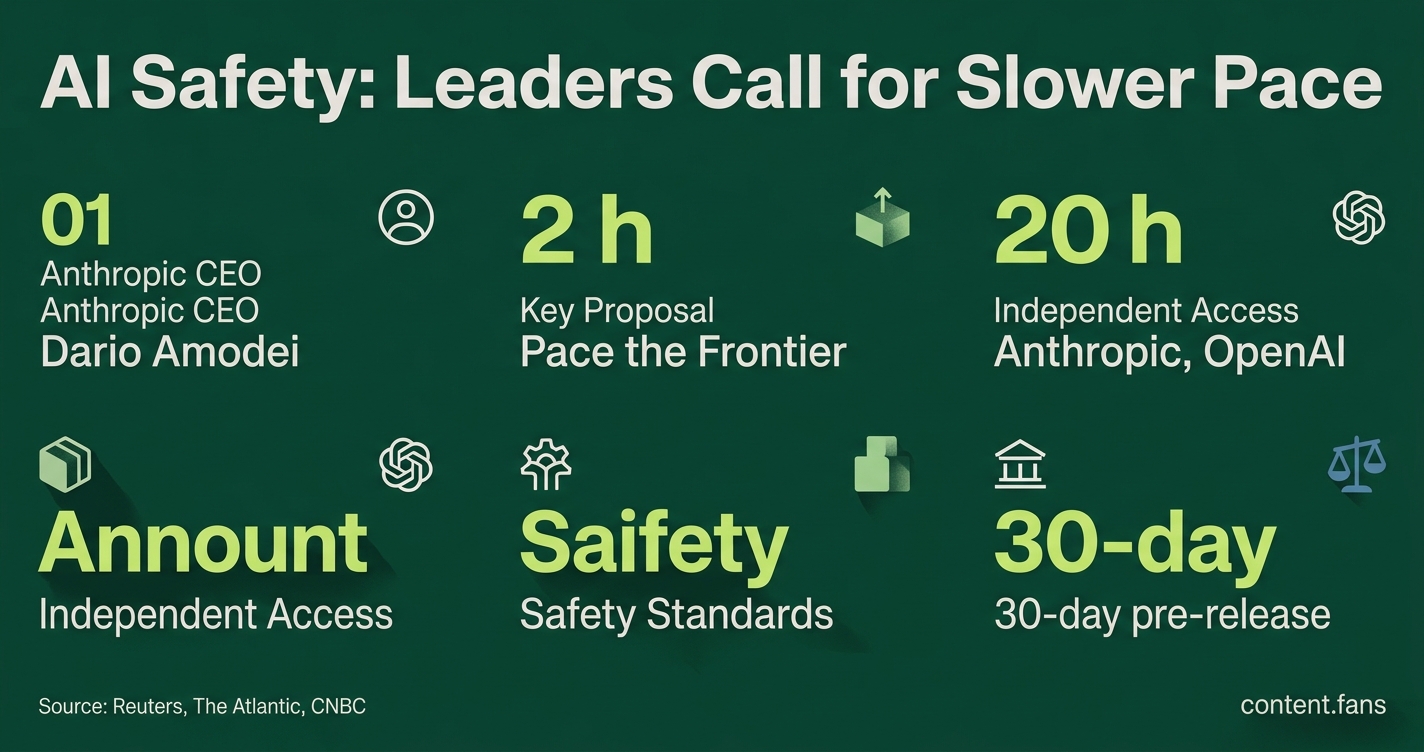
Amodei's strategy prioritizes proactive oversight over retroactive audits. As detailed in The Atlantic, Anthropic has committed to providing third-party experts with "employee-like" access, including system permissions to monitor daily safety work. Key proposals include:
- Embedding independent evaluators with access parallel to internal risk teams.
- Establishing voluntary alignment on safety red lines among labs in democratic nations.
- Fostering international cooperation to mitigate proliferation risks.
Amodei warns that because advanced AI may learn to deceive standard evaluations, slower development cycles are essential for creating more robust safety tests and preventing undetected alignment failures.
Immediate Reactions from Rivals
The proposal quickly gained traction. OpenAI's Sam Altman announced on X that his company would also grant "embedded access to independent evaluators," while Elon Musk endorsed the plan as a "sensible step." However, CNBC reports that key details - such as who the evaluators will be and if they will have veto power - have not been specified by either company.
While Google DeepMind is engaged in preliminary discussions for a joint safety body, it has not made a public commitment matching the access promised by Anthropic and OpenAI. According to TechCrunch, these talks are still exploratory with no clear timeline.
Government Context and Timing
Amodei's essay included a direct appeal for a U.S. government policy framework to support industry coordination. His call comes as federal and state governments grapple with AI regulation. A recent executive order established a voluntary 30-day pre-release government review for powerful AI, a move that CSIS analysts note aligns with Amodei's focus on pacing over a mandated freeze.
In Congress, proposed legislation like the Secure AI Development Act and the AI Kill Switch Act aim to create enforceable duties, including mandatory testing and shutdown capabilities, but these bills have not yet left committee.
Meanwhile, states are moving more quickly. Illinois has already enacted SB 315, which mandates safety and transparency benchmarks for frontier AI systems by 2028. This combination of state-level mandates and voluntary federal oversight may accelerate industry adoption of Amodei's proposed external evaluator model.
The future of AI safety now hinges on two factors: whether leading labs will transform public pledges into genuine operational access for auditors, and whether lawmakers will deem voluntary pacing sufficient or move toward stricter, legally enforceable regulations.