
LLMs Gain Memory: New Techniques Extend Context Without Inflating Costs
Serge Bulaev
Recent studies suggest that large language models (LLMs) do not remember personal details between uses, so applications must repeat context for each turn. Engineers describe three layers of memory: trained memory (background knowledge), working memory (current context window), and persistent memory (external storage like databases). New techniques, like DeepSeek V4.1-Flash and Recurrent Looped Transformers, may make memory use more efficient without raising costs. Developers face choices between methods like sliding-window prompts, summarization, and retrieval-augmented generation, each with benefits and trade-offs. Researchers propose that combining efficient internal memory with structured external storage may allow LLMs to keep important information without high costs.

For LLMs to gain memory and provide continuous experiences, applications must manage context carefully. Because models are inherently stateless, they do not retain personal details between API calls, forcing applications to reconstruct history for every interaction. This guide explores the core types of LLM memory and summarizes emerging research aimed at extending context without inflating costs.
The Three Layers of LLM Memory
Large language models leverage three memory types: trained memory (static knowledge), working memory (the active context window for a single task), and persistent memory (external databases managed by the application). True long-term recall is an engineered feature, not an innate model capability.
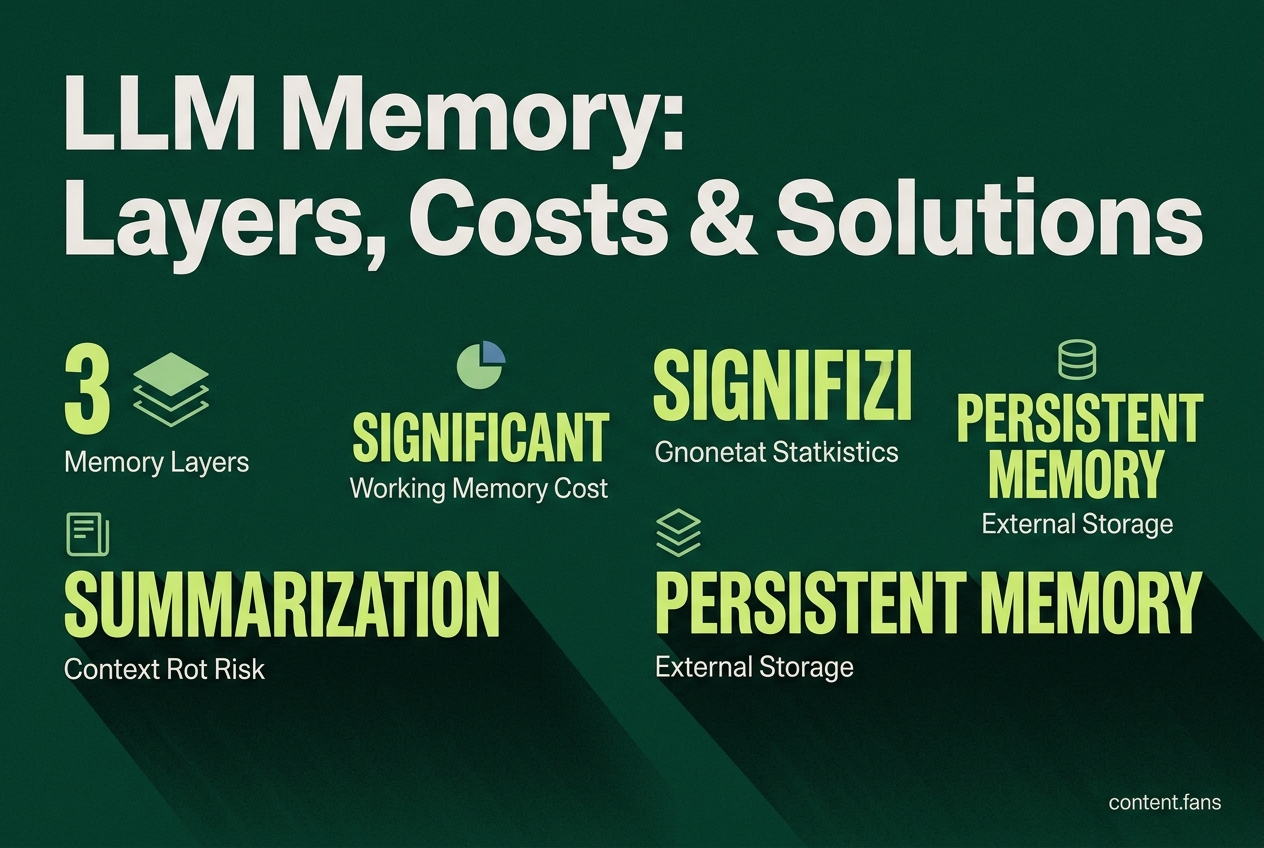
To understand how LLMs handle information, engineers distinguish between three distinct layers:
- Trained Memory: This is the static, foundational knowledge embedded in the model's weights during its pre-training. It is not updated during standard use.
- Working Memory: The active context window, measured in tokens. It serves as a temporary scratchpad for the current conversation or task.
- Persistent Memory: External storage systems like vector databases or user profiles that hold information across sessions. The application is responsible for managing this memory.
The cost of working memory is significant. For example, in a large context window, many tokens might be allocated to instructions, conversation history, and retrieved documents. Since the entire context is reprocessed with each turn, both cost and latency increase as conversations grow longer.
Emerging Techniques for Efficient LLM Memory
Research is focused on improving internal memory efficiency. Innovations in recent models use techniques such as compressed sparse attention to significantly reduce KV cache usage compared to previous requirements. Other approaches, like the Recurrent Looped Transformer, aim to carry hidden states between tokens to extend memory depth without constant context resets.
Current Memory Management Strategies and Trade-Offs
Developers currently balance performance, cost, and accuracy with several techniques:
- Sliding-Window Prompts: This method keeps only recent tokens, offering significant speed-ups for streaming tasks but at the cost of discarding older context.
- Summarization: Compressing conversational history can achieve high compression ratios with minimal accuracy loss initially. However, repeated summarization can lead to "context rot," where key details are lost.
- Retrieval-Augmented Generation (RAG): RAG stores information externally and retrieves only relevant chunks as needed. Studies show the choice of retrieval method can significantly impact accuracy.
Ultimately, cost dictates strategy. With providers billing linearly per token, production systems often use a hybrid approach - combining prompt caching, selective RAG, and summarization to manage the expensive context window effectively.
The Future of LLM Memory: A Hybrid Approach
The consensus among researchers points toward a hybrid solution. The most effective systems will likely pair an efficient internal memory architecture with a structured and editable external memory store. This combination promises to deliver durable, session-spanning recall while keeping the active context window - and its associated costs - to a minimum.
Do LLMs remember my previous conversations on their own?
No. Large language models do not retain personal, session-to-session memories by themselves. Each API call is typically stateless, which means the model begins fresh unless an application deliberately reconstructs the scene. Applications create the illusion of memory by resending prior messages, retrieving stored facts from a database, or inserting summaries and documents directly into the prompt. True persistence is almost always engineered in the surrounding software rather than inside the model weights.
What is the difference between trained memory, working memory, and persistent memory?
An LLM system operates with three distinct memory layers. Trained memory lives in the model's weights and reflects broad knowledge absorbed during pre-training, but these weights are not rewritten by typical API calls. Working memory is the context window, measured in tokens, which serves as the model's active scratchpad for any single request. Persistent application memory consists of external stores such as vector databases, user profiles, and conversation logs that survive across sessions. The application, not the model, decides what gets pulled from persistent storage and placed into the working context window.
Why do longer conversations increase cost and latency?
Cost and latency rise because every token in the context window is reprocessed on each turn. In a back-and-forth conversation, a request late in the thread can end up reprocessing the full history rather than just the latest question. Without careful management, the bill and wait time grow with every additional round as more tokens need to be processed to maintain continuity.
What techniques extend context without inflating costs?
Applications rely on several strategies to keep memory useful while containing token growth:
- Sliding windows, which discard the oldest turns to cap history length
- Summarization and compaction, which compress past exchanges into shorter notes
- Structured extraction, which pulls out key facts rather than retaining raw dialogue
- Vector-store-backed retrieval, which fetches only relevant chunks from a larger archive
- Long-term profiles, which store user preferences outside the model and inject them selectively
Most production systems combine two or more of these approaches, treating the context window as a scarce working set rather than an unlimited datastore.
Can summarized memories stay accurate over time?
Summarization is inherently lossy. When an application repeatedly compresses older context to save space, subtle details can blur or vanish, a phenomenon sometimes called context rot. The more times a conversation is distilled, the greater the risk that numbers, constraints, or intent shift. Because of this, critical facts are often kept in structured external stores rather than relying solely on recursive summaries. A well-designed memory manager selects, compresses, and inserts memories into the context window with full awareness of what might be lost in translation.